


 3 Photos
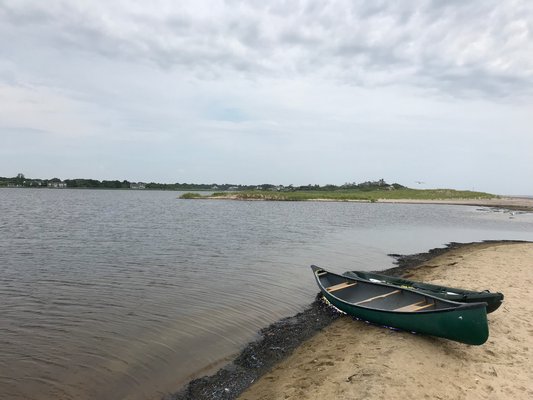
A view of Georgica Pond from the southwest. The pond has been infested with algae in previous years. BEN KAVA
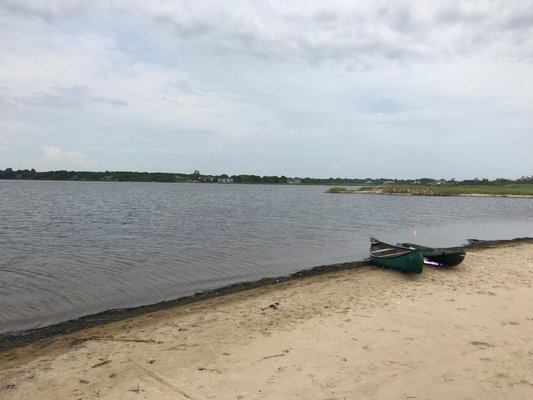
Lonely canoes sit on the shore of Georgica Pond. BEN KAVA
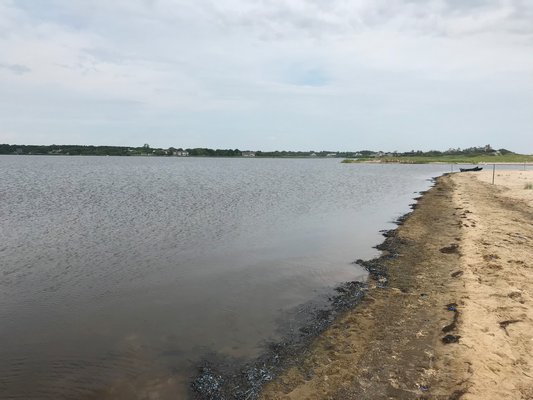
Georgica Pond has not been infested with blue-green algae this summer. BEN KAVA
Wainscott residents just can’t seem to escape the plague of blue-green algae.
On Friday, July 13, the Suffolk County Department of Health Services confirmed what some locals may have already inferred: Wainscott Pond is now occupied by the same cyanobacteria algae that has kept beachgoers out of the hamlet’s other water body, Georgica Pond, for more than five years.
A series of tests performed by Dr. Christopher Gobler and his team of ecologists from Stony Brook University reported the presence of a new bloom of the cyanobacteria algae, which is more commonly known as blue-green algae, in Wainscott Pond. Though the algae itself is harmless in natural and small quantities—it normally resides on the bottom of water bodies—it becomes harmful to people and other life when it forms “blooms.” The blooms often produce scum-like substances that appear on the surface of the water and are known to reflect a blue-green “paint-like appearance” through the water, said officials at the Department of Health Services.
If the fight to rid Wainscott Pond of the newfound algae blooms will be anything similar to the process undertaken to remove the same substance from Georgica Pond, residents may have to wait some time before wading in the water again.
Nearly six years ago, a Jack Russell terrier died after coming into contact with an algae bloom in the pond, an event that prompted residents of the Georgica Association, a private community with homes on the west bank of the pond, to form Friends of Georgica Pond, a nonprofit organization dedicated to cleaning the water at all costs.
Ever since, the organization has worked with Dr. Gobler, who routinely collects data measuring water temperature, salinity, bacteria levels, land nutrients and blue-green algae levels in both Wainscott Pond and Georgica Pond. He collects data from a buoy situated in each pond; in Georgica Pond, a buoy has been in place since 2015, in Wainscott Pond, one was placed this year.
“The two main factors contributing to the blue-green bloom are [water] temperature and nutrients,” said Dr. Gobler. When water temperature rises, an environment more friendly to the algal blooms is created—conversely, cooler water temperatures bring an atmosphere more hostile for blue-green algae growth. Nutrients from water, such as salt from the ocean, as well as from surrounding land areas that feed runoff water into the two ponds, such as fertilizers, play an important role in the growth of the algae, Dr. Gobler explained. And because the two ponds have drastically different ecosystems, the levels of nutrients in each are likely to be different.
Most noticeably, Georgica Pond is classified as “brackish,” that is, it is not entirely composed of either salt water or fresh water, but rather a combination of the two. Wainscott Pond is a freshwater pond, and, with lower salinity, provides a more nurturing environment for the blooms.
In addition, Wainscott Pond is much smaller than Georgica Pond, which is covered on all sides by private homes that back up to the water. As a result, the water is more dense with nutrients, including those that can be harmful.
Wainscott Pond is surrounded by farmland, suggesting that there may be more land-driven nutrients in its water than in Georgica Pond.
“There’s definitely more agriculture near Wainscott [Pond],” said Dr. Gobler.
After significant data collection, Georgica Pond is currently free of dangerous blue-green algae blooms for the first time in five years and is safe for swimmers, according to Sara Davison, director of the Friends of Georgica Pond.
And though the summer is still in full swing, Dr. Gobler said that continuing warm weather does not necessarily mean that the blooms will return. “We’ve collected a lot of data from the buoy,” he said, “and it doesn’t look to be trending toward blue-green algae.”
There are several factors that could have played a role in the absence of the blooms, according to Dr. Gobler. Successful efforts spearheaded by the Friends of Georgica Pond to reduce fertilizer use and upgrade septic systems delivering harmful nutrients throughout the association likely are a factor, as is the fact that the pond was cut open to the ocean on March 15, according to Ms. Davison, which allowed for higher levels of salinity within the pond.
Lastly, Dr. Gobler noted that in the last two years, there have been significant efforts to remove macroalgae and seaweed from Georgica Pond’s surface, and that practice has coincided with less bloom growth. These efforts were also led by Ms. Davison and the Friends of Georgica Pond.
“Everything is going in a positive direction,” said Ms. Davison of the state of the pond. “But it can also change quickly.”


