


 1 Photo
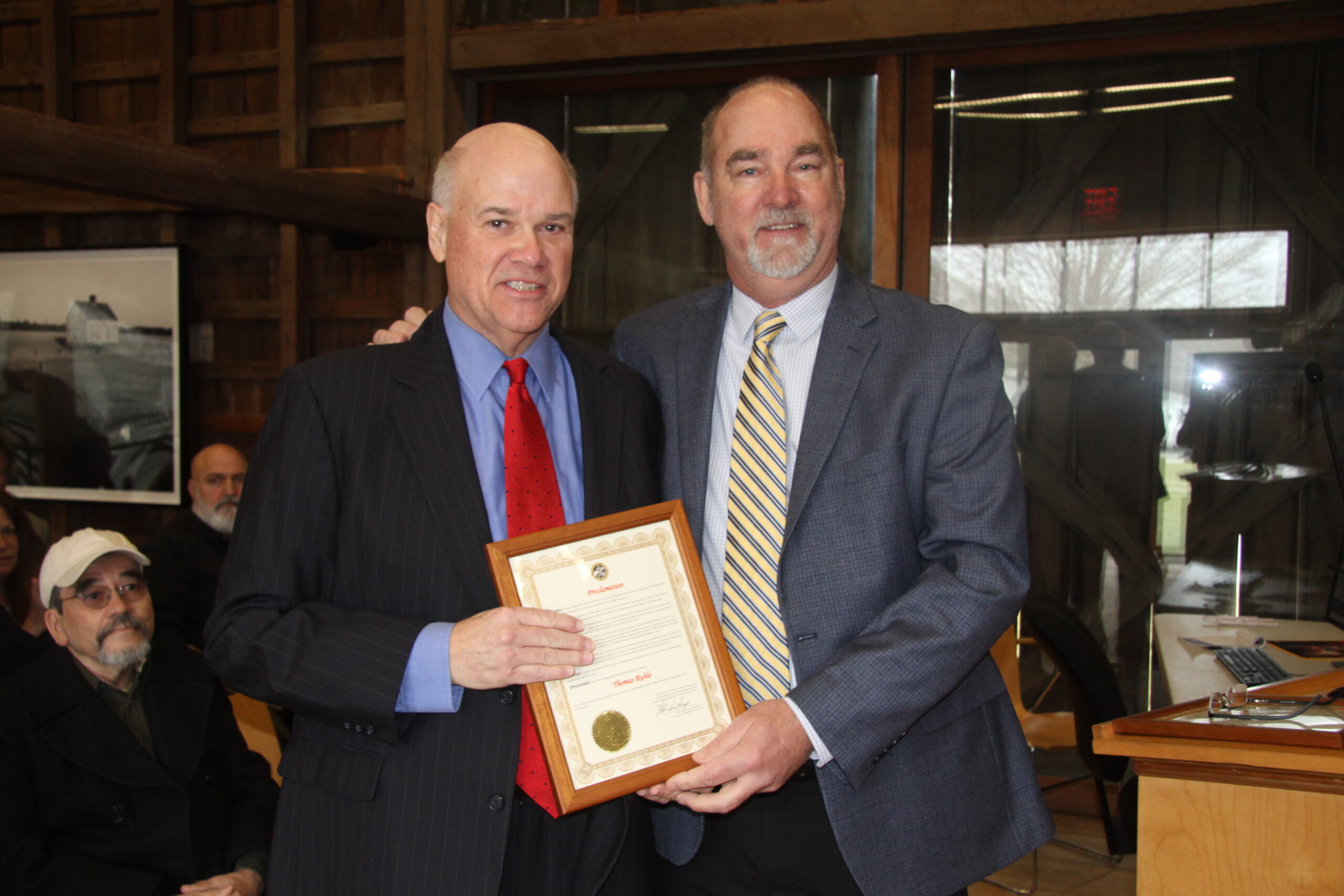
East Hampton Town Supervisor Peter Van Scoyoc, right, presented a town proclamation to Tom Ruhle, a former town councilman and planning board member and most recently the longtime director of the East Hampton Town Housing Department, who is retiring this week after nearly 40 years in town government. Two other longtime department heads, Maintenance Supervisor Anthony Littman and Building Inspector Ann Glennon, are also retiring this winter.
East Hampton Town Supervisor Peter Van Scoyoc said in his “State of the Town” address last week that creating affordable housing and improving cellular communications will continue to be among the town’s top priorities, while it also carries on its fight to reverse the impacts of decades of septic pollution in town waters and fight to gain local control over the flight patterns at East Hampton Airport.
Van Scoyoc, who has not yet announced whether he will seek a fourth term in the supervisor’s office in this year’s town election, applauded the work that town staff and officials have done over the past year on a variety of town initiatives, from water quality improvement project grants, to the planning for a new senior center, expanding renewable energy resources at town facilities, the reconstruction of the Montauk skate park, historic preservation efforts at Carl Fisher House, Second House and several town cemeteries, and various infrastructure upgrades like drainage projects at Stephen Hands Path and Industrial Road in Montauk.
In last year’s address, the supervisor announced the “All Hands On Housing” initiative that tasked each Town Board member with advancing a different aspect of the effort to create more affordable living arrangements throughout the town. With 50 below-market rental apartments under construction on Three Mile Harbor Road and planning underway for another 50 apartments off Route 114 and 16 single-family homes that will be sold at a fraction of market value on Pantigo Road, he said that initiative has gotten off to a good start and the board will continue striving for results in 2023 — with a new arsenal of financial support behind it.
The town will soon appoint a new advisory committee that will help strategize the use of the Community Housing Fund, a multimillion-dollar revenue pool that will be fed by a newly approved half-percent tax on real estate sales and will fuel what he expects will be the most significant boost to housing assistance the town has seen.
Cellular communications will also be a top priority and two important steps in the effort to provide better service within view: the construction of a new cellular and emergency communications tower in Springs and the adoption of a new cellular master plan for the town that will make it easier for cellular providers to create new transmission facilities.
The Town Planning Board last month approved a new 180-foot tower on the Girl Scouts camp on Flaggy Hole Road. The tower, which will be constructed this spring, is expected to quickly bring better cellular service to areas of Northern Springs, where service is currently poor or even nonexistent. The tower will also host the town’s emergency communications equipment — the final link in what will ultimately be the more than $14 million upgrade of the town’s emergency communications network.
The town will also continue to fight for control of the airport — an effort it directed more than $3 million toward last year alone. In 2022, the town proposed a plan to privatize the airport by closing it briefly and reopening it as a new facility with new restrictions on flight traffic. But a state judge shot down the proposal just hours from it being implemented. The town is appealing the ruling and simultaneously starting the process over.
“The Town Board remains committed to successfully reaching our community’s goal to gain meaningful relief for the ever growing multitude of people whose quality of life is negatively affected by aircraft noise,” Van Scoyoc said.
The heads of three town departments, each with at least 30 years of experience in the town’s employ, are departing their posts early this year.
Tom Ruhle, the longtime head of the town’s Housing Department, and Anthony Littman, head of the town’s buildings and maintenance crews, retired this week. Ann Glennon, the town’s senior building inspector, will retire next month.
Littman started with the town in 1991 as a mechanic and rose to head of maintenance and grounds in 2007, a post he has held since. Van Scoyoc credited him with overseeing the management of all the town’s facilities, including historic properties, leading several town committees and playing a crucial role in the town’s response to the pandemic.
Glennon started in the Building Department in 1993 as a messenger. After holding every administrative position in the department, she became the town’s first female building inspector in 2015, and simultaneously took over as head of the department.
Ruhle joined the East Hampton Town Planning Board in 1984 and was elected to the Town Board in 1988. In 1992, he began working at the town Office of Housing and Community Development and took over as housing director in 2004. Van Scoyoc credited him with leading the town’s efforts to create affordable housing and was critical in the spearheading of the recent Community Housing Fund plan.
“It was a collective effort of a community that looked at itself and said we have to keep it a year-round community. We have to have a population that can grow up here and can have hope of buying or renting and living here,” Ruhle said, also harking to his multi-faceted history with the town. “I’m one of the few people that can say I’ve been appointed, elected, I was in the union and I was management. For that, I thank all the citizens of East Hampton who just said, keep doing what you are doing.”


 Michael Wright on Jan 11, 2023