


 2 Photos

The East Hampton Town Planning Board has objected to the Town Board leading the review of the new Senior Center project. Chairman Sam Kramer, pictured, and five of the other six board members voted in favor of the Planning Board seeking lead agency status for the project review. MICHAEL WRIGHT
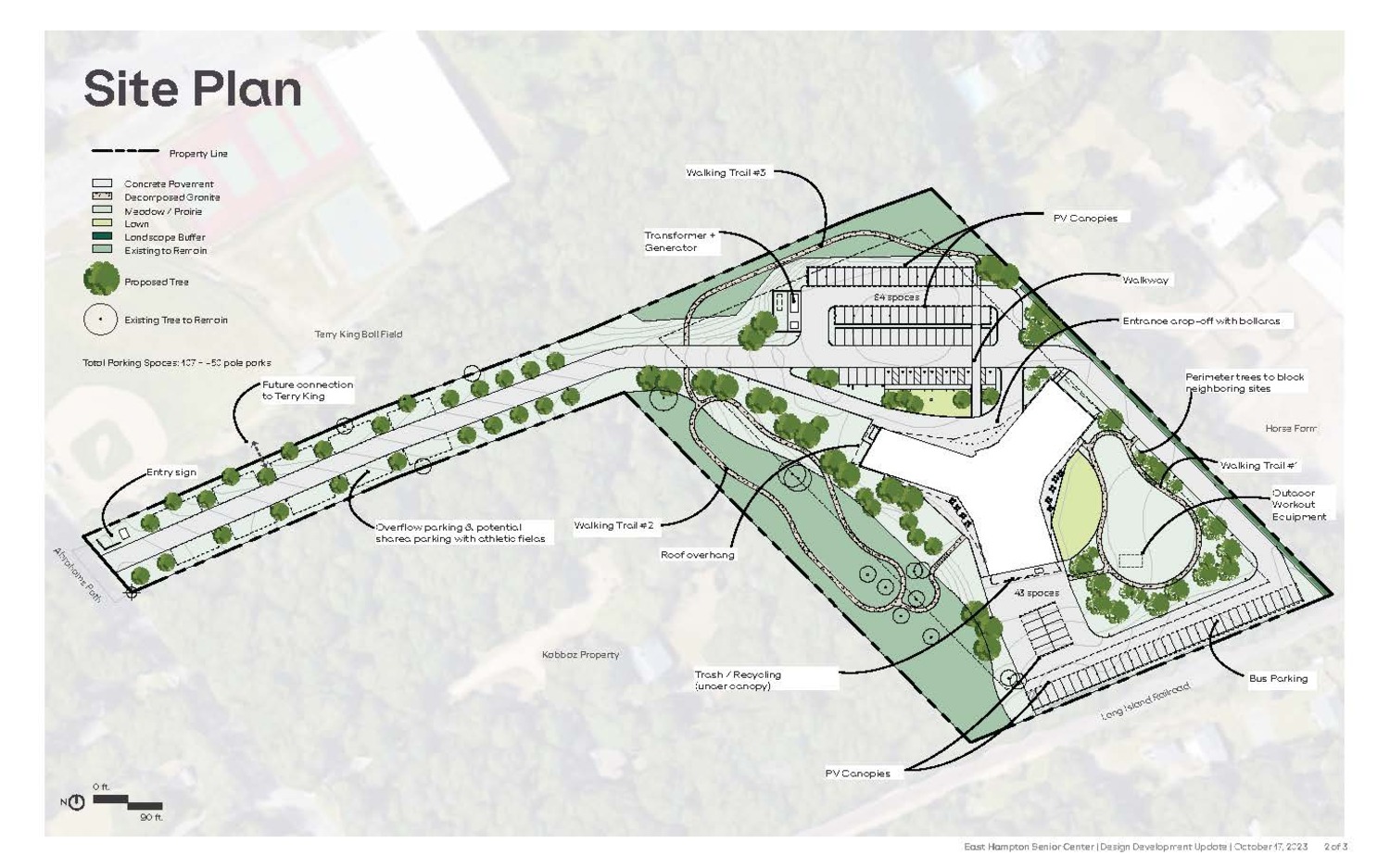
The architects who designed the Senior Center project had hoped that preliminary clearing of the 7-acre site could get underway this winter, allowing the actual construction to get underway by late summer and a late 2025 or early 2026 completion date. But town officials said this week that the debate over the project's scope will not allow for approvals in time for the clearing to be done by the end of February. Trees may not be cut down between March 1 and November 1 to protect endangered long-eared bats, which will mean at least a 5 month delay for the overall project's schedule.
The East Hampton Town Planning Board last week formally objected to the Town Board’s claiming the designation of “lead agency” for the state mandated environmental review and approval of the 22,000-square-foot Senior Center proposal, asserting its usual oversight authority on large scale development projects.
Asked by the Town Board — a requirement under State Environmental Quality Review Act guidelines — whether it had any objection to the town’s five elected lawmakers taking control of the review, the seven members of the Planning Board voted, 6-1, in favor of issuing an objection. Only board member Michael Hansen voted against it.
The others said that because the Planning Board would usually review any project that involves a site plan, as the review of design and layout of commercial developments or residential subdivisions are known, the Planning Board is the most experienced at judging what the good and bad elements of a design are.
“If we’re not lead agency as we would typically be, it is ceded to the Town Board,” the board’s chairman, Sam Kramer, said during the Planning Board’s January 24 meeting, “and our ability to act in the way we ordinarily would in any ordinary application would be ceded.”
The Town Board has said that it wants to lead the review and has proposed invoking a legal precedent that would allow it to exempt the project from local zoning laws.
In the face of criticism, the board has already put off making a decision on that matter. That will mean at least five months of additional delays to the project’s original construction timeline, which called for a late 2025 or early 2026 completion.
The Town Board has made the case that its members — led by Supervisor Kathee Burke-Gonzalez — have been working on the design and planning of the project for years, in conjunction with the town Planning Department, meaning the project’s design and planning hurdles and pitfalls have been vetted extensively already by expert staff, and the need for certain spacial and architectural features weighed against potential negatives.
The importance of the facility to the aging East Hampton community is too great to be taken out of the hands of the elected officials, the supervisor said this week.
“The Town Board is also the largest stakeholder among the town’s boards because it is responsible for approving the plans, the contracts and the funding that is required to make the proposed senior center a reality,” a statement from Burke-Gonzalez’s office on the project said. “As elected officials, Town Board members are also directly answerable to the public, especially the senior residents this project is intended to serve.”
The board has said it will refer the project to the Planning Board, Zoning Board of Appeals and Architectural Review Board and ask them for detailed input on the project. But the ultimate decision on whether details of the project, and the project as a whole, are acceptable would remain with the town.
Most of the Planning Board members felt, however, that their expertise should mandate a greater role.
“If we don’t take lead agency, we are basically surrendering the process so that they get to oversee the project without any Planning Board review,” board member Lou Cortese said.
“This board has the experience in dealing with site plan and subdivisions,” Kramer added.
The lone voice of dissent was from Hansen, who echoed the point Town Board members have made: that the extensive work done by the elected officials and professional planning staff was sufficient.
“It’s been a thorough and comprehensive process that the town has put into this project,” he said.
With the formal objection, the Planning Board’s claim to lead agency will be considered sent to the New York State Department of Environmental Conservation, which officially designates lead agency on any project in which more than one authority has a claim on the role.
In the background of the discussion was the Town Board’s proposal to exempt the project from town zoning codes — and whether that would mean the Planning Board would not be able to give the project the typical code-based parsing even if it was made lead agency.
In December, the Town Board proposed applying what is known as the Monroe balancing test — a nine-step assessment of a project to determine whether the municipality proposing it can legally sidestep its own regulations or those of another overlapping municipality. The test focuses on the potential impacts on other authorities and the perceived benefits to the public of allowing the project to move forward without potential interference.
Some on the Planning Board wondered aloud why the town would present the lead agency question before deciding on whether to invoke Monroe. Assistant Town Attorney Nancy Marshall said that her belief was that if the Planning Board were made lead agency before the town invoked Monroe, the project would still be subject to a full review at the hands of the Planning Board.
Critics have said a project the size of the proposed new Senior Center should go through the full zoning process regardless of the public benefit and pressing need for the new facility, even if it means an extra year or more delay in the center opening.
If it were to be subject to town zoning, the center would likely require the most in-depth analysis by the Planning Board, and several variances granted by the Zoning Board of Appeals.
Burke-Gonzalez said this week that the town had hoped to vote on the Monroe decision by this week, but has taken the exhortations of critics seriously and is still weighing its options.
That decision means the project itself — already a decade in the making — is also facing a delay of at least several more months because the Town Board will not be able to approve the project in time to allow preliminary site clearing at the property by the end of February.
As of March 1, all cutting of trees in the town will be banned until November 1 to protect endangered long-eared bats that may live in the region in spring and summer.
“Procedurally, the project is not at the point where the board will authorize the clearing to proceed,” a statement sent by the supervisor said.
The architects had proposed that the clearing be done this coming month so that crews could get started with the early site work — like leveling the property and laying conduits for buried utilities — while the town finishes tweaking the design details and has construction documents drawn up. They had hoped the construction work on the building could begin by August of this year, projecting it to take about 18 months to complete.
With the clearing not able to be done until November, and the site prep getting underway then the construction will have to wait until next spring, pushing the likely completion date well into 2026.


 Michael Wright on Jan 31, 2024