


 3 Photos
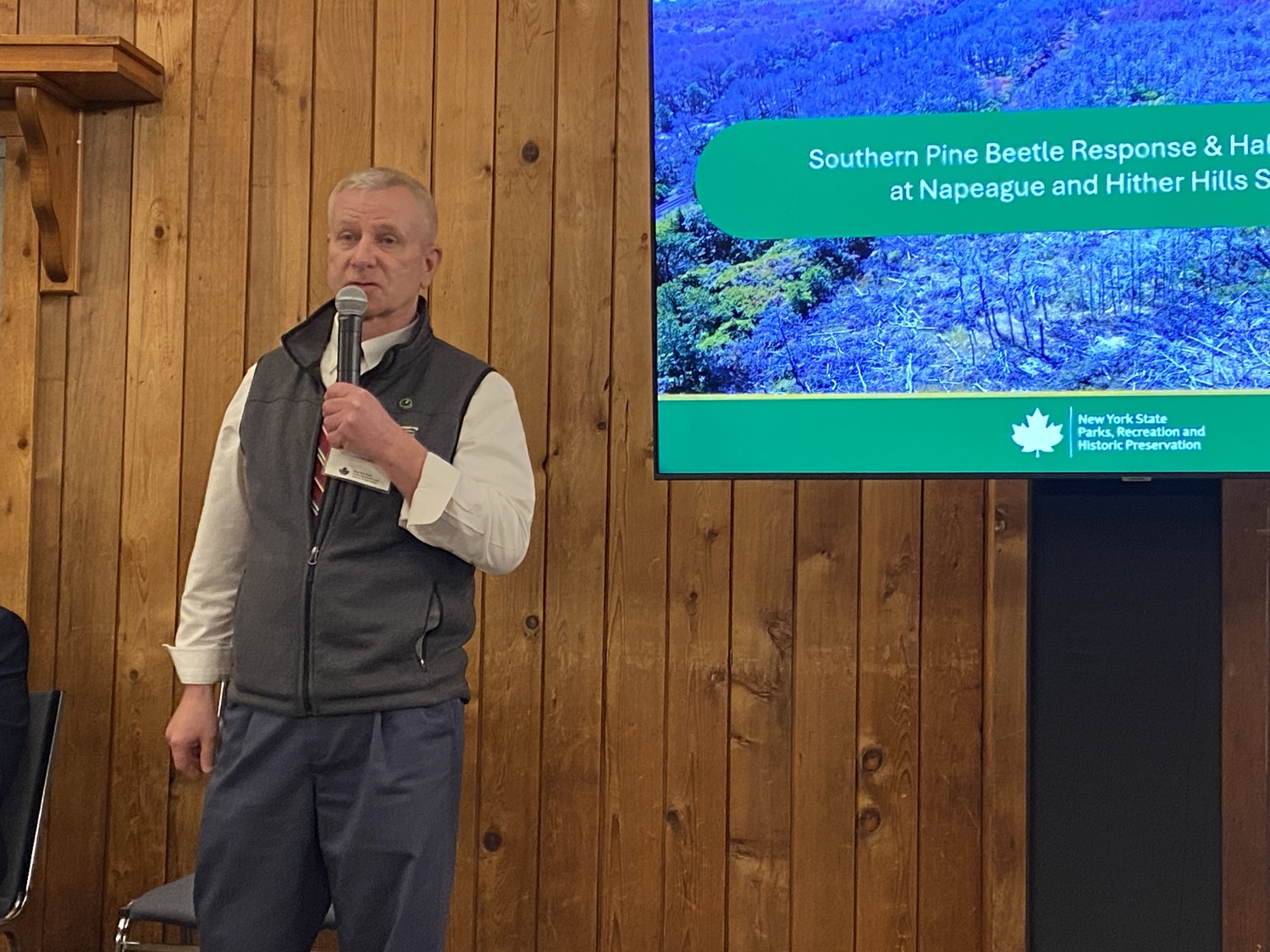
Starting in 2021, the southern pine beetle "crashed over our parks like a tidal wave in this area," Ron Rausch, New York State Parks, Recreation and Historic Preservation's deputy commissioner of environmental stewardship, said of Napeague and Hither Hills State Parks. CHRISTOPHER WALSH
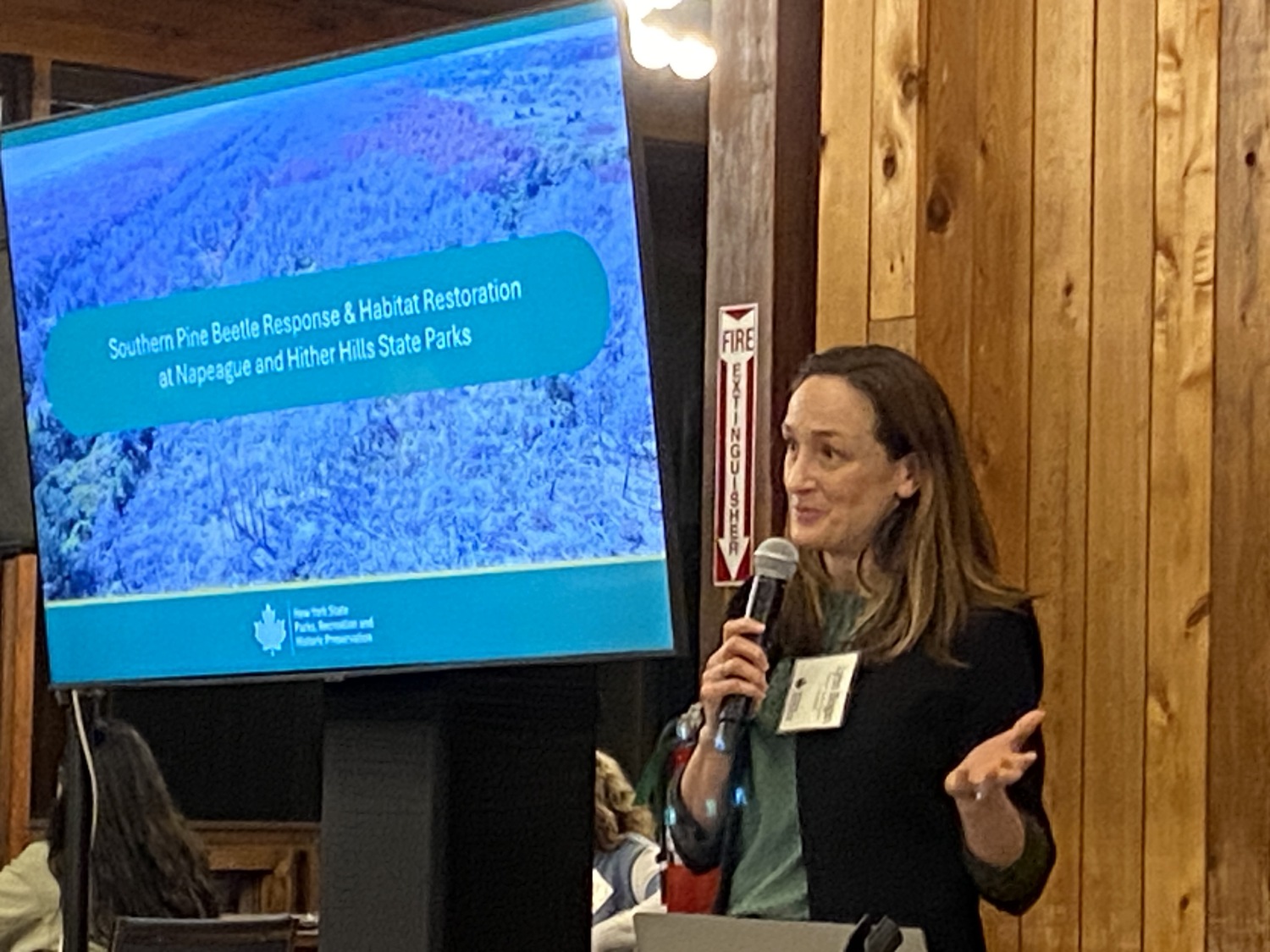
A certified “burn boss” will be hired to create a fuel mitigation and fire management plan for Napeague and Hither Hills State Parks, said Lynn Bogan, the Parks Department’s assistant division director for environmental stewardship and planning. CHRISTOPHER WALSH
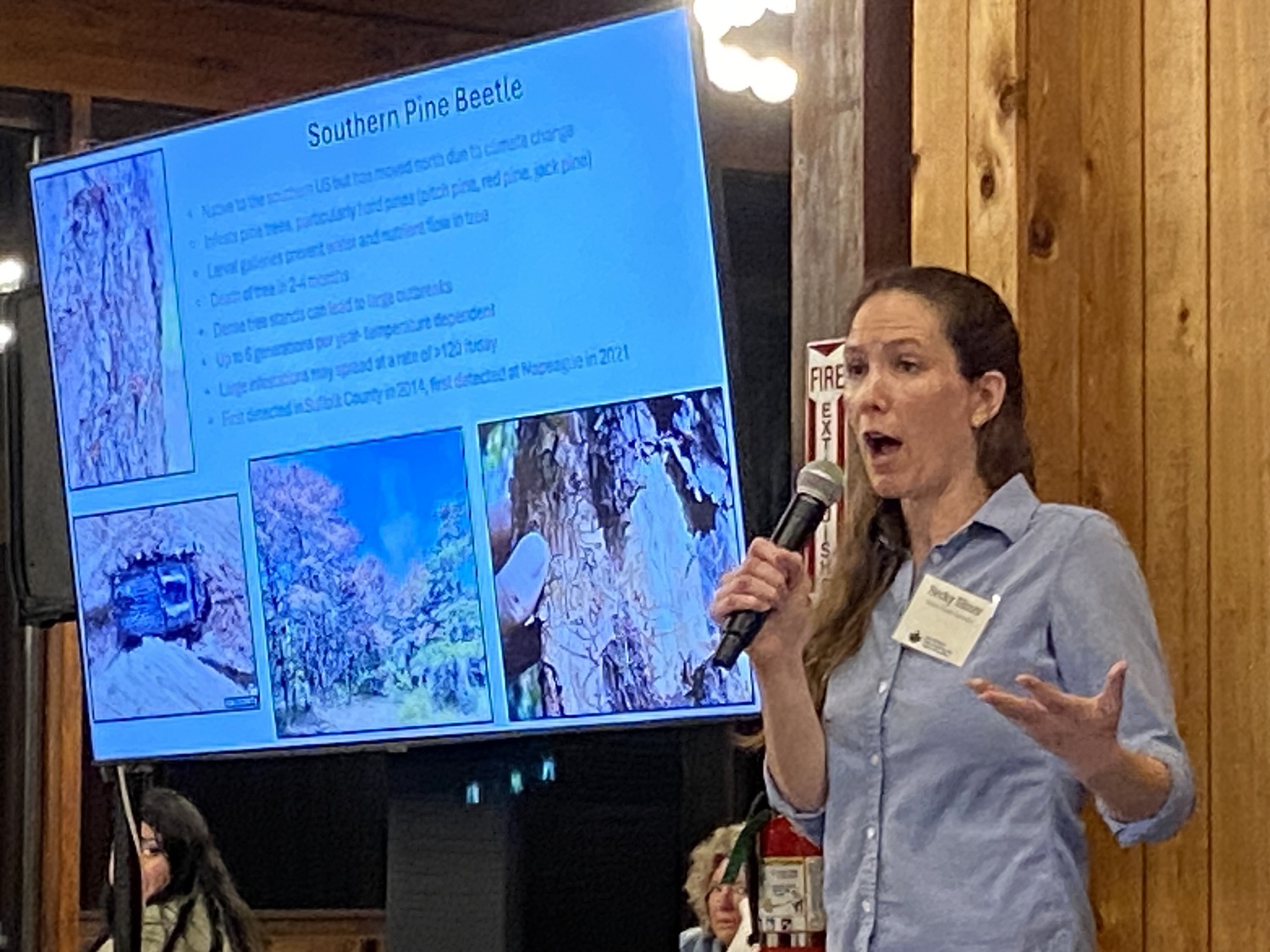
The southern pine beetle infestation is a manifestation of climate change, said Becky Sibner, the Parks Department's forest health specialist. CHRISTOPHER WALSH
Reduction and mitigation of threats to public safety, protection and promotion of rare and vulnerable species and natural communities, and the strengthening of ecosystem resiliency to pests and disease, are the goals for management of the invasive southern pine beetle in East Hampton Town, which has caused devastation to woodlands including Napeague and Hither Hills State Parks.
These goals were enumerated during a public meeting hosted by New York State Parks, Recreation and Historic Preservation officials at Montauk Downs State Park last Thursday, February 13.
The invasive species was discovered in the town in the autumn of 2021 and “crashed over our parks like a tidal wave in this area,” said Ron Rausch, the Parks Department’s deputy commissioner of environmental stewardship. An estimated 40,000 trees were killed “within just a couple years,” said Becky Sibner, the department’s forest health specialist.
The Parks Department and other agencies including the Department of Environmental Conservation “jumped on top of it as quickly as we possibly could to squelch southern pine beetle spread,” added Lynn Bogan, the Parks Department’s assistant division director for environmental stewardship and planning. “That didn’t work. And then we moved into response: protect public health and safety, and then protect the natural system and ecological health, and we are going to continue to do that.”
The infestation is a manifestation of climate change, Sibner said, the southern pine beetle having dramatically expanded its geographic range due to warmer winters.
“Individually, the beetles are not really a problem,” she said, “but they’ll attack a stressed tree and they’ll grow their numbers larger and larger,” emitting pheromones to attract more beetles and overwhelming stressed trees. “And then those beetles get large enough numbers that they can start attacking even healthier trees and really growing the infestation outward.”
A tree will die within two to four months of a beetle entering it, Sibner said. The beetles “also have multiple generations per year, and each generation is exponentially expanding outward — climate change is a real factor here, too. Warmer summers allow for more generations.”
Infestation can spread at a rate of 120 feet per day, she said.
“So you’re trying to manage this infestation that every day that you come out has moved in every direction,” she said, “sometimes at this incredibly rapid pace. So it’s really hard, obviously. It’s really hard to manage and just to keep up with.”
In 2022, the Parks Department and the DEC conducted “suppression cuts” in an effort to stop the infestation’s spread, felling every affected tree as well as a buffer outward “because they live under the bark of the tree,” Sibner said. “You’re trying to knock down the populations and create a large enough space that they won’t then move to other healthy trees.”
There is also an effort to thin trees at the Promised Land area at Napeague, she said. “If it’s scattered trees, then those pheromones disperse, they dissipate. The beetles are not as effectively able to pull in more and more beetles. But in these dense canopies, the pheromone really lingers and it helps them to be able to congregate and overwhelm these trees.”
Complicating the effort, the northern long-eared bat was reclassified as endangered in November 2022.
“You can’t cut trees in summer anymore,” Sibner said. “That’s when the generations are happening. That’s when suppression cuts happen. Suddenly, we no longer have that tool available.”
The suppression cut, however, “did not work anyway,” she added.
Long-term planning began in 2023.
“The ecosystem won’t just naturally bounce back from this level of destruction,” Sibner said. “And there’s some real concerns about public safety,” she said, a reference to fire.
The State Department of Transportation began cutting trees along Montauk Highway in 2023, and the Parks Department installed 25-foot-wide fuel breaks where the pine forest meets residential areas. Trees within 10 feet of either side of Paumanok Path and Promised Land trails in Napeague State Park were felled in 2024.
“The trail is not blocked,” Sibner said, “but the trees were felled and left because of this really narrow cutting window, because of the bat.”
Shrubs were also cut back to reduce the chance of a ground fire reaching the tree canopy while also opening access and visibility.
Planning for restoration and long-term management is ongoing. A certified “burn boss” will be hired to create a fuel mitigation and fire management plan for both parks, Bogan said, with consultation and planning with fire departments, the DEC and other partners. Felled trees will be piled to improve access and create space between fuels, and a burn plan will be developed and the piles burned to remove fuel from the site. Dead trees will continue to be cut and piled over the course of several winters — “we can’t do this all at once,” Bogan said.
Dead trees will be left standing in environmentally sensitive areas and areas near houses or other infrastructure.
“These sites are incredibly rich with biodiversity; they’re very special places. So we need to take that into our management considerations,” she said.
Pitch pine regeneration and health will be promoted through prescribed fire and/or other disturbance, tree planting, deer protection and invasive species control. The same strategies are to be employed at mixed oak-pine forests.
“We just don’t know if it’s going to kill every last standing tree or not. I tend to doubt that it will,” Rausch said, suggesting that the beetle infestation “may have burned out already” or that this winter’s cold temperatures may impact it.
“The short answer is: We just don’t know,” he said.


