
Sag Harbor Express

Effort Underway To Pinpoint Precise Layout of British Fort in Sag Harbor That Was Taken in 'Meig's Raid'

icon 2 Photos
Randy Croxton keeps a nautical chart showing the route of Meig's Raid in his home next to the Sag Harbor Presbyterian (Old Whalers') Church. STEPHEN J. KOTZ

Randy Croxton keeps a nautical chart showing the route of Meig's Raid in his home next to the Sag Harbor Presbyterian (Old Whalers') Church. STEPHEN J. KOTZ

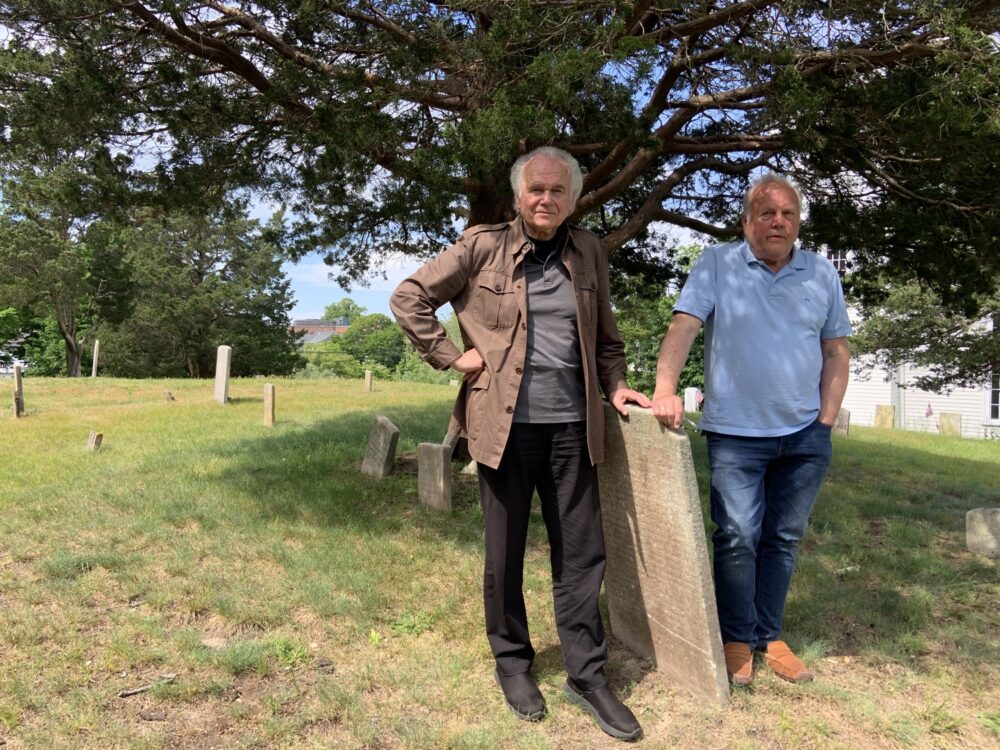
Randy Croxton, left, and Zach Studentroth, stand in the Old Burying Ground next to the First Presbyterian (Old Whalers') Church, near what would have been the entrance to a British Revolutionary War fort on the site. STEPHEN J. KOTZ

Randy Croxton, left, and Zach Studentroth, stand in the Old Burying Ground next to the First Presbyterian (Old Whalers') Church, near what would have been the entrance to a British Revolutionary War fort on the site. STEPHEN J. KOTZ

authorStephen J. Kotz on Jun 5, 2024

From a window at the top of the staircase of his home on Madison Street, Randy Croxton has a clear view of the Old Burying Ground next to the First Presbyterian (Old Whalers’) Church in Sag Harbor.

When the trees are bare and the morning light is just right, Croxton, who is an architect by profession, can make out the slightest contours in the sloping topography that mark the remains of a British fort — or, more accurately, redoubt — that stood on the site for the seven years when the British occupied Sag Harbor during the American Revolution.

Despite the fact that the fort was constructed on high ground with a commanding view in all directions, it was overrun by a small force of Patriots on May 24, 1777, during the Battle of Sag Harbor, which is more commonly known locally as “Meig’s Raid.”

“I know what people think Meig’s Raid was,” said Croxton. “They think it was nothing.”

In reality, he said, what many people think was a brief skirmish was actually a daring attack that was spectacularly successful. As the Americans’ first victory on Long Island, it proved to be one of the few bright spots during the early days of the Revolution.

Today, he said, modern military historians recognize the attack as the first example of “special operations” in American history.

Now, with the help of Croxton and its vice president, Zach Studenroth, who is also the village’s historic preservation consultant, the Sag Harbor Historical Museum plans to undertake a study with ground penetrating radar and other technology to map out the precise dimensions of the fort and determine whether there are any unmarked graves in the old cemetery.

A longer-term goal is to recreate the fort in an interactive video that will allow people to understand how the fort functioned during the Revolution, Studenroth said.

The cemetery study will be the focus of “Historians Corner,” when the museum holds its annual gala on June 29 on the grounds of the Custom House. Croxton and Studenroth will be joined by archeologist Jo-Ann McLean to discuss the initiative.

More attention to the fort and the village’s role in the Revolution will be paid as the 250th anniversary, or semiquincentennial, of the signing of the Declaration of Independence approaches in 2026, Studenroth said.

Croxton, relying on the contours he could see from his house, said he was able to effectively map out the boundaries of the fort to within a foot. He said it would have been a 50-foot-by-50-foot earthen construction, surrounded by ditches and protected by sharpened timbers that protruded outward, making it a difficult for attackers to overwhelm it. A narrow entryway would have been on the south side of the structure, he said.

Croxton said Sag Harbor’s role in the Revolution is more significant than many people realize.

He said the tiny fort in Sag Harbor was the first one the British built on American soil after they drove George Washington’s army off Long Island in late summer 1776. The fort helped the British maintain control over the village and was part of a British presence that included 14 British warships that blockaded Long Island Sound during most of the war.

He said the British produced a field manual that gave precise instructions for how to build a redoubt. While the Sag Harbor fort was the first to be captured by the Americans, a similar structure at Yorktown, Virginia, was taken in what would prove to be the final engagement of the war.

Studenroth said when the British arrived in Sag Harbor in 1776, they found a deep-water harbor that suited their needs. Long Wharf had been constructed in 1770 and provided them with a place from which to ship plundered food, ammunition and other supplies.

Meanwhile, the cemetery had only been established in 1767, and a portion of it had already been cleared. The British conscripted American farmers and forced them to help build the fortifications, he said.

In early 1777, as the British consolidated their power on Long Island, the Americans plotted a counterattack.

On May 23, Colonel Return Jonathan Meigs set off from Connecticut with a force of about 170 men, who rowed 13 whaleboats across Long Island Sound, accompanied by three sloops. They landed on the North Fork and portaged across a narrow spit of land, where they left a small group of men and two of their boats, before continuing on their way.

The group arrived at Long Beach at around midnight. Croxton said about 120 to 140 men then marched onto Sag Harbor, splitting up at what is now the intersection of Main Street and Brick Kiln Road. One group made its way to Long Wharf, where it destroyed food stores and burned nearly a dozen British vessels to the water line.​

The other group swung east and attacked the fort, charging quietly up the exposed hillside with bayonets fixed.

The Americans did not suffer any casualties, but for the British it was an ignominious setback. Six British soldiers were killed, and between 90 and 99 British were taken captive, including their commander.

The small American contingent, prisoners and plunder in tow, marched back to their now heavily laden boats and rowed back to the North Fork, where they met with their escort ships. The whole operation took about 25 hours.​​​​​

You May Also Like:

Sag Harbor Village Police Reports for the Week of December 11

SAG HARBOR VILLAGE — An officer responded to a call from a Rysam Street address a little after midnight on Saturday. The caller told the officer that a man wearing a black ski mask had walked onto her porch and banged on the front door then ran off. The woman provided the officer with surveillance video from her Ring camera, which visually confirmed what the woman said had happened. Police described the man as white, “approximately 6 feet tall, wearing a black ski mask, black hoodie with a red logo on the back, and wording on the left chest, a ... 12 Dec 2025 by Staff Writer

Harmony for the Holidays

Let’s be real: As jolly as the holidays can be, they can also be overwhelming. ... by Jessie Kenny

A Little Time, a Big Impact: Pierson's Interact Club Brings Joy to Seniors and Revives Blood Drive

Isabella Carmona DeSousa didn’t know much about Pierson’s Interact Club when she joined two years ... 11 Dec 2025 by Cailin Riley

Dear Neighbor

Congratulations on your new windows. They certainly are big. They certainly are see-through. You must be thrilled with the way they removed even more of that wall and replaced it with glass. It must make it easier to see what is going on in your house even when the internet is down. And security is everything. Which explains the windows. Nothing will make you feel more secure than imagining yourself looking over the rear-yard setback from these massive sheets of structural glass. Staring at the wall has well-known deleterious impact, and windows the size of movie screens are the bold ... by Marilee Foster

I Can Dish It Out

Our basement looks like the final scene in “Raiders of the Lost Ark,” where the (found) ark is crated and wheeled into the middle of a government warehouse with stacked crates going on for miles. In other words, we have a lot of stuff. This tracks. Mr. Hockey and I have been married for 36 (according to my calculator) years. We’ve had four (no calculator needed) pucks. We’ve lived in seven (according to my fingers) different homes in three (no calculator or fingers needed) countries. In 2010, we moved back to East Hampton full time. We brought everything we had ... by Tracy Grathwohl

The Urgency of Real

The Hamptons International Film Festival typically takes up a lot of oxygen in the fall on the South Fork, but it’s worth celebrating a slightly smaller but just as vital event in late autumn: the Hamptons Doc Fest. Running this week for its 18th year, the festival of documentaries was founded by Jacqui Lofaro and has become an essential part of the region’s arts scene every year. It’s a 12-month undertaking for Lofaro and her staff, and the result is always a tantalizing buffet of outstanding filmmaking, not to mention unforgettable stories. The arrival of the era of streaming services ... 10 Dec 2025 by Editorial Board

Hitting Pause

East Hampton’s housing shortage is real; the town can’t afford to ignore any potential long-term solutions. But the recent — and now scrapped — plan for a large employer-run complex on Three Mile Harbor Road raises too many questions that haven’t been fully answered. The proposal, put forward by Kirby Marcantonio and an unnamed partner, would have created 79 units of employer-controlled housing, comparable to a project he has pitched on Pantigo Road. To make it happen, the East Hampton Town Board would have had to allow the project to sidestep the town’s 60-unit limit on affordable developments, and rezone ... by Editorial Board

Proceed With Caution

Overlay districts are a common zoning tool used by many municipalities. Southampton Town has used them to varying degrees of success — the aquifer protection overlay district has been a winner; a downtown overlay district in Hampton Bays less so — in various parts of the town. They essentially look at the existing zoning, then allow those rules governing what can be done on properties to be reconsidered if there’s a newer concern to be addressed. In a bid to clean up the process for creating more affordable housing, the Town Board is looking at a new overlay district that ... by Editorial Board

The Whole Picture

When it comes to evaluating a complex development proposal, splitting up the application into separate parts may seem tempting, especially when environmental uncertainties loom. But in the case of Adam Potter’s plan for 7 and 11 Bridge Street, the Sag Harbor Village Planning Board should resist any temptation to segment the project for review. Potter’s attorney has asked the board to consider the gas ball property at 5 Bridge Street — a site that could provide the 93 parking spaces required for Potter’s 48 residential units and commercial spaces nearby — separate from the main development. The reason is understandable: ... by Editorial Board

New Law Requires Owners of Historic Buildings in Sag Harbor To Document Historic Features Before Renovation Work

The stories are almost commonplace: People seeing dumpsters full of old windows, doors and trim outside historic houses in Sag Harbor that are being renovated. On Tuesday, the Village Board adopted a proposal that it hopes will help put an end to that practice. It will require the owner of a historic house to complete a construction protocol and preservation plan before undertaking any major renovation. That document could be a few sentences or several pages long, depending on the type of work being considered. The amendment requires that the plan outlines “with specificity the detailed preservation, rehabilitation, restoration and/or ... by Stephen J. Kotz