


 2 Photos
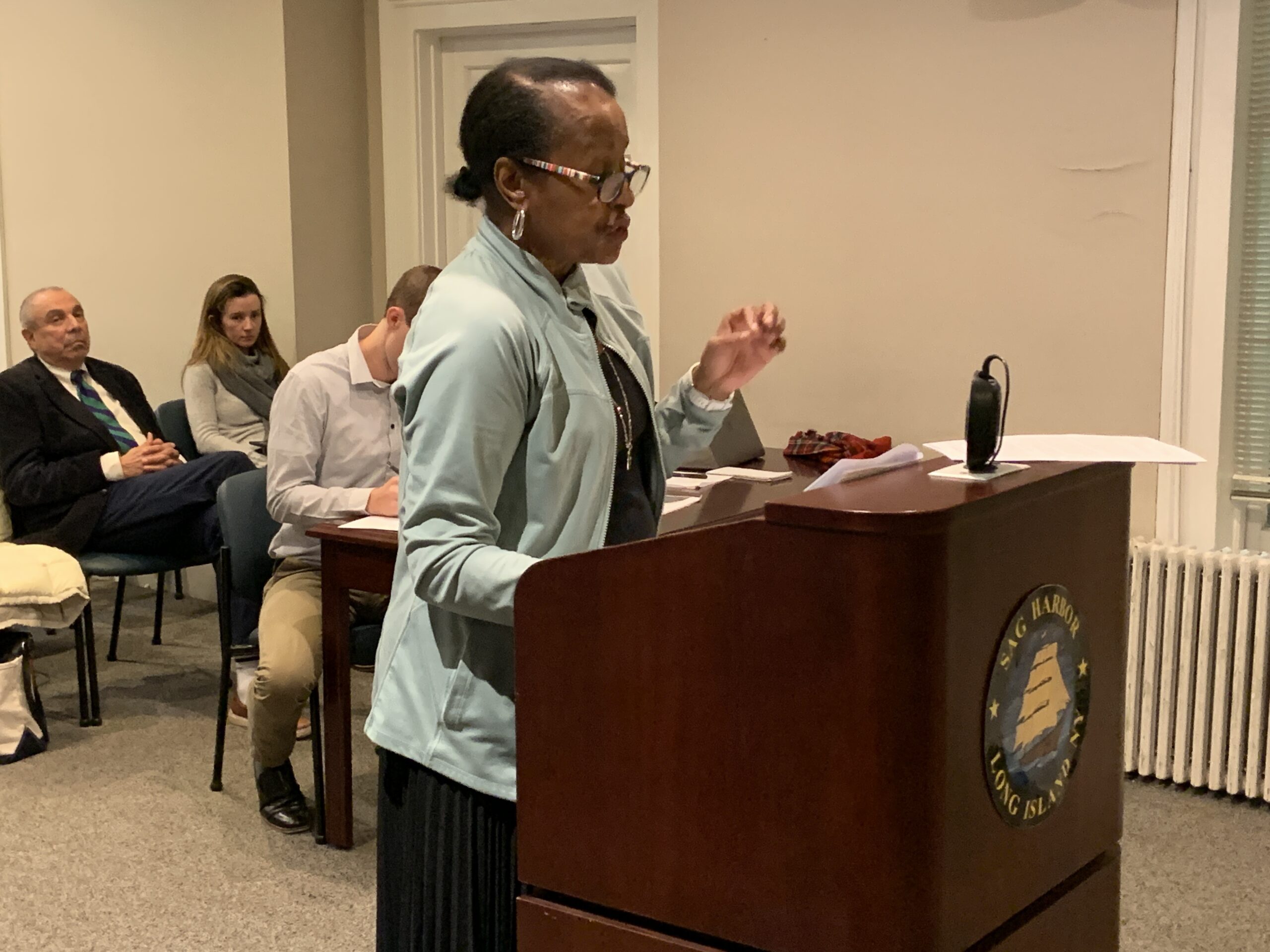
Renee Simons criticized the Sag Harbor Village Board for failing to act on the SANS organization's request that the village add three historically Black neighborhoods to the village's historic district. STEPHEN J. KOTZ

Steve William, president of the Azurest Property Owners Association, spoke in favor of the overlay district proposal. STEPHEN J. KOTZ
The Sag Harbor Village Board on Tuesday unanimously approved the creation of a special zoning district for the three historically Black beachfront communities on the east side of the village.
The measure has been pushed by the presidents of the homeowners associations of Azurest, Sag Harbor Hills and Ninevah Beach who have repeatedly told the board that residents in their communities overwhelmingly support the proposal over a concurrent effort by the SANS organization to add the three neighborhoods to the village’s historic district.
After listening to about an hour of testimony, board members, who had already held two previous hearings, agreed to adopt the Historically Black Beachfront Communities Overlay District without further discussion.
However, Mayor Jim Larocca said the board would in the future take up the question of whether some properties in the three neighborhoods should be added to an inventory of buildings said to be “contributing structures” to the village’s historic fabric, which could be a precursor to expanding the historic district.
Lisa Stenson Desamours, president of the Sag Harbor Hills Improvement Association, again urged the board to adopt the zoning overlay district proposal, which limits house sizes to 4,000 square feet and imposes other measures that residents say will help protect the character of their communities without imposing the same kind of restrictions that would come with inclusion in the historic district.
Although the three neighborhoods, under the acronym SANS, have been named to both the New York State and National Registries of Historic Places in 2019, Desamours said architecture was not the reason why. Those nominations stressed community planning and development, their social history and their Black and ethnic heritage, she said. “Architecture was not deemed an area of significance for our SANS community.”
Steve Williams, the president of the Azurest Property Owners Association, also spoke in favor of the overlay district, saying that the stricter guidelines of a historic district would prevent homeowners from being able to improve their houses and unlock their value.
“You have not heard from anyone who has a house that is a 1940s vintager that supports the program that SANS is trying to submit to you,” he said, adding that both Renee Simons, who has been a champion of historic district expansion, and Ed Dudley Jr., her neighbor who spoke in favor of her proposal, both lived in houses that had been renovated.
Simons continued her effort to convince the board that it was both duty-bound and legally bound to consider her request that the three neighborhoods be added to the village’s historic district.
She said the history of the three neighborhoods, where Black people were able to buy property and build vacation homes during a period of redlining and predatory lending practices, was as important as Sag Harbor’s past as a whaling port, which has been cited as a major reason the village adopted its initial historic district in the 1970s.
“SANS is of national importance, and has been chronicled for years,” she said. “When you walk through SANS, you are visiting a national historic site.”
Simons said the board had ignored the work that she and members of her committee had been doing for the past seven years at its own expense and said, as a Certified Local Government, the board was required to add to its inventory of historic structures “at a minimum all properties in a municipality that have been listed in the state and national registries of historic places.”
Dudley, who like Simons is a resident of Sag Harbor Hills, urged the board to both adopt the zoning overlay district, not because he supported it, but because so many of his neighbors did, but to also press ahead with adding the neighborhoods to its historic district as the only way to truly save it.
He told how his father, a groundbreaking Black diplomat, sought a refuge from the city in the village. “He and others were gerrymandered into this beautiful oasis,” he said. “They didn’t want Blacks on Main Street or Madison Street or High Street.”
Today, he said, the community is under continued assault from speculators buying up houses and noted that a neighboring family, whose daughter plays with his granddaughters, was moving because they could not afford to turn down the offer they had received for their house.
Larocca announced that the New York State Public Service Commission had ordered National Grid to continue its temporary lease with the village for the gas ball parking lot on Bridge Street and Long Island Avenue. The Village Board announced two weeks ago that it was petitioning the PSC to annul a long-term lease it had signed with developer Adam Potter after Potter backed out of a deal that would have him turn the lease over to the village. The village’s lease was set to expire at the end of the current year but will continue until the PSC makes a final ruling in the matter.
Landscape architect Ed Hollander, who has been donating his services to the village for the development of John Steinbeck Waterfront Park, gave a brief presentation on recent work at the park. The village recently received a huge load of clean fill, which it is using to create a low-lying amphitheater-like seating area. Hollander noted that fill, top soil, oak trees, and stone, which will be cut into benches for the seating area, had been donated to the village. He estimated that phase of the work would be complete by early May.
The board unanimously approved a 2.5 percent pay increase for employees to help them weather the effects of the high inflation that has gripped the economy over the past year. Village Treasurer Tim Bullock said the increase, which goes into effect January 1, would cost the village about $84,000 next year.


 Stephen J. Kotz on Dec 14, 2022