


 7 Photos
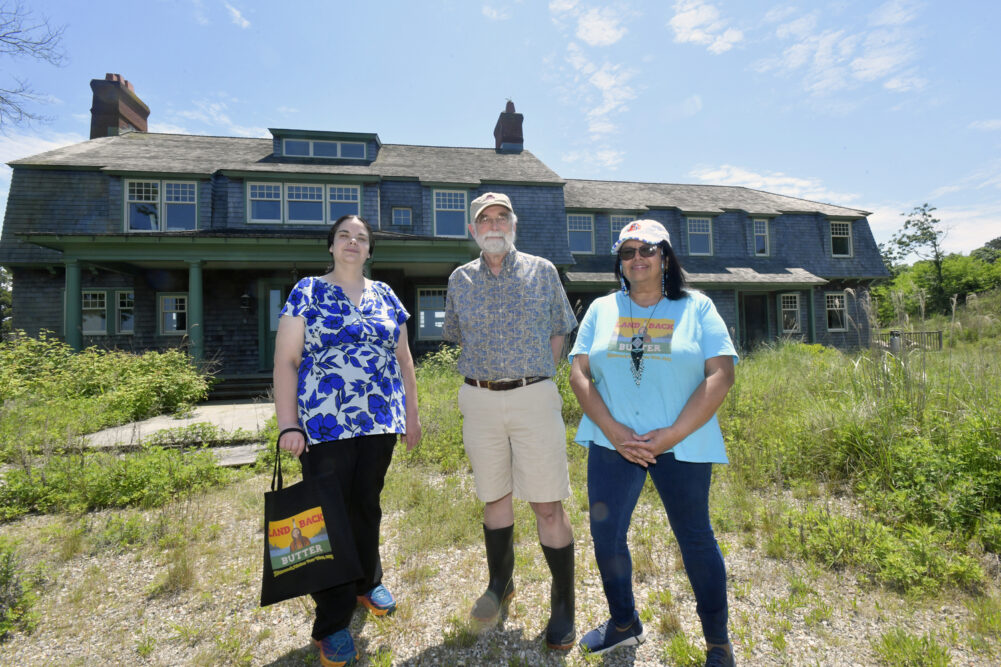
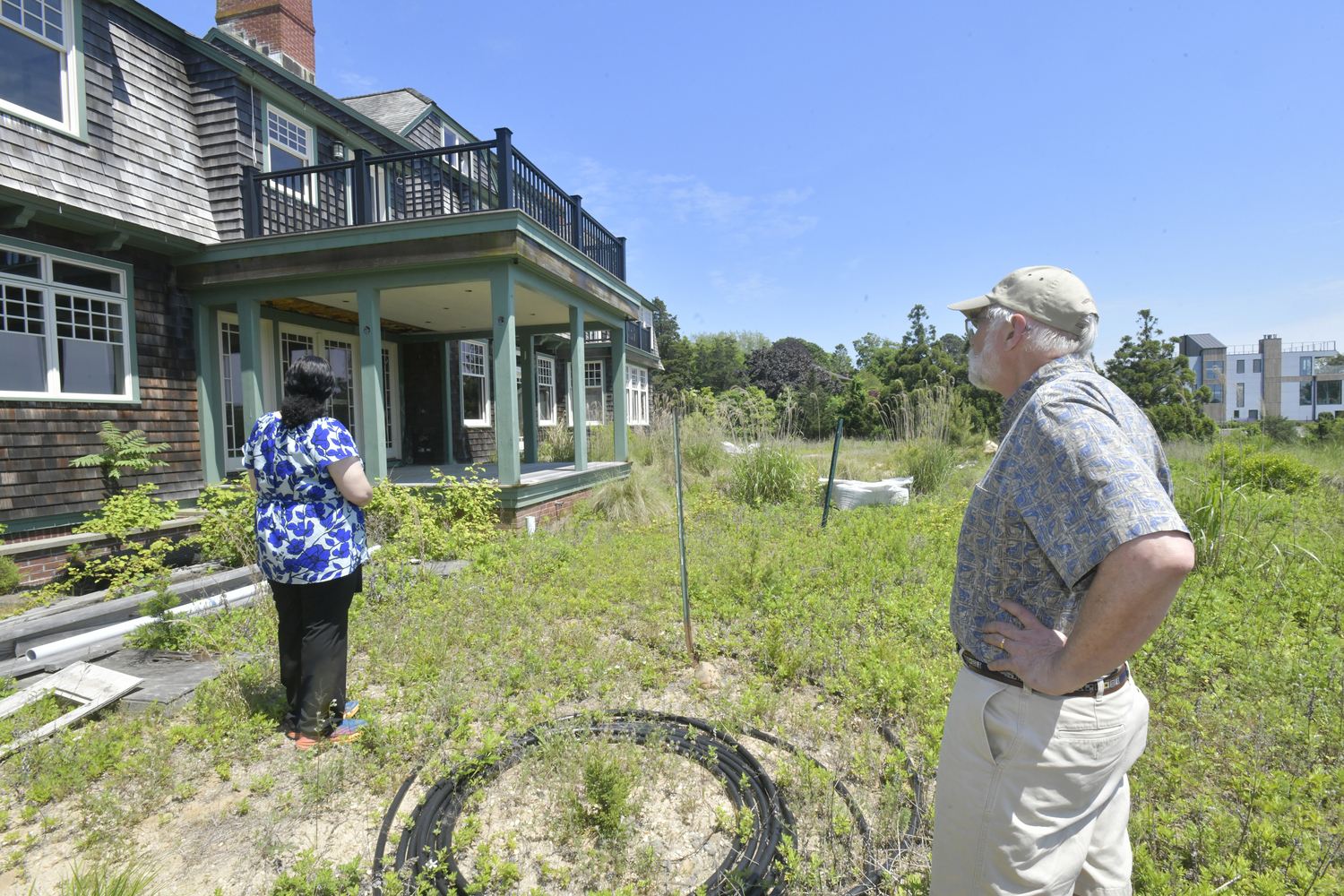
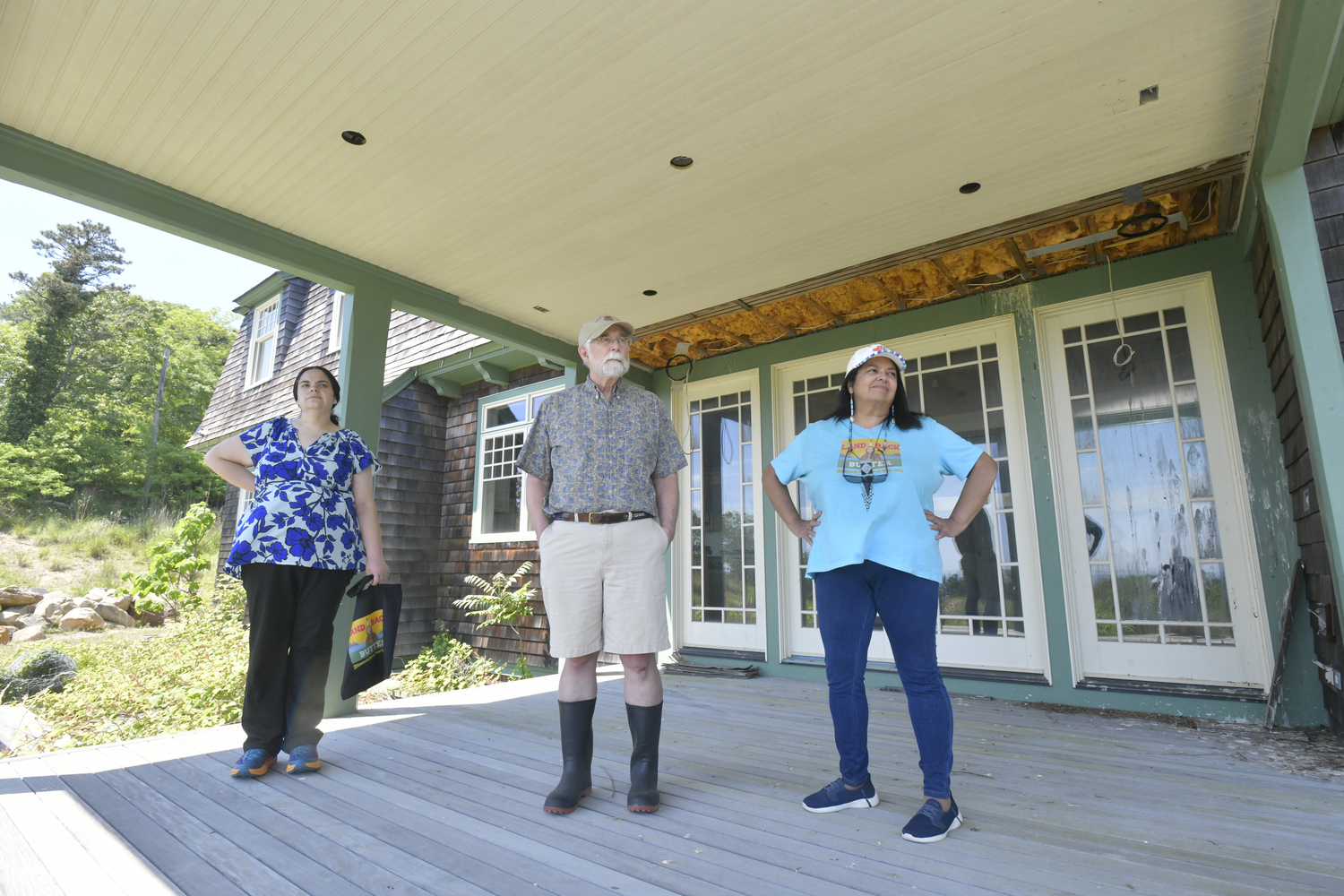
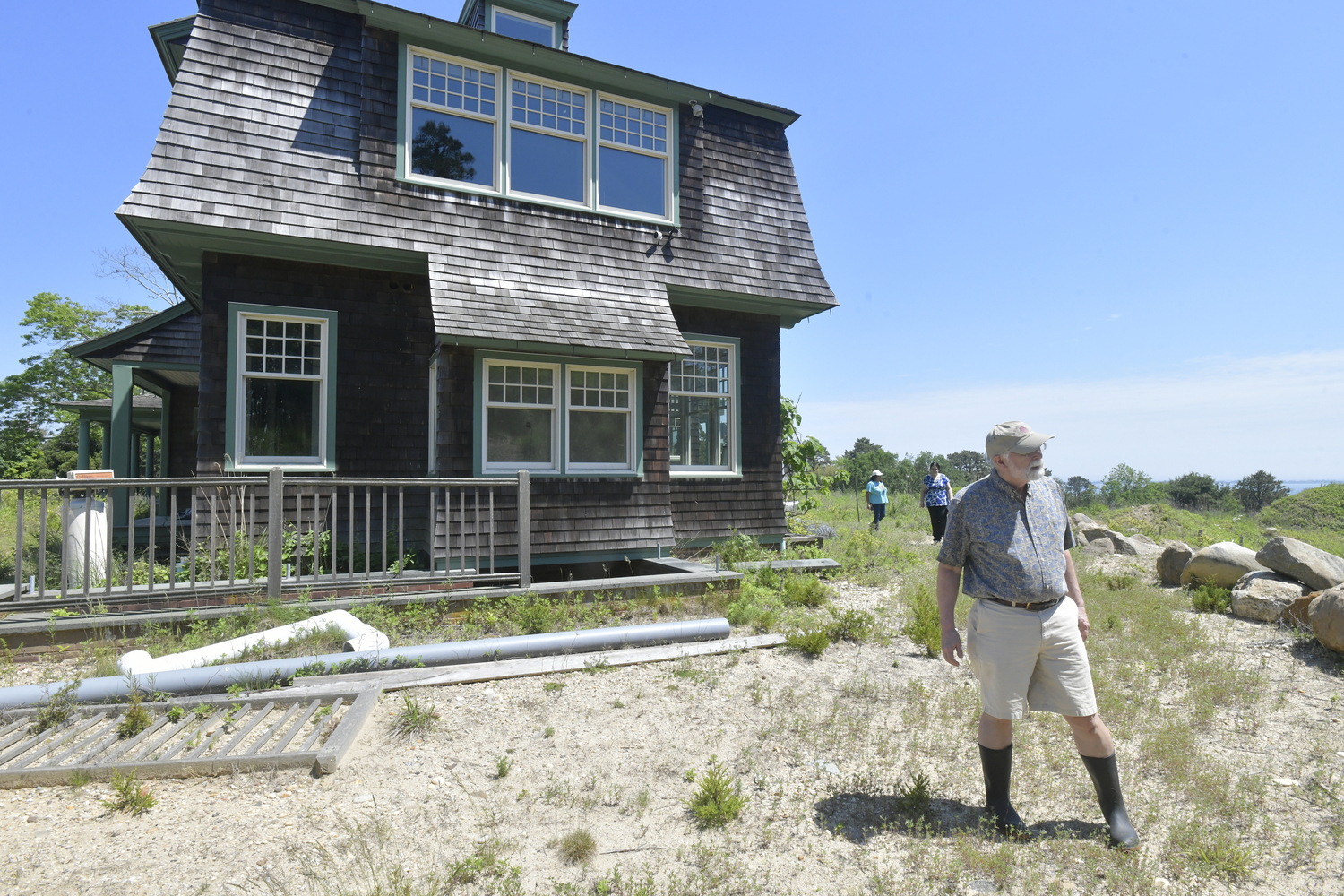
From left, Tela Troge, John v.H. Halsey and Denise Silva-Dennis at an abandoned house in Shinnecock Hills currently being considered for landmark status by Southampton Town. The Peconic Land Trust owns the land and is co-managing it with the Shinnecock-led Niamuck Land Trust. Both groups want the house removed from the site, which is an ancient Shinnecock burial ground — but some residents are hoping to relocate the home, which was originally built more than 100 years ago and had undergone extensive renovation before being abandoned during a bankruptcy proceeding. DANA SHAW
DANA SHAW
DANA SHAW
DANA SHAW
DANA SHAW
DANA SHAW
DANA SHAW
Nearly three years ago, Tela Troge had an experience she says she will never forget.
She accompanied a group of elders and fellow members of the Shinnecock Nation to an area known as Sugar Loaf Hill, a high elevation point just south of Montauk Highway in Shinnecock Hills, with a beautiful view of Shinnecock Bay and, not too far in the distance, the Ponquogue Bridge and Atlantic Ocean.
It marked the first time tribal elders had set foot on the land — where, underneath their feet, are buried the remains of many generations of their ancestors, dating back thousands of years — since 1859. That's when the land was stolen from the tribe in a deal, now widely recognized as illegal, for the purpose of expanding the Long Island Rail Road, pushing them onto the Shinnecock Territory on Shinnecock Neck.
They finally gained access to the land again after years of advocacy, which led to the Peconic Land Trust purchasing a 4.6-acre parcel from the Nappa family in 2021 for $5.6 million, and Southampton Town purchasing the development rights for $5.3 million.
Between 1859 and 2021, a lot happened on the expanse of land on and around Sugar Loaf Hill, none of it under the control or guidance of the Shinnecock people, for whom the land holds such immense significance.
Several large luxury homes dot the undulating landscape, now known as Atterbury Hills, as a sign near the entrance of the small private road proclaims. While many of the houses there are new and modern, the neighborhood was home to many wealthy and influential families as far back as the late 1800s and into the early to mid-1900s.
Thousands of years ago, it was a different story entirely.
Long before any European settlers arrived on the nearby shores, the Shinnecock people and members of other Indigenous tribes from the surrounding area would make the trek to Sugar Loaf Hill to bury the remains, often the ashes, of their loved ones.
Current members of the Shinnecock Nation, like Troge, say that the cultural and spiritual significance of the place cannot be overstated, and the fact that they’d been unable to connect with the land for so long represents a deep historical trauma many generations of Shinnecock people have had to bear.
The battle to have ancestral land returned to them, especially culturally significant areas like Sugar Loaf Hill, has been a long, challenging and seemingly unending process for the Shinnecock people. But in recent years they’ve had the support of the Peconic Land Trust, the Southampton-based nonprofit established by John v.H. Halsey in 1983 to ensure the protection of Long Island’s working farms, natural lands, and heritage.
When the trust acquired the Nappa parcel in 2021 and demolished the home there, it was really not meant to be a one-off. The Peconic Land Trust and the Shinnecock Nation have a longer-term plan to restore Sugar Loaf Hill in a more complete way.
They’re currently co-managing the land with the Niamuck Land Trust, a nonprofit recently formed by the Shinnecock people to protect, preserve and purchase burial sites, along with other culturally significant sites sacred to Indigenous communities.
That arrangement and collaboration between the like-minded preservation groups allowed several Shinnecock elders to set foot on the burial site for the first time since 1859.
“I’ll never forget that day,” Troge said last week. “Just seeing how many of my elders were so emotional and were moved to tears just being there in this place that’s so important to us, and finally being able to be there and have a ceremony and be reconnected to the land and the ancestors who are buried there. I can’t even put into words how significant that is.”
The drive to restore that land to its original use and purpose, to allow for more moments like those, and not just on a small portion of that sacred burial ground but on an even greater expanse of that entire sacred area continues to unite the nation and the Peconic Land Trust.
But what will happen next has been complicated by the presence of a large abandoned house on another adjoining parcel, also owned by the trust.
The trust had originally planned to do at 520 Montauk Highway exactly what it did with the first parcel: demolish the home, which was most recently owned by Laura Sillerman, the widow of wealthy media executive and investor Robert F.X. Sillerman, who died in 2019, and help the tribe restore the maritime grassland environment, and eventually deed the property to the Niamuck Land Trust.
Before it could get that far, however, architect Pam Glazer — whose home and office are located on Southway Drive, the small road in the Atterbury Estates neighborhood within viewing distance of the house in question — presented a site plan and proposal to landmark the house and move it to nearby property at 85 Eastway, where another building, a barn, formerly owned by the Atterbury family, is located. Glazer and her partner, builder Blair Dibble, who she lives with in Atterbury Estates, have been working on coordinating the move, which would be funded by Joe Zoccali, who owns the property at 85 Eastway. Neither Glazer or Dibble or being paid for their efforts to try and save the houses, Glazer said, but simply have a shared interest in trying to preserve it.
That proposal has set up an interesting debate about the future of a house and a property with a lot of history, in a neighborhood with a rich and varied past, raising questions about what should be preserved and how, what aspects of a geographic area’s history are considered important and culturally significant — or even simply known and told — and who is granted the power to make those decisions.
When the Southampton Town Landmarks and Historic Districts Board met in mid-April, Chairman Ed Wesnofske shared a report, based on research from Southampton Town Historian Julie Greene, on the relatively more recent history of the property and home at 520 Montauk Highway — which, despite what the physical address may imply, actually sits well off the highway, not visible from the main road, in the Atterbury Hills neighborhood to the south.
The shingle-style house was constructed in 1889 by noted builder James H. L’Hommedieu for a wealthy sugar merchant from the Philadelphia area named Osgood Welsh. L’Hommedieu was prolific and built many homes for wealthy elites at the time in Southampton and Bridgehampton, as well as in Tuxedo Park, in addition to building schools and other institutional buildings in the area, and at one point he was the largest employer in the state.
In 1905, before his death, Welsh transferred the home to his daughter, Frances Welsh Gray, who then sold it to Charles Atterbury, a railroad lawyer who had come to the area from Detroit.
His son, Grosvenor Atterbury — a famed architect who designed the original Parrish Art Museum on Jobs Lane — inherited the house and, in 1954, sold it to a man named Charles Platt, who worked as a Southampton Village attorney. Platt turned the property into a seaside motel named Horizon Hills that was open from the late 1950s to the 1970s, using both the original home and a series of other buildings that were constructed and, eventually, razed after the motel stopped operating.
The original home and property went through a series of other owners after that, and over the decades, was significantly remodeled and renovated many times, although some of the original beams and framework remained. The land surrounding the home still bears the scars of several golf holes that were at least partially dug out there at some point as well.
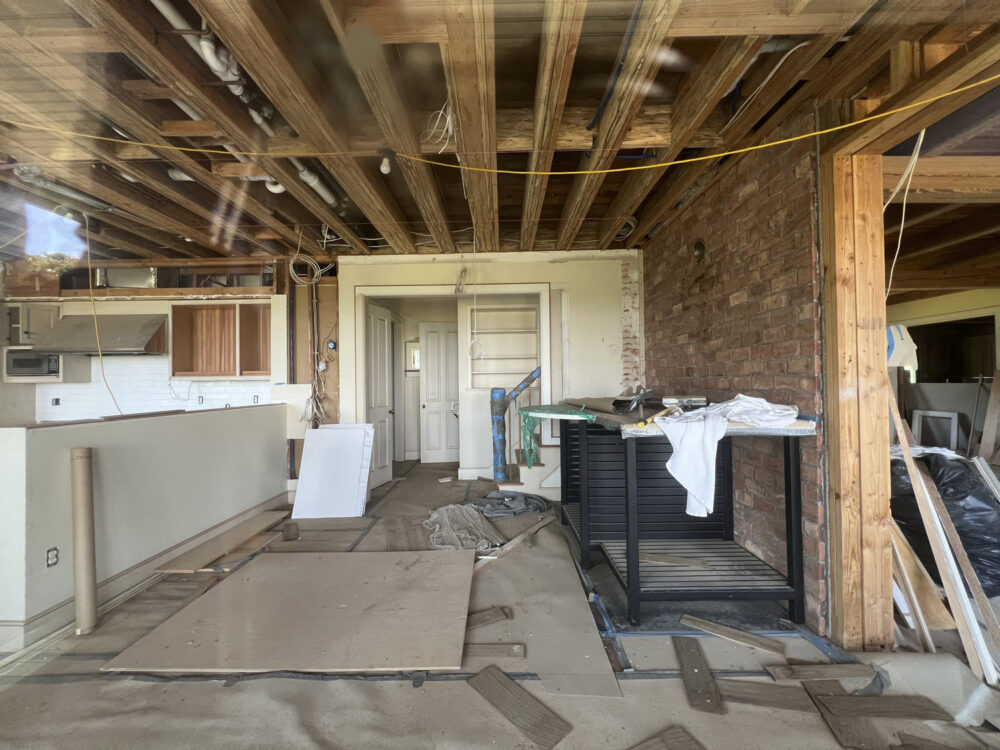
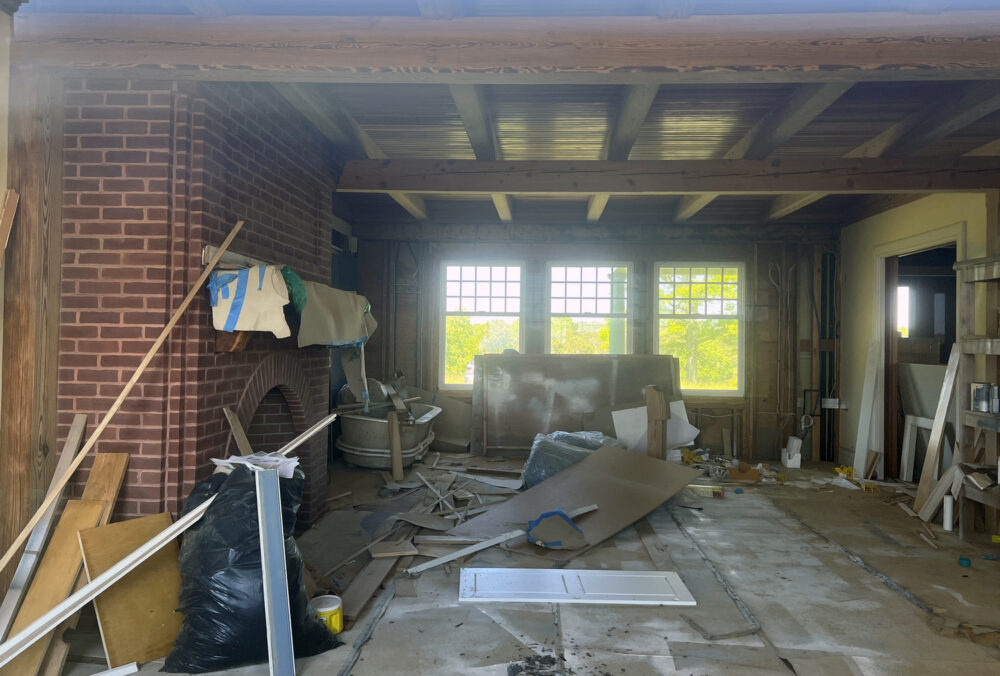
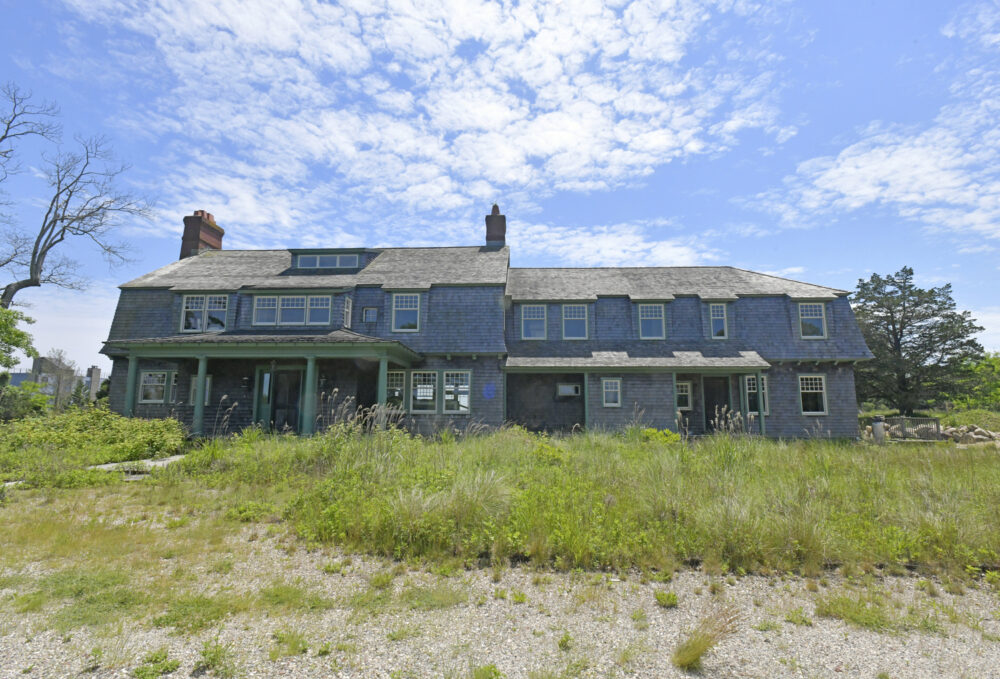
As it stands today, the house is a study in strange juxtapositions. The siding, shingles and virtually the entire exterior look brand new — and yet the home was also very clearly neglected before all the most recent new work was complete. Bird droppings cover brand new windows, both on the exterior and interior; overgrown grasses and abandoned materials, including a water tank and extension cord, are exposed to the elements on the property; a large weed is growing out of the top of a new brick chimney.
Despite the ownership changes and different iterations of uses for the house and the property, the Landmarks Board ultimately voted to recommend to the Southampton Town Board that the house receive landmark status, but made that designation contingent upon the relocation of the house to a different location.
Wesnofske listed the five criteria for landmarking, and the rest of the board agreed that it met four of the five criteria points — that the structure possesses “special character or historic or aesthetic interest” in the region; that it is identified with “historic personages;” that it “embodies the distinguishing characteristics of an architectural type, period or style” (noting that the changes made did not significantly alter that style); and that it is the work of an architect or builder “whose work significantly influenced an age.”
The only criteria it did not meet — and it only needs to meet one of the criteria — was being in a unique location or a familiar visual feature. Because of its location far enough off Montauk Highway as to not be visible from Montauk Highway, it did not qualify there.
While the Town Board likely will vote in favor of taking up the recommendation of the board sometime this summer, the fate of the house is still up in the air.
It will be a costly and painstaking endeavor to move the house, and neither the Peconic Land Trust or Niamuck Land Trust has any interest or desire in contributing to that effort.
What they are concerned with, however, is the way in which the people who want to take charge of the effort to relocate the house do it. Their primary and really only concern is ensuring that the sacred land on which the house sits is not further desecrated or disturbed by the relocation process, and that the home is not moved to another area that is just as culturally significant and sacred as the place it is at now.
At the Landmarks Board meeting in May, Halsey, Troge and archaeologist Alison McGovern all spoke, adding their own expertise, perspectives and insight into the property to provide a more complete picture of its significance and value.
Troge shared that the property now owned by the trust lies within the cultural resources overlay district that the town recently designated, and also that Sugar Loaf Hill was designated as an Indian Burial Area by the State Department of Environmental Conservation in 1990. The area has been a skeletal and cremation burial site for at least 3,000 years and possibly as far back as 6,000 years, she said at the meeting, and it was used not only by the Shinnecock but by tribes throughout the Northeast.
In his remarks to the Landmarks Board, Halsey shared that he’s the 12th generation of the family of Thomas and Phoebe Halsey, who were among the original English settlers who came to the area in 1640. That, he said, makes him a “relative newcomer” in comparison to the Shinnecock people.
He started his remarks to the board with a land acknowledgment, pointing out that the meeting was taking place on the ancestral grounds of the Shinnecock people, who have occupied the land for more than 400 generations.
Halsey said that while he and Troge and other tribal members don’t oppose the relocation of the house on the property in principal, they do not find any of the current relocation proposals acceptable. It’s currently what he calls a “dynamic” situation, as a solution that is satisfying to everyone involved still has yet to be settled upon.
But he, Troge and the rest of the people invested in the effort to restore the land to the Shinnecock people and return it to its natural, maritime grassland state hope the discourse around the property and the fate of the house can be the catalyst for a wider discussion.
“My hope is that this will turn into a longer conversation not only about the property but about how the town recognizes the value of cultural resources that predate the arrival of my ancestors,” he said at the meeting.
McGovern pointed out that Grosvenor Atterbury gave permission for excavations to be done at the site in the 1930s, without the knowledge or consent of the Shinnecock people, and those excavations revealed 41 graves, artifacts like broken clay pottery vessels, and bone ash deposits from cremation. She pointed out that the presence of buildings and structures in the area “does not negate the sacred history or suggest that burials are no longer present in the area.”
McGovern also made a counterargument against the criteria presented at the April meeting for landmarking the house, saying that the Atterburys and others who owned the house and property at times throughout recent history were “complicit in the alienation and destruction of burial sites,” and their presence there also served as a reminder that the area was transformed in the late 1800s and early 1900s into a “playground for the rich at the expense of the Shinnecock people.”
“Landmarking the house is a way of commemorating a colonial history that caused violence and trauma to the Shinnecock people and destruction of their sacred landscapes,” she concluded.
Troge pointed out the irony that, in 1990, the same year that the Native American Graves Protection Act was passed by Congress, Southampton Town issued a building permit for a home on Sugar Loaf Hill, which was demolished when the trust purchased that parcel.
Troge said the proposal to move the house is troubling because the process of moving it will further disturb and desecrate the land that has already been so disturbed by the building and development that has occurred there over the last 100-plus years.
Proponents of landmarking and relocating the house argue there are ways it can be done without disturbing the property, but it remains to be seen if an agreement can be reached.


 Cailin Riley on Jun 7, 2024