


 1 Photo
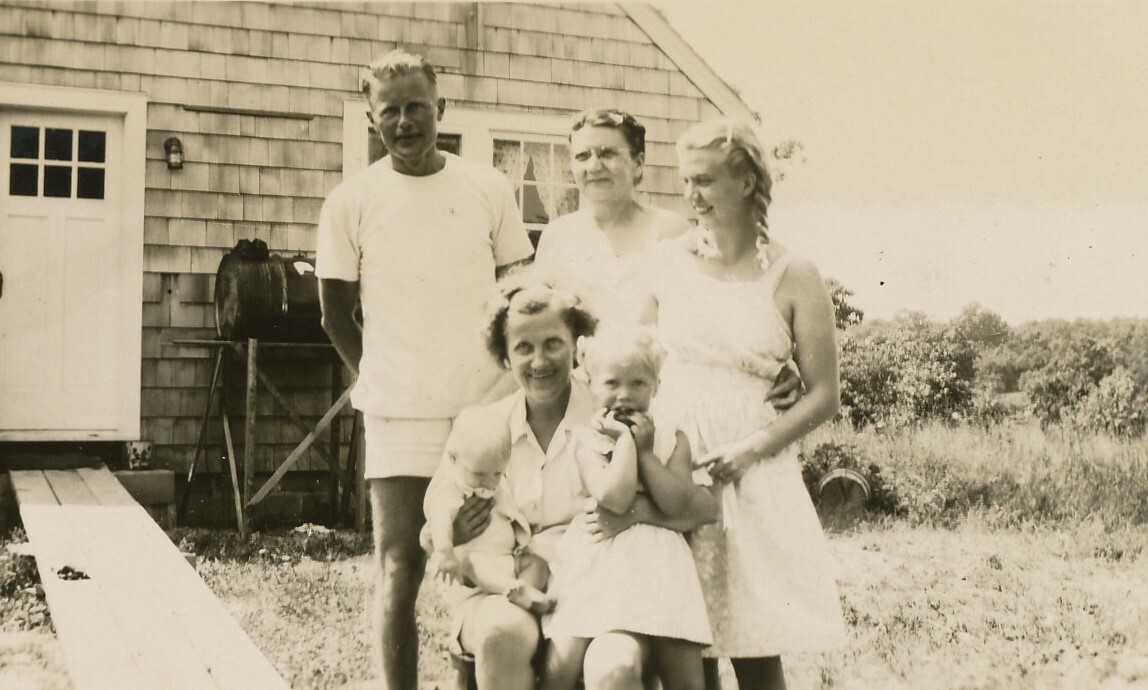
Members of the Wells family at their Hampton Bays property in the 1940s. Current owner, Robert Wells, is the baby sitting on the knee of his great aunt Tyne Enberg Albrecht. Good Ground Cemetery, where all the adults in the photo are buried, can be seen in the background.
Her husband, Robert, their niece Judith Salmon and she are, Linda Wells said ruefully, “the only living neighbors” of a sewage treatment plant under discussion for Hampton Bays.
“Everybody else is in the cemetery or the park,” said Wells, speaking from Florida, as her husband prepared to undergo surgery.
Beyond the Wells family land, the proposed plant is bordered by Good Ground Cemetery and Good Ground Park.
The family once owned land along Cemetery Road that stretched north all the way past Sunrise Highway, including 30 Cemetery Road, where Southampton Town officials envision the sewage treatment plant. In 2015, it was purchased by a limited liability company that traces to developer Alfred Caiola.
Around the same time, Caiola offered to buy their properties, at 20 and 24 Cemetery Road, but the family said no. “To us, this is love. Our family home. Our children spent all their summers there. We love this place,” Wells said.
Interviewed this week from her primary residence, Wells spoke out against the building of the plant, a key component of Caiola’s vision for downtown revitalization, next door. Salmon was unable to offer input, as she is caring for two seriously ill family members.
“Naturally, everyone is going to say, ‘Of course you’re opposed to it — you’re a NIMBY, you don’t want it in your backyard.’ I can’t imagine anybody would want a sewage treatment plant in their backyard,” Wells began.
“My husband’s family has been there for a couple of hundred years,” she continued. His great-grandfather owned the Wells Livery Stable on Montauk Highway. He and his wife, Elsie, are buried in the cemetery, as are their sons. Robert’s father and mother are buried there. His maternal grandparents are buried there, and the couple has plots there for themselves and their children.
“Our family has been on that little plot of land for hundreds of years. They were involved in the Methodist Church and the cemetery board,” Wells said. “They were involved in everything in Hampton Bays. They’ve been there,” she paused, “forever, when it was Good Ground.” Hampton Bays was christened Good Ground in the 1700s. It was established with its current name just 100 years ago.
“We have a hard time believing people have become so insensitive and don’t see putting a sewage treatment plant next to a cemetery is almost like a desecration,” Wells said. “How could you even think about it? It’s disgusting.”
Good Ground Cemetery is a special place in Hampton Bays, she continued. “It has historic significance.”
The plant has been “a done deal for a very long time,” Wells believes, blaming herself for not paying enough attention when the Caiola Realty Group began buying up property.
Once the couple read about the Hampton Bays Downtown Overlay District’s annulment, they started paying attention. “We read everything we could and we were just knocked out,” she said.
The overlay district presumed the necessary infrastructure, including a sewer district and sewage treatment plant. The engineering report presumed the plant would be built at 30 Cemetery Road.
Officials were supposed to conduct a study to find the best location for the plant, Wells said. She asked what other properties had been analyzed and determined. None was discussed.
Meeting via Zoom teleconference, she raised the question to Town Planning and Development Administrator Janice Scherer, recalling the administrator telling her the property had been offered to the town to use for a sewage treatment plant, so other parcels weren’t considered.
“I was a little flabbergasted by that,” Wells said. “They said, ‘If you’ve got any other place, let us know.’
“That’s not my job,” Wells said.
The topic of an alternative site arose last month during a Town Board work session focused on the engineering report for the plant. Mention was made that other sites were considered, “But nobody asked ‘Where did you look?’ Nobody asked the question,” Wells said.
Scherer offered a rebuttal via an emailed statement:
“We did indeed informally assess several parcels in the immediate area to determine if any were of suitable size and shape, which the engineer Steve Hayduck confirmed that they were not. The subject parcel that was assessed was the only one available. The owners already indicated the intention to place a private STP on the parcel to accommodate the sanitary flow for whatever they were going to propose (this is not unusual — there are private STPs on parcels all over town. He can propose tomorrow to land any of the multi-family zones and use that as the STP for his own sanitary designs) but was amenable to us completing an engineering report to consider the feasibility for a public district to allow for multiple connections so that other property owners could benefit. Once we could understand what the cost of that was and if anyone wanted to actually do it (all parcels in the boundary get a vote on a special district) then we could proceed, or not.
“Ms. Wells indicated that there were numerous other parcels that we could instead consider, to which I told her that if she knew of something specifically, to let me know because we had already looked at all the vacant ones.”
The property at 30 Cemetery Road was offered up for $800,000. “It’s convenient, and they can get it,” Wells said. “The problem is, it’s awful. I think people who own burial plots there, like my husband and I do, only yards away, would have a small problem with spending eternity next to a sewage treatment plant.”
She noted the plant is oriented so it doesn’t infringe on the Wells property, but there is a need for setback variances from the park and cemetery.
Speaking again of the family’s love of their property, she opined the hamlet is lovely the way it is. Of the brief moments they can stay there, she said, “Even though we get to spend so little time there, when we get there, we’re so happy.”
They’ve rented houses on the land to local families for affordable prices. Over the years, tenants have been able to save up and buy their own homes. “It made us happy to help them out,” Wells said.
Like opponents of the overlay district, Wells is specifically concerned about the potential for additional residential units — apartment buildings that could abut her land.
Reiterating her sense that the plant will be built, despite any opposition, she said, resigned, “During our lifetime, we’ll live next to sewage treatment plant, and after we’re dead, we’ll be next to sewage treatment plant for eternity.”
She concluded, cautioning, “If wider Hampton Bays doesn’t get in the know, anything can happen.”
Community members will have the chance to get in the know on Monday, August 29, when the Hampton Bays Civic Association holds a community forum at the high school at 7 p.m. The forum will include panelists from a consulting engineering firm, as well as Caiola’s design team. It will be held in-person only.


