


 2 Photos
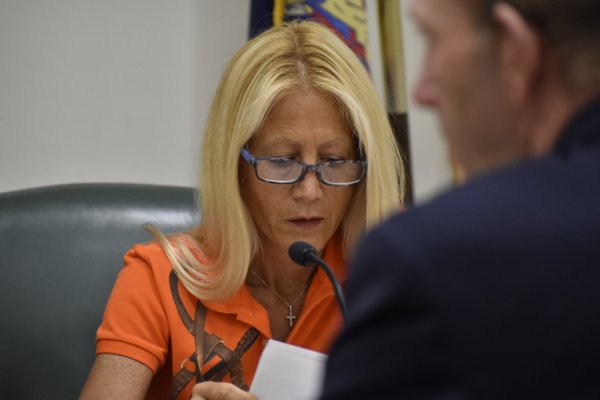
The Southampton Town Board met with Southampton Town Comptroller Len Marchese to discuss the costs associated with upgrading the HBWD's infrastructure. VALERIE GORDON
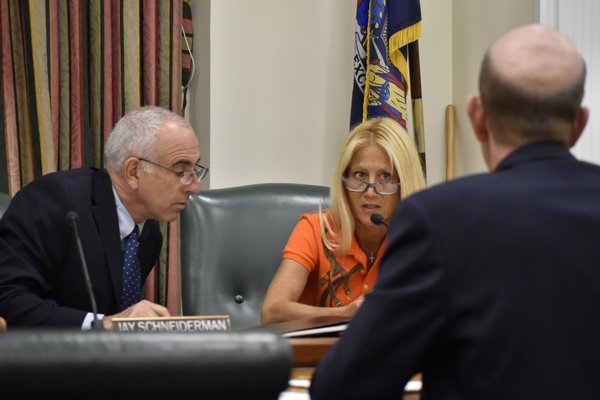
The Southampton Town Board met with Southampton Town Comptroller Len Marchese to discuss the costs associated with upgrading the HBWD's infrastructure. VALERIE GORDON
Hampton Bays Water District customers could soon see a significant increase in their water bills if the Southampton Town Board ultimately decides to keep the water district local rather than turning it over to the Suffolk County Water Authority, as has been proposed.
At a work session on Thursday, June 27, Southampton Town Comptroller Leonard Marchese said that customers could potentially see a 20- to 25-percent increase in their water bills to fund two “priority” infrastructure upgrades.
The increase in rates would potentially fund the installation of a $3.6 million iron and manganese filtration system at the district’s fourth well field, located along Bellows Pond Road near Sears Bellows County Park, as well as the resurfacing of the site’s tanks, which is estimated to cost another $2.8 million.
“Everyone needs to know, it’s not a free lunch,” Mr. Marchese said.
The Suffolk County Water Authority submitted a proposal to take over the day-to-day management of the locally owned district last year, which included a total of $14 million worth of infrastructure upgrades—$6.1 million to be completed in the first three years.
Under the proposal, the cost of upgrading the district’s system would be shared with the water authority’s 1.2 million customer base, rather than just among the Hampton Bays Water District’s 6,400 customers.
According to Southampton Town Supervisor Jay Schneiderman, the water district’s superintendent, Robert King, has agreed that both projects are a priority. However, Mr. King could not be immediately reached on Friday.
At Thursday’s work session, Mr. Marchese noted that the district currently has approximately $1 million in its reserves—not nearly enough to cover the upgrades.
He suggested that the Town Board take immediate action and increase the district’s water consumption rate by 10 percent, which he said would garner roughly $109,000 in additional revenue each year.
On average, he said that the district collects $1.9 million annually from customers’ quarterly water bills and a $132 annual fee included in their tax bills, which currently goes toward funding maintenance and debt service.
Mr. Marchese estimated that an additional $500,000 to $700,000 is needed annually in order to fund the filtration system and tank resurfacing projects.
Mr. Schneiderman seemed supportive of Mr. Marchese’s suggestion to increase the water rate rather than the annual maintenance fee. “You pay for what you use,” he said. “If you want to waste water, you’re going to pay more than someone else.”
Currently, per quarter, a water district customer using 3,500 cubic feet, or 26,182 gallons, pays an average of $44.80 for the three-month period, including both usage fees and the annual maintenance charges.
The same amount used by a water authority customer would cost approximately $46.72, according to the authority’s CEO, Jeff Szabo, who has said that water rates would not increase under the management proposal—and the rate includes the infrastructure upgrades, which the local water district rate does not.
Mr. Marchese said that the water district has not increased its rates since 2012, when the Town Board, which acts as commissioners of the district, approved a 5 percent increase to its water consumption rates. He said that, on average, the water authority increases its rates by roughly 4 percent each year.
However, Southampton Town Councilwoman Christine Scalera said she was hesitant to move forward with enacting a rate increase without first hearing from consultants D&B Architects. The Woodbury-based firm was hired by the Town Board in March for $47,000 to assess the condition of the water district’s infrastructure and establish a 10-year capital improvement plan, listing and prioritizing the items needing immediate attention.
“I feel like we’re operating in the dark without all the information I need to make an intelligent decision,” Ms. Scalera said.
Mr. Schneiderman, however, shared Mr. Marchese’s concern that by waiting to increase the water rates, the district would miss out on the increased revenue expected from the summer season. “I personally don’t think we have the luxury of waiting,” he said.
He pointed to 10 years’ worth of reports from Melville-based H2M Architects + Engineering, which have for years identified both the iron filtration system and tank resurfacing as “high priority” items.
In fact, at a recent work session in May, the Southampton Town Board met with Hampton Bays Water District Assistant Superintendent Richard McCuen and determined that one of two wells located at the district’s fourth well field would need to be taken out of service.
At that time, Warren Booth, a maintenance crew leader for the water district, said that recent test results showed a combined manganese and iron concentration of 1.8 mg/L at well 4-1 and 5.7 mg/L at well 4-2—both individually exceeding the state limit by a wide margin.
Until recently, water district officials were permitted to address the problem in the district’s water supply by injecting a polyphosphate orthophosphate blend to help prevent iron from oxidizing and causing discoloration, a process called sequestering.
However, under new Suffolk County Department of Health regulations, water suppliers can no longer sequester wells exceeding a combined iron and manganese concentration of 1 mg/L.
Mr. Schneiderman confirmed last week that well 4-2 has been turned off but 4-1 is still operational.
In May, Mr. Schneiderman had suggested that Mr. McCuen seek a variance from the Health Department to continue sequestering well 4-1. It’s unclear whether it has been obtained, as Mr. Booth referred all questions to Mr. King.
At Thursday’s work session, Mr. Schneiderman requested that Mr. Marchese reach out to D&B Architects to determine the status of the capital report and, at the very least, offer a recommendation as to the necessity of the filtration system and the tank resurfacing projects.
“I would be shocked if this wasn’t sitting in their action plan,” Southampton Town Councilman John Bouvier added.
The Town Board is planning to meet with water district officials at a community outreach meeting on July 15 at the Hampton Bays Community Center on Ponquogue Avenue to discuss increases to the district’s water rates.
Mr. Schneiderman said that the Town Board will likely put the decision on whether to hand the district over to the water authority to a public vote—but only after receiving D&B’s recommendations.
“We’re trying to keep it local,” he said. “If the costs are significantly higher—if they want to pay for that, I think that’s their right.”


 Valerie Gordon on Jun 28, 2019