


 1 Photo
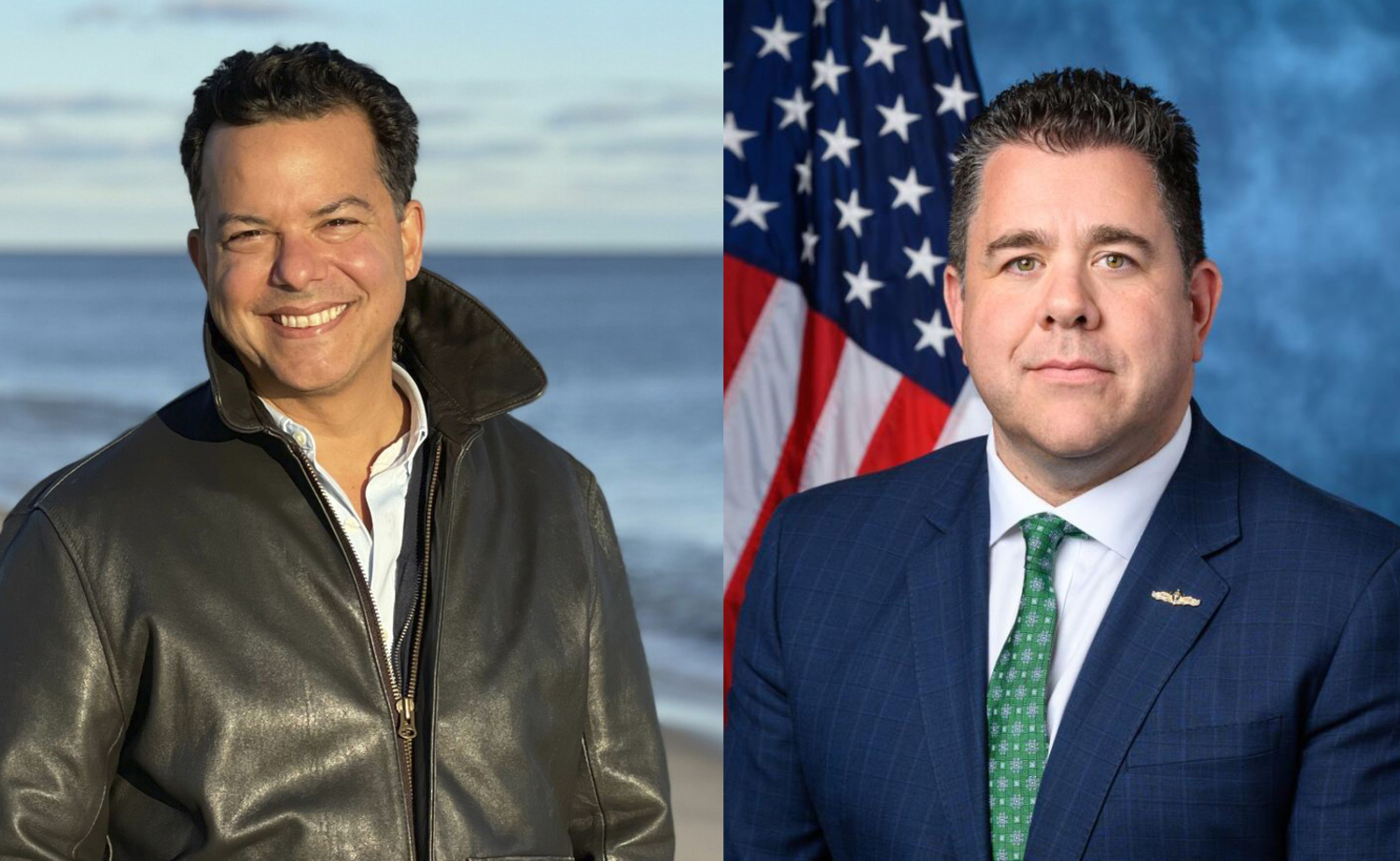
John Avlon, the Democratic candidate, and Nick LaLota, the Republican incumbent, are vying to represent New York's 1st Congressional District.
Representative Nick LaLota, a Republican who is seeking a second term in the U.S. House of Representatives, and his Democratic challenger, John Avlon, agree that removing the cap on the state and local tax deduction, known as SALT, is critical to improving the economic well-being of residents of New York’s 1st Congressional District.
In the second installment of 1st District Matters, a six-part podcast in which LaLota and Avlon discuss their respective position on a range of issues, the candidates focus on economic matters. It is available starting today, Thursday, October 3.
The SALT deduction allows taxpayers who itemize to deduct property taxes, sales taxes and state or local income taxes. In separate interviews with the candidates, Avlon repeatedly criticized Republicans for capping the deduction at $10,000 in the GOP-led tax overhaul of 2017, prior to LaLota’s election to the House but during the term of former President Donald Trump, whom LaLota endorses. Previously, there was no limit to how much taxpayers could deduct through the provision; implementing the cap effectively raised taxes for many Americans.
“Let’s remember, Trump and the Republicans raised our taxes,” Avlon told moderators from the Express News Group and WLIW-FM, “and they did it out of spite as part of a political stunt.” Republicans, he insisted, “will never repeal it because they’re too invested in the red state-blue state divide.”
New York, he said, “always gives more to the federal government than we get back. That tends to be true for blue states, whereas red states get more from the federal government than they give, and then complain about the federal government.”
“The first and foremost thing we need to do is to increase the state and local tax deduction,” LaLota agreed. “That is something that was unfairly taken from us a number of years ago, and it should be given back.”
He is a member of the Bipartisan SALT Caucus, “and this year was able to get a vote to increase the SALT deduction for married couples,” he said. The SALT Marriage Penalty Elimination Act, which he co-sponsored, would have, for the 2023 tax year, doubled the cap for married couples filing jointly and with incomes up to $500,000. It failed to progress to a House floor vote. “Unfortunately, 18 of my Republican colleagues on February 14th of this year voted it down,” he said, “but every one of the 210 House Democrats voted it down, including members who were in high-tax states and even members who were in the Bipartisan SALT Caucus.”
LaLota “may talk a good game” on restoring the SALT deduction, Avlon said, but is “rubbing SALT in our wounds” because he is “never going to get it done, because Republicans have already told him to go pound sand. … He couldn’t convince his own colleagues to give it a hearing.” He said that Senator Charles Schumer, the Senate majority leader, and Representative Hakeem Jeffries, the House minority leader, have prioritized restoration of the full SALT deduction. “That’s an average of $10,000 back in your pocket every year.” LaLota, he said, is “giving false hope because his party is dead set against it. … Let’s restore it. That’s a way we can help working families.”
LaLota said he will “continue to build coalitions” toward full restoration of the deduction in the next Congress. He also advocated for “better energy policies,” stating that the federal government is too onerous with respect to “the extraction of American energy from our grounds,” referring to billions of barrels’ worth of untapped oil. Some places, however, should be off-limits, he said. “I helped pass an amendment to ensure there’d be no drilling off of the shore of Long Island, and fortunately was able to earn bipartisan support for that provision,” he said. “But there are parts of the country that welcome this,” he said, citing Louisiana.
Avlon pointed to the Child Tax Credit, which was expanded in the 2021 American Rescue Plan and was partly responsible for the largest one-year drop in child poverty, according to the nonpartisan Center on Budget and Policy Priorities. The expiration of that aid in 2022 led to 5 million more children living in poverty in 2022 than in 2021. The expansion was “one of the most successful experiments we ever did,” Avlon said, “if you believe that cutting childhood poverty is important. And then we let it roll back because Republicans wouldn’t support it. They want to support special interest tax breaks, but not for kids. ... It’s the right thing to do to help working families get ahead.”
Both candidates discussed economic engines within the 1st District, but pointed to different industries. LaLota, who said that his mother worked at the Grumman Aircraft Engineering Corporation, referred to manufacturing for national defense. When Grumman reduced its presence on Long Island, “the perception was a lot of that went away as a whole,” he said. “But the reality is there’s about 200 small-to-medium-sized defense suppliers here on Long Island that make everything from blades on helicopters to wheels on planes to tracks on tanks, and a lot of things in between.”
On the Armed Services Committee, “I’ve been able to give those Long Island defense manufacturers a lot of exposure,” LaLota said, “not just in the 1st District, but the 1st through 4th. They exist in a bunch of different places here on the Island, but I’ve been able to give them a decent amount of exposure to federal contracts.”
For Avlon, renewable energy is “one of the most exciting things that can happen to our country and our community. Climate change is real, no matter what some folks on the far right say,” he said, and can be “depolarized” in the district, pointing to the coastal erosion and flooding that impacted Long Island’s north shore in August, which “doesn’t give a damn what political party you belong to.”
Climate change must be addressed with mitigation and innovation, he said, the latter representing “how you really get out of the problem.” He called innovation “the most American thing there is” and pointed to Stony Brook University and Brookhaven National Laboratory, “two of the premier research facilities in the world, not just the country, focusing on clean energy technology. … That nexus between Brookhaven National Lab and Stony Brook University creates the condition to have the East End of Long Island be sort of ‘Silicon Valley East’ when it comes to innovating next-generation technologies that can help promote clean energy.”


