


 2 Photos
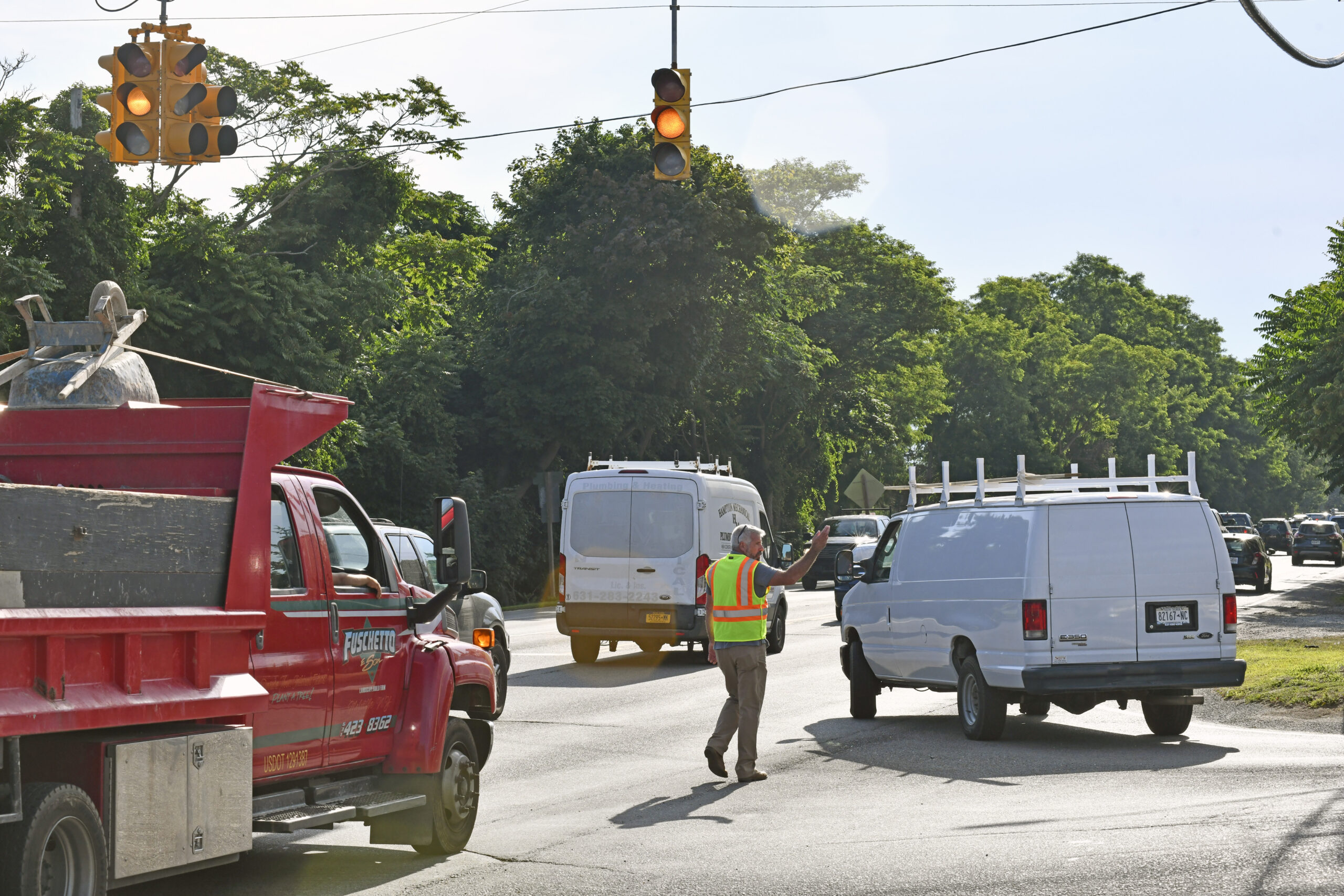
Southampton Town Highway Superintendent Charles McArdle overseeing the short-lived program that set signals at certain intersections to flash yellow during the morning commute.
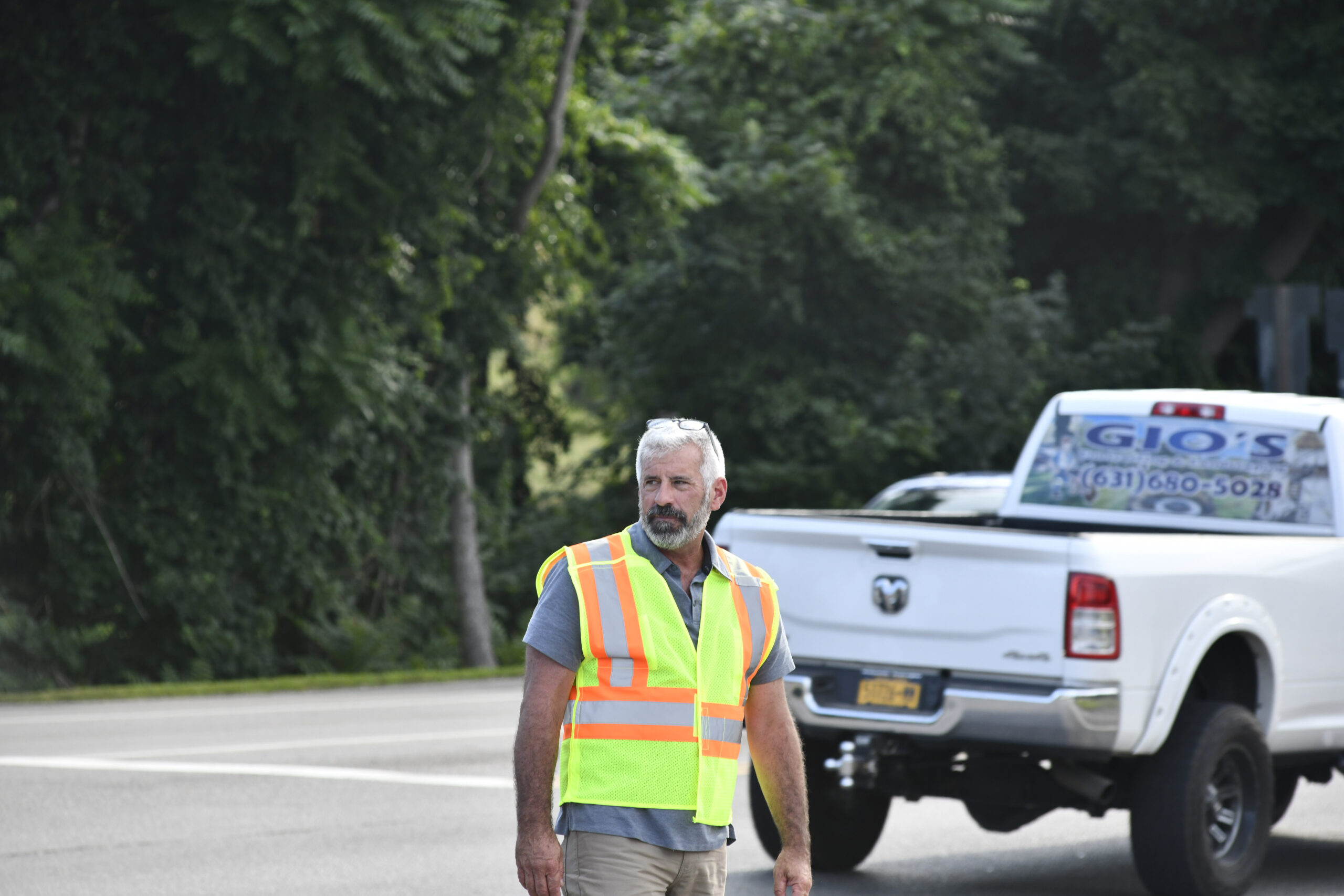
Southampton Town Highway Superintendent Charles McArdle overseeing the short-lived program that set signals at certain intersections to flash yellow during the morning commute.
The scheme employed by Southampton Town Highway Superintendent Charles McArdle was over in the blink … of a yellow light. Or was it?
After an abrupt suspension of the traffic program last week, he reported that as of 3:35 p.m. on Tuesday, Town Police traffic control officers were stationed at St. Andrews Road and Montauk Highway. “They’re blinking the light,” he said of the intersection. He was uncertain as to whether police had taken over the entire program he implemented last week.
On July 18, he was able to get traffic lights on County Road 39, at the Tuckahoe Road and North Main Street intersections in Southampton, plus in Water Mill at Montauk Highway, and on Montauk Highway near St. Andrews Road and the other end of Tuckahoe Road, to flash yellow during the morning commute for east-west traffic. He had designs on an afternoon experiment but wanted to see how the morning plan worked first.
And, although community members posting on social media said the program saved them time, and expressed gratitude for the action, by Wednesday afternoon, July 20, the plug — or key — was pulled.
Southampton Town Police officials, who have a special key to use to change lights, and had lent him one to use for the Canoe Place Road flashing light project in Hampton Bays, took it back.
At Canoe Place Road and Montauk Highway, since June 24, a Highway Department crew has set up barrels and cones to extend the turning lane from Canoe Place Road in Hampton Bays all the way to the bridge spanning Shinnecock Canal. Workers then took up positions on foot near the intersection of Newtown Road and Montauk Highway, and at the merge lane by Spellman’s Marine, to direct traffic if necessary — preventing cars coming south on Newtown from making the U-turn at Canoe Place Road to go east on Montauk Highway. Town Police first implemented the program last summer but, citing staffing shortages, ceased after the season.
Police Chief Steven Skrynecki declined to comment about taking the key back, other than to say, “County Road 39 is a county road, and the police department doesn’t have permission from the county to adjust the lights. We have sought permission in the past and been denied.”
McArdle said last week he was working with the head of the county Highway Department. He didn’t procure a green light from county officials before going ahead and changing the light, but said he’s in talks with county officials and has support from County Executive Steve Bellone.
Bellone’s office did not return a request for comment.
According to State Assemblyman Fred W. Thiele Jr., state highway counterparts said they would not object if town officials used their own key to change the lights to blink yellow in the mornings on their roads — that’s Montauk Highway.
“The DOT is fine with the town doing it. The town has to staff it and take the liability for it,” Thiele said.
By all the anecdotal evidence he’s seen, the light change does seem to help with the grinding morning traffic: “The issue with it always was, it’s not cheap to staff it.”
“The county has to say the same thing and we’ll be back in full force,” McArdle said Tuesday. Every intersection will be staffed and, if there is any issue, can change the lights.
All they need is the key from the police.
“The police have the authority to change the lights,” Southampton Town Supervisor Jay Schneiderman maintained. Highway Department staff can man the intersections, but police have to change the lights.
The supervisor added, “I support the program. Let’s keep things rolling.”
The quest to implement a blinking light program dates back years. Schneiderman recalled, “We’ve been talking about blinking these lights for years.” The idea first surfaced when the U.S. Open took place at Shinnecock Hills Golf Course in 2004.
During the program using cones to add an extra lane to County Road 39, which was completed in 2008, the idea of changing traffic signals along the corridor resurfaced. Then a county legislator, Schneiderman had discovered, several years earlier, that the promised expansion of the congested thoroughfare — widening the road and adding extra lanes — had been pushed off in the capital program presented by then-County Executive Steve Levy.
The original plan looked to condemn portions of commercial properties along the corridor and carried a price tag in excess of $70 million. Forced to come up with an alternative, Levy had the road redesigned to avoid condemnations, and the project came in at $15 million. A second expansion, the continuation of the extra eastbound lane to the 1.5-mile stretch between North Sea Road and Montauk Highway lanes, was subsequently added.
Meanwhile, another experiment — removing the restriction on turns onto Shrubland Road — began on July 14, and is slated to conclude this week.
During the three days of the blinking light trial, McArdle reported little to no additional traffic on Shrubland. On Tuesday, July 26, he weighed in again, answering the question of whether the traffic increased on the back road: “Shrubland is a ghost town … all you hear is crickets.”


