


 1 Photo
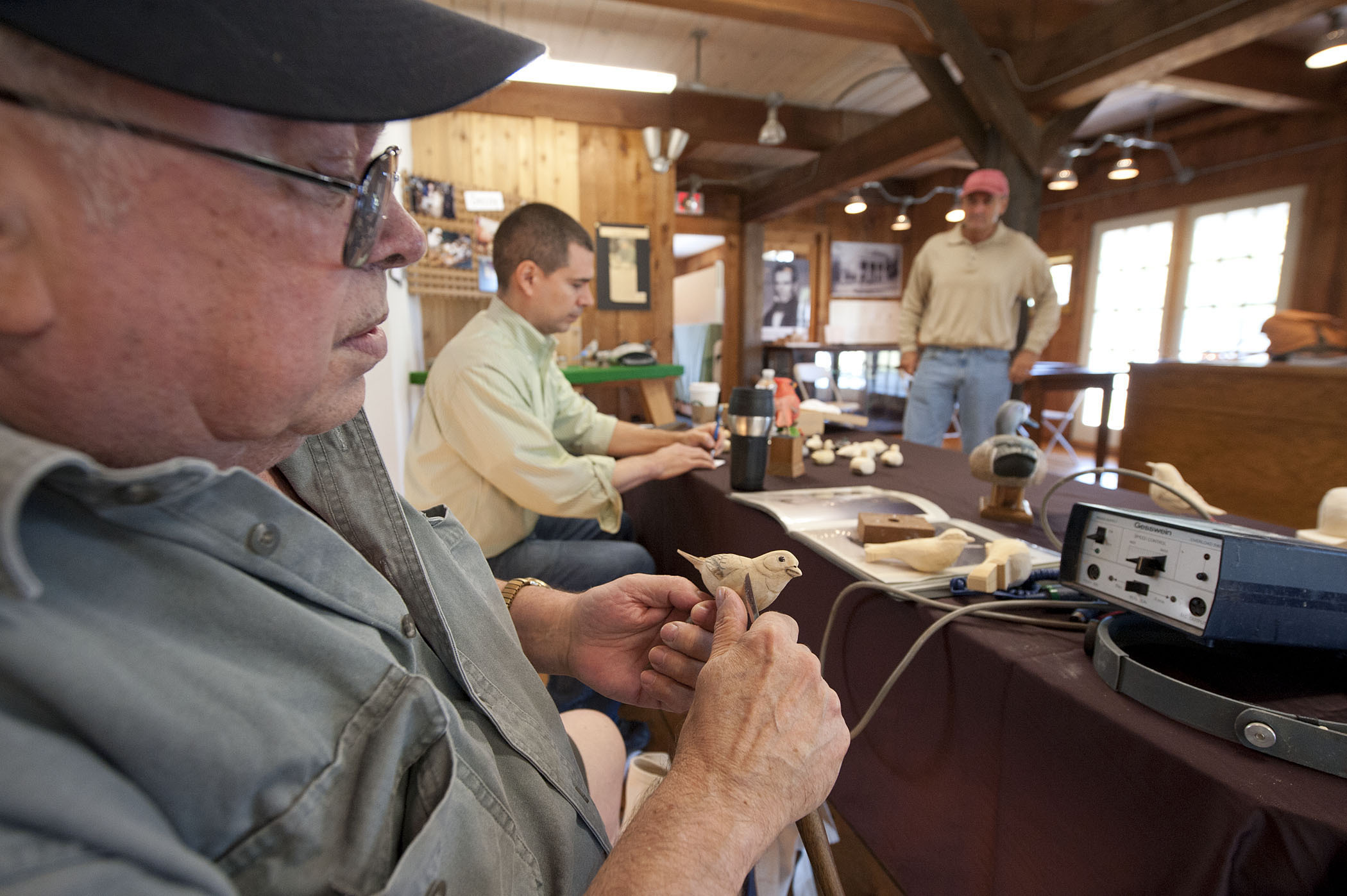
Bob Hand hand-carves a small bird during a demonstration of decoy-carving at the Bridgehampton Historical Society Archives Building in 2012. MICHAEL HELLER
Every afternoon, like clockwork, Robert Hand Sr. could be found relaxing at his kitchen table in Sag Harbor, watching the birds through the window.
He knew them all. For the renowned decoy carver, they were his friends, his muses, his inspiration — and, in turn, he was their biggest fan.
But in recent weeks, the birds have gone without an audience. Mr. Hand died on January 11 after a cardiopulmonary arrest due to COVID-19 pneumonia at Stony Brook Southampton Hospital, according to his eldest son, Robert Hand Jr. He was 77.
“If you want to know anything about my dad, the most important thing is he made us men,” his younger son, Tom Hand, said. “He didn’t make us perfect men that wouldn’t make mistakes, but he made really good men out of me and my brother. And he was just an awesome artist.”
Known locally for his unassuming shop, and his home behind it, on the corner of Madison Street and Jermain Avenue, Mr. Hand’s reputation as a master carver eclipsed the bounds of Sag Harbor and even the East End. His meticulous attention to detail and prolific craftsmanship garnered nationwide recognition — as did his personality.
He was colorful, bold, straight-forward and loved a good prank. His demeanor was stern, yet approachable, and he came into his own as a natural mentor and teacher to those who asked. He didn’t have a pretentious bone in his body, Robert Hand Jr. said, and above all else, he was a “character” — in the purest sense of the word.
“He really was — that, I don’t think you’d find anybody to argue with,” he said with a soft laugh. “He had a mischievous sense of humor, a natural with one-liners. Whether politically correct or not, they would just flow. He always really enjoyed laughing.”
Robert Francis Hand was born on August 10, 1943, into three generations of potato farming in Bridgehampton. He grew up hunting and fishing, and by age 7 or 8, he could identify every songbird he saw. At age 15, he had taught himself how to carve rudimentary duck decoys — having practiced with a whittling knife since he was old enough to hold one.
“The first ones were crude; he didn’t have the right tools for the job or anything,” Robert Hand Jr. said of the early decoys. “But he evolved, he stuck with it, and became one of the best.”
After serving four years in the U.S. Marine Corps, Mr. Hand left the potato business when his grandfather and father died within three weeks of each other, and pivoted toward carpentry and furniture repair — with, naturally, decoy carving on the side.
“This is someone who, basically, got a GED while he was in the Marines, no college, no nothing — but just using his wits, his own natural ability, had so many different things to make a living,” Robert Hand Jr. said. “And while he never made millions, he fed his family, he kept a roof over our heads and built quite a reputation for himself as a fixture out in Sag Harbor.”
Over the course of his carving career, which spanned four decades, Mr. Hand sold more than 2,000 decoys duplicating hundreds of species of birds, from songbirds to waterfowl to birds of prey. Each was an exercise in precision and creativity — a balance that he taught to his eldest son, who made his first piece, a cork black duck, in the mid-1970s at age 9.
“I think he was a generous teacher and enjoyed passing his craft on,” Robert Hand Jr. said. “He was so committed to our success. He was a taskmaster, he had high standards. He wanted us all to be our best.”
Today, the Hand family decoys live in private collections and natural history museums around the world. At the height of their carving practice, the father and son would compete at virtually every regional and national competition around the country — consistently taking home win after win, according to fellow carver and longtime friend Dick Clark.
“Bob was a great carver, he really was. He knew a lot of people and a lot of people liked him. If he liked the guy, he liked him. And if he didn’t, he’d tell him so,” he said. “So if a judge gave him a second, when his bird was clearly the better bird, that judge heard all about it. He was a huge asset to carving in this whole eastern community — and all over.”
A younger Mr. Clark first met the master carver 41 years ago, to be exact. The burgeoning artist had recently turned 16 and, free to drive where he pleased, decided to pay Mr. Hand a visit, gifts in hand.
“I went and I brought him a couple of rabbits — because he loved rabbit, someone told me — and I said, ‘Can you teach me how to carve?’” Mr. Clark recalled. “And he looked at me and just started laughing. And then we became the best of friends.”
This was not an unusual occurrence at his childhood household, said Robert Hand Jr., whose memories are dotted with customers, students and curious passersby stopping in at all hours of the day and night for a chat, a beer, a purchase, or a lesson.
“He had, over the years, taught many people how to carve,” he said. “His shop, off and on, was a bit of a gathering place for friends and other people carving, or hunters and fishermen. He was an outdoorsman. You could walk in the shop at 10 o’clock in the morning and there could be two people there with paper cups of coffee, BS-ing with my dad while he was painting on a decoy.”
Mr. Hand lived his life by a true open-door policy — quite literally. Whenever he left his shop, he would turn the hand-written “Open” sign, hanging on the door by a string, to “In House Around Back,” complete with an arrow.
“It’s not pretentious, like ‘Call for Appointments.’ It’s like, ‘No, I’m in the house around back,’” Robert Hand Jr. said. “And I would always joke with him, like, ‘Dad, people don’t want to bother you! No one’s gonna want to come around the back and bother you.’ And he’d just be sitting on the couch, having a beer, watching television, and someone would come and he’d go, ‘Hey, alright!’ And he’d get up and take them out into the shop, and that’s how it would go.”
The carver’s history with the house and storefront dates back to the early 1970s, when Mr. Hand was a tenant in the apartment upstairs, installing shingles in exchange for rent. That is when he first crossed paths with Lauren Schellinger — who was, then, 11 years old.
“He was very friendly with me and my sisters and my brother, so we would rush home from school so we could joke around with him,” she recalled. “He was good with kids.”
In due time, Mr. Hand would move his carving business into the storefront and marry Ms. Schellinger’s mother, Frances, who survives him, as do his daughter-in-law, Amy Hand, four additional stepchildren — Sharon Adam, Rhonda Cunha, Cherryl Cunha and Anthony Cunha — and his four grandchildren, Nat, Kat, Samantha and Jordan Hand. A fifth stepchild, Manuel Cunha Jr., predeceased him.
“Bob and my mother were two peas in a pod,” Ms. Schellinger said, noting that Ms. Hand is currently battling COVID-19. “When she goes, she told me she wants them to be buried together. My mother and Bob, they got it right. They stayed together for over 30 years.”
Most nights, Mr. Hand would cook a meal for them, relying on game he hunted, fish he caught, or a combination of the two that his friends routinely delivered. He wasn’t afraid to get innovative, once building a smoker to make goose breast jerky, Ms. Schellinger said, and he even taught himself how to make pickled herring.
After dinner, they would play old records and dance in the living room — which is Tom Hand’s favorite memory of the couple.
“I would love to see that again. I miss seeing those two happy,” he said. “Fran and my dad were one. She is him, and he is her. They had that, they found each other. They found the perfect match.”
After Ms. Hand suffered a stroke in 2010, Ms. Schellinger stepped in as a caretaker alongside her stepdad, who would thank her with carved birds, mostly gifting them on holidays. She keeps them in a display case at her home in Sag Harbor — a cardinal and a sandpiper, an owl, four shorebirds and “some little Tweetie birds.”
“I told him he needed to put the names underneath them, because I couldn’t remember the names of them all,” she said. “If you pointed out a bird to him, he knew exactly what kind of bird it was, how they nested, anything that had to do with it, especially shorebirds and ducks. He knew his stuff.”
This time of year, Mr. Clark — who works full-time in landscaping — would normally be visiting Mr. Hand every day at the shop, though the carver did step back from his business after receiving a grim chronic obstructive pulmonary disease diagnosis.
“Really, this is ‘Bob time’ for me. It’s a big loss,” Mr. Clark said. “When I was younger, his favorite word was ‘perseverance.’ He would walk you through it a little bit, but he made you do it. He’d draw five feathers on the side of the bird and say, ‘Here, you finish it.’ That’s how you learn, you know?”
A lifelong student himself, Mr. Hand went through phases and constantly picked up new hobbies — from photography to voraciously reading history to earning his captain’s license and running a 29-foot charter boat, which he appropriately named “The Decoy,” in the 1990s.
Mr. Clark owns that boat now, which he keeps near his home on Shelter Island to use with his own son. “That was a great part of his life,” he said. “He made all his own rods. He was proud of it.”
A memorial for Mr. Hand will be held at a later date, said Tom Hand, who will forever remember his father as the complex, multi-dimensional man who impacted so many.
“He’s a legend, and he had both sides of the spectrum,” he said. “He could be the toughest person you’d ever want to see, or he could be the most gentle guy and say, ‘Look at this bird. Look at this pretty little bird.’
“There was only one of him,” he continued. “There wasn’t a mold, somebody free-handed him. He had it all and I took it all in. I will miss everything — the back and forth with the jokes, and his smile, and seeing him happy. Seeing him happy with Fran.”


 Michelle Trauring on Feb 3, 2021