


 1 Photo
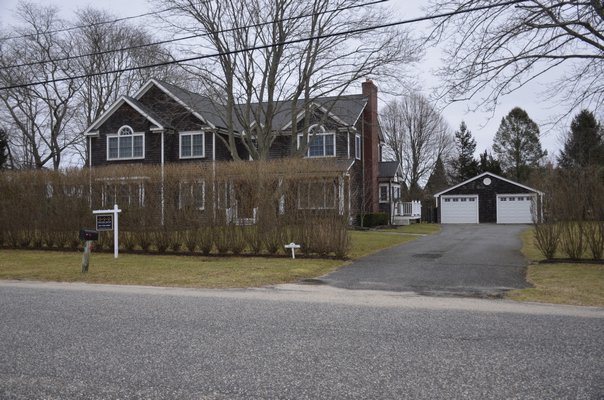
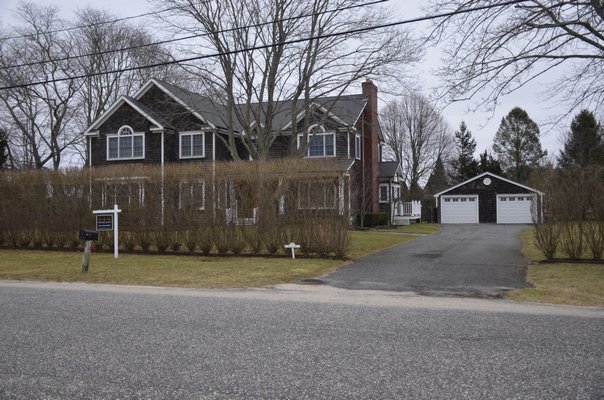
Southampton School District residents will vote on May 15, whether to allow district officials to purchase 50 Narrow Lane for the purpose of administrative officies. GREG WEHNER
Low attendance at a handful of public forums and concerns about “misinformation” in paid advertisements and letters to the editor of The Press that were critical of a $5.2 million plan to purchase a Southampton Village home and convert it into administration offices have Southampton School District officials scrambling to get their message out to registered voters before the plan is voted on next week.
Dr. Nicholas Dyno, the superintendent of the Southampton School District, said the letters and advertisements urging voters to reject the district’s plan have contained inaccurate information.
“I’m disheartened about the neighbors’ comments, because I think what’s being put out there are untruths and misinformation that are misleading in many ways,” Dr. Dyno said last Thursday, May 3.
To address the critics, Dr. Dyno and members of the School Board have held multiple public forums over the past two weeks. Despite staggering the times and locations of the meetings to try to accommodate as many people as possible, attendance has been low at times, and the crowds have rarely included parents of students in the district.
A copy of the presentation was placed on the district’s website, but Dr. Dyno said he still worries that false information will prevail.
The district is in contract to purchase the property at 50 Narrow Lane, near the high school, for nearly $2.3 million from John Pace Jr. and Donna Marie Pace. School Board members approved the agreement in February and put down a $115,000 deposit, which is refundable if voters reject the purchase as part of the regular budget vote and school board elections on Tuesday, May 15.
Voting will take place from 10 a.m. to 9 p.m., at the Southampton Intermediate School music room.
On top of the $2.3 million, district officials are proposing to spend an additional $2.9 million to renovate the house into an office building, making the total cost $5.2 million. The renovations include filling in a backyard pool and creating an addition—which in some areas will be two stories—between the home and the garage. It would include office space and an elevator to ensure the office is compliant with the Americans with Disabilities Act.
The conversion also entails gutting and refitting the house for offices, paving parking spaces, and installing new HVAC and sanitation systems. The total cost includes legal fees, consulting fees, engineering fees and planning services.
Once renovated, the 4,000-square-foot residence will be a 7,200-square-foot office building.
The purchase and renovation would be paid for with money set aside in a 10-year capital reserve fund, currently totaling about $8 million, so the project would have no direct impact on district residents’ tax bills. But the money in the capital fund cannot be spent on the project without the approval of voters in a referendum.
Dr. Dyno said talks of moving the administrative staff, which include 22 paid employees, into a new district office began years ago, when the current offices—located in temporary classroom structures, which were designed for only a few years of use, but have been used for nearly a half century—began to deteriorate.
In 2012, the School Board began looking at the possibility of building a 17,000-square-foot, two-story building with a basement on the northwest corner of the high school ball fields, near the intermediate school parking lot. To build on that particular location, Dr. Dyno said, two baseball fields and two soccer fields would have had to be moved and shrunk, which could affect their use.
After several public meetings on the topic, School Board members chose not to present the nearly $8 million option to the public for a vote, because talks of a merger with Tuckahoe School District were taking place, and the move might have created more space. The merger was eventually rejected by voters.
In 2015, School Board members looked at four options: finding available space within the district, building a new structure on the current site, leasing office space, and purchasing an existing structure in Southampton.
The key criteria that was considered by district officials was that the size of the building needed to be 17,000 square feet, close to the schools and ADA-compliant, and the construction disruption had to be kept to a minimum. District officials also evaluated factors such as the cost of leasing space during construction, architects, engineers, landscapers and furnishings, and financial flexibility.
The final proposal then was to purchase an office building on Hampton Road for $7.75 million. But district voters rejected the purchase.
In October 2017, board members sought input from the public and asked about properties for sale that were in close proximity to the schools and had approximately an acre of land. Nearly 50 sites were submitted to the district—a number that was quickly narrowed down to 20.
After closely evaluating the sites, the district narrowed them to three: 97 North Sea Road, 200 North Sea Road, and 50 Narrow Lane. The district also looked at a property at 120 Leland Lane, but it was taken off the market when the owner reached a deal.
Of the final three properties, Dr. Dyno said, board members settled on the Narrow Lane home because of its close proximity to the school. The two properties on North Sea Road were far enough from campus that they feared that, with heavy seasonal traffic, travel between the office and the schools could take between 20 and 30 minutes.
This time around, like in 2015, board members looked at other options, like building on the existing footprint, constructing a modular administration building on the current footprint, and purchasing a property.
If the district were to build on the existing property, Dr. Dyno said, it would cost $5,467,198, but the district would also need to lease office space for administrators for three years, at a cost of $420,000 bringing the total to $5,887,198. The building would be 9,063 square feet and include a basement.
Dr. Dyno said the cost of building a modular administration building on a triangular piece of property would be $5,195,939, and, again, the district would have to lease space for three years at $420,000, bringing the cost to $5,615,939.
Rather than purchase a new building, Dr. Dyno said, the district could lease space—but the capital reserve fund could not be used, and taxes would go up. “The money for rental of space has to come from the operating budget,” he said. “In turn, it would increase the budget each year, which increases the taxes—and the reserve still sits there.”
That left the option of purchasing on Narrow Lane.
“It’s not only the least expensive, it’s the smartest investment for the school district,” School Board member Anastasia Gavalas said last week.
As far as the money from the capital reserve fund, Dr. Dyno said the only other way the money could be spent would be to reduce the district’s $29 million debt. If there was any money left over, voters would be able to decide which reserve to put the money into.
Residents have expressed concern that putting the administrative offices at on Narrow Lane would increase traffic and decrease property values in the neighborhood.
School Board member Jackie Robinson said neighbors should be happy with the plan, adding that the offices will not be open on weekends, there won’t be parties at the property, and the offices won’t stay open late.
“What better neighbor in the Hamptons can you get?” she added.
Dr. Dyno said he did not expect traffic to increase. Currently, Leland Lane is a transient neighborhood, with the high school and the fire station on the corner of Narrow Lane. He said it is rare during the day that the district office gets double-digit numbers of visitors, unless there is a special education meeting.
To get to the point of putting the plan to a vote, Ms. Gavalas said the board has been very transparent, adding it would be a shame if voters reject the proposal. “It’s fiscally responsible,” she said. “It’s the smartest investment.”


 Greg Wehner on May 9, 2018