


 3 Photos
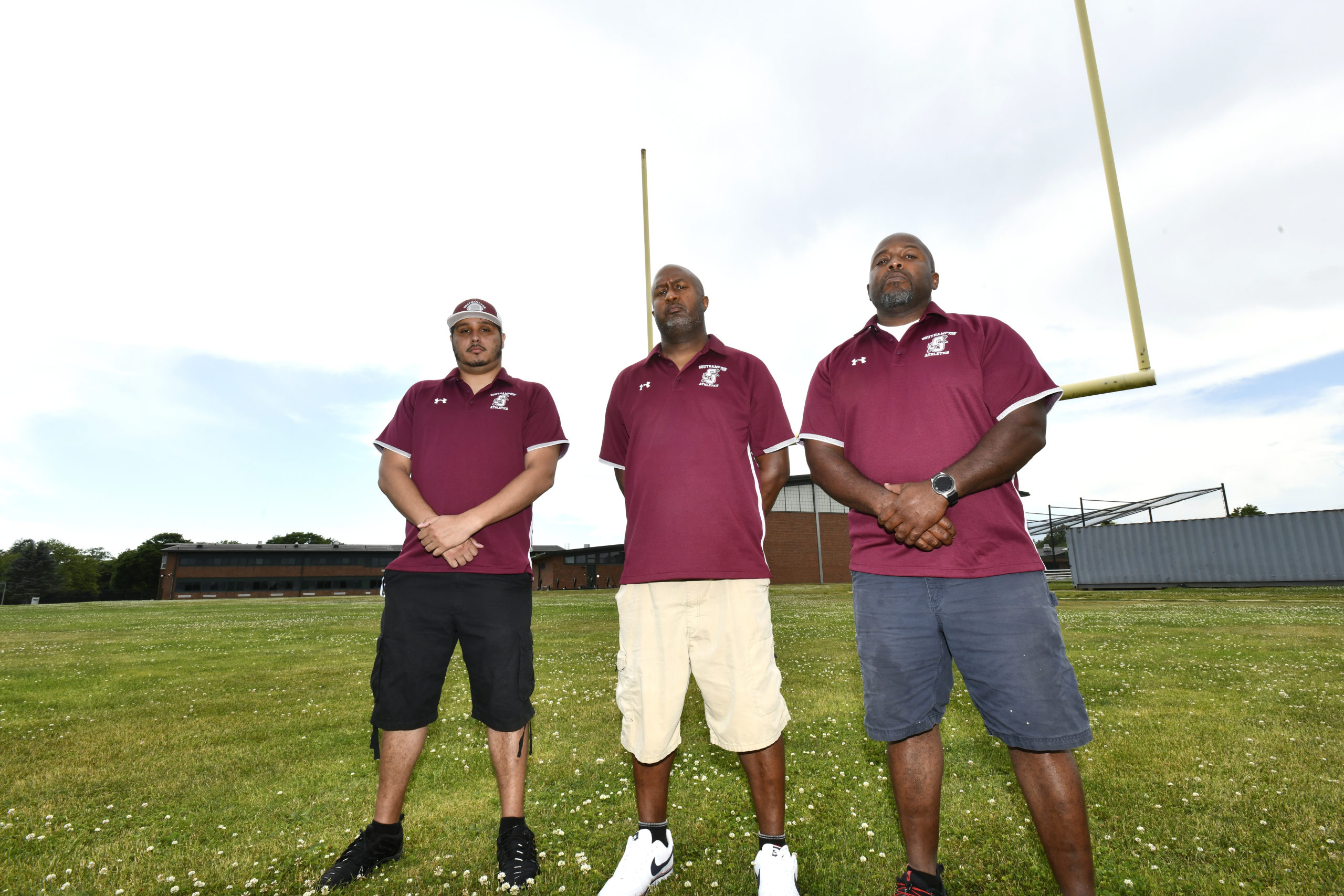
Southampton Football Coach Chris Campbell, center, with assistant coaches Shawn Smith and Eddie West. DANA SHAW
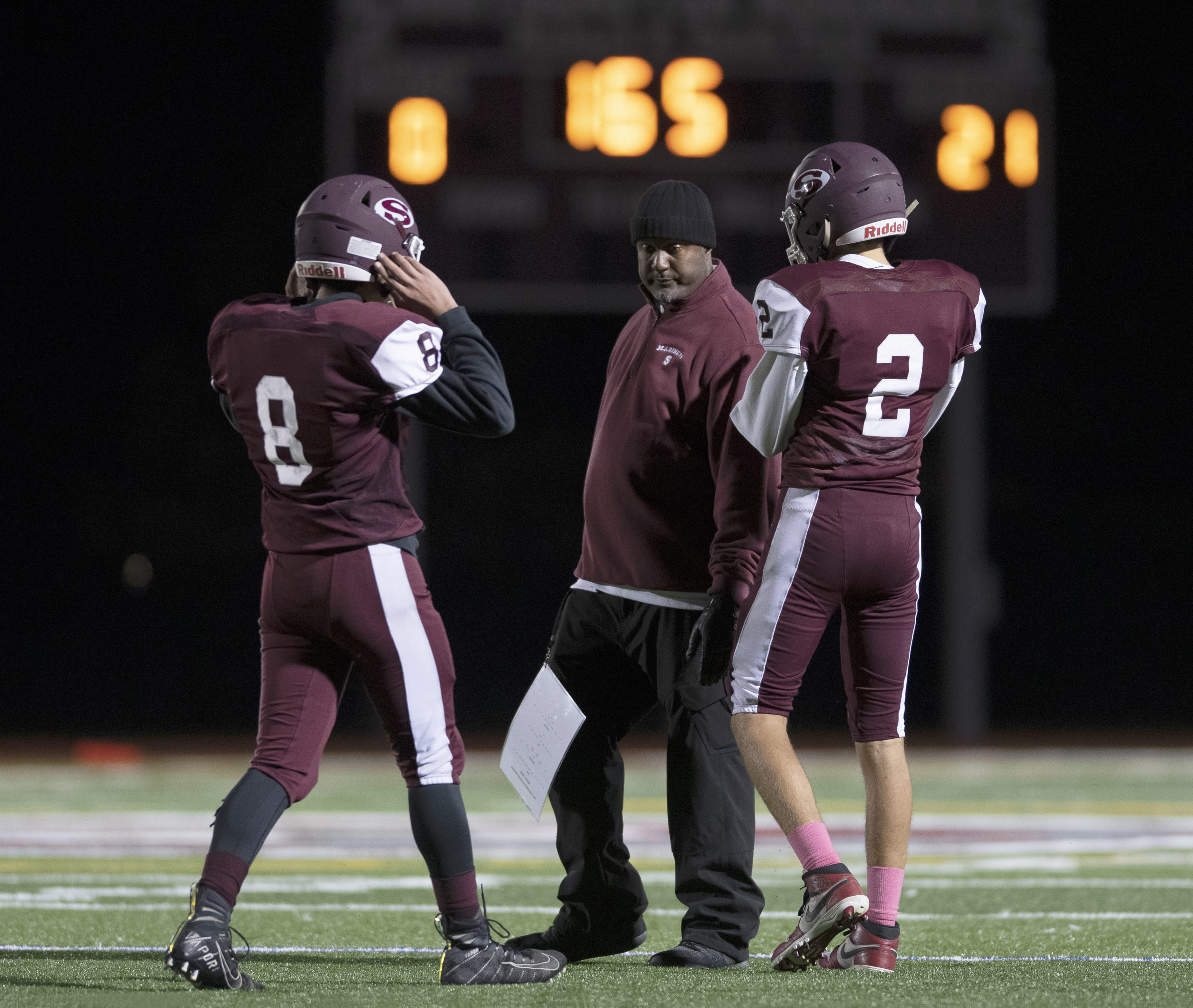
Southampton Football Coach Chris Campbell. PRESS FILE
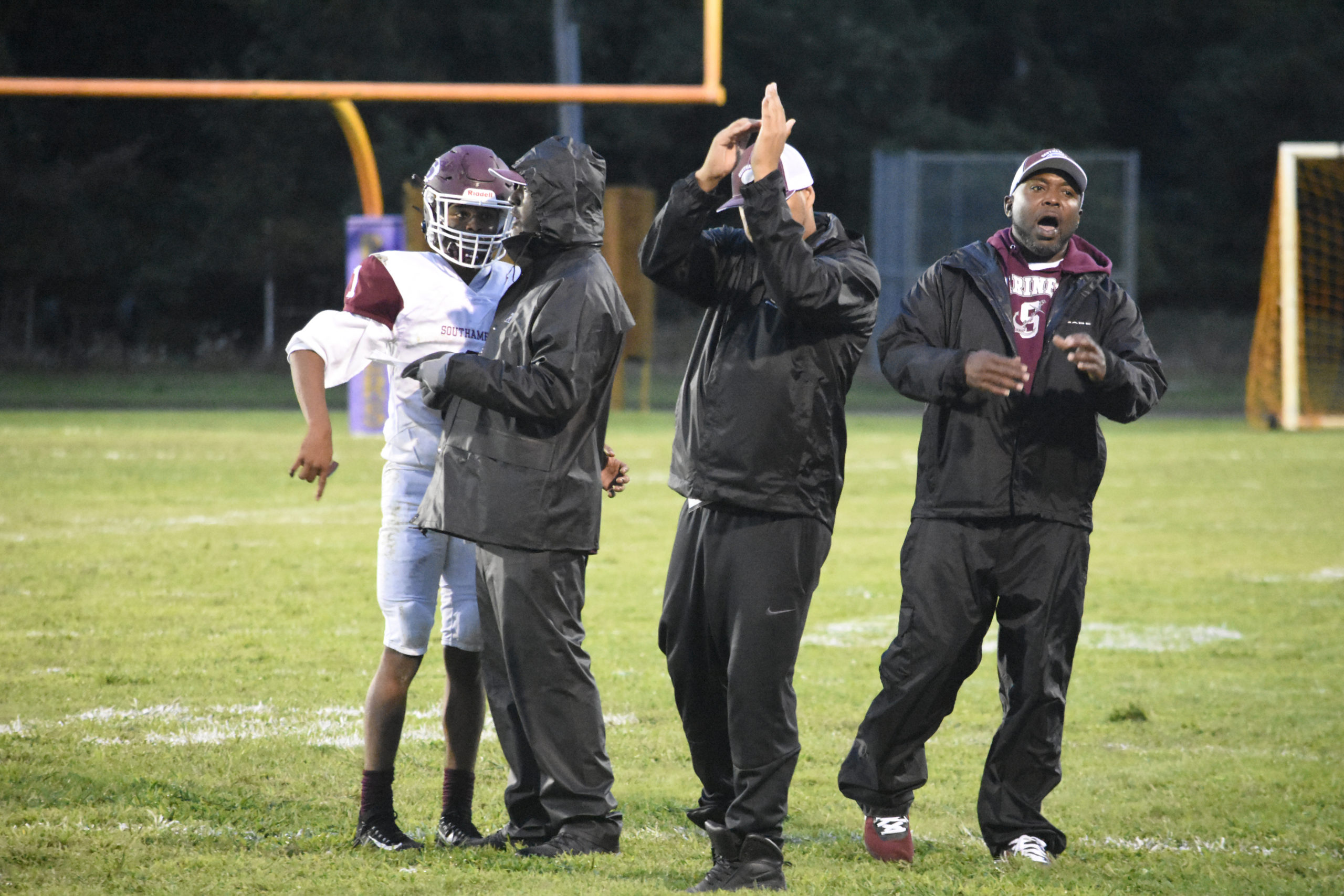
The Southampton coaches at a November 2019 game. PRESS FILE
Complaints about referees are commonplace among fans and coaches of teams in just about any sport. And when a season goes poorly, as it did for the Southampton Mariners football team last year, those complaints might get a little louder.
But Coach Chris Campbell and his two assistants, Shawn Smith and Eddie West, say the situation that unfolded when their outmatched Mariner squad took on Bayport-Blue Point last October 25 crossed the line. They say it went from simple disagreements over the calls to what appeared to be racial bias on the part of the referees.
Furthermore, they say their subsequent efforts to meet with the officials to discuss the situation has been ignored by Section XI, the governing body for high school sports in Suffolk County.
Coach Campbell, whose team finished 2-6 in his inaugural campaign, said the Bayport game, a 40-6 loss, would have likely been shrugged off as an unpleasant experience, if not for the spotlight that recently has been shone on race relations in this country following the killing of George Floyd by Minneapolis police last month.
“We were talking about it,” he said of his fellow coaches, “and just thought it should not be forgotten about, especially in light of what’s going on around the country.”
Section XI Executive Director Thomas Combs and Mickey Kane, the president of the Suffolk County Football Officials Association, both vehemently denied there was any racial bias exhibited by the officials, or that they had ignored the request of Coach Campbell and the athletic director, Darren Phillips, to hold a meeting to discuss the matter
Coach Campbell said before the start of the Friday night game on October 25, 2019, he and the head official chatted about the high quality of Southampton’s artificial turf field — and he joked that his players had become well-accustomed to the feel of it during the disappointing season.
Before the game, the head official is supposed to give a card with the all of the officials’ names to the coach of each team, so they can grade them on their performance. They also address both teams about sportsmanship and safety.
But the officials did not have that meeting with the Mariners or give the coaches the card, according to Campbell.
“The pre-game meeting is like getting up and brushing your teeth,” he said. “You always do it.”
But he said Southampton security staff and members of his team saw the officials talking to the Bayport-Blue Point team near their locker room before the game — and that whatever they were saying had the team fired up.
“They said those kids were riled up, and the pregame speech is not a pump-up speech,” he said.
The game became chippy early on, with numerous penalties, including personal fouls for unsportsmanlike conduct, being called. Southampton coaches acknowledged that their players committed their share of penalties, but they could see their players growing frustrated as the game wore on by what they said was a clear pattern of harsh treatment by the officials.
Coach Smith said early in the game a Bayport player pushed Southampton quarterback Dakoda Smith’s head into the turf after a tackle. He said Smith tried to bring it to the referee’s attention, as players are instructed to do, “but he didn’t want to hear it.”
After an incomplete pass, the Southampton receiver and Bayport defender exchanged words, and Smith said the official grabbed the Mariner player, who is Native American, roughly by the front of his jersey and reprimanded him.
Coach Smith said he told the referee not touch his players — and he responded: “Show me in the rulebook where it says I can’t touch him.”
Another Native American Southampton player, who tripped a Bayport receiver in the end zone, was called instead for the more serious foul of intentionally kicking him, which resulted in his ejection from the game.
Eventually, three Southampton players were tossed, and also were therefore ineligible for the team’s season finale against Port Jefferson. Their unavailability and injuries forced the team to forfeit that game.
Two of the players ejected were Native American and the third was white. Campbell said, ironically, the white player was flagged for head-to-head contact, the most serious foul, but was not told he had to leave that game. The coaches only learned later that he had been disqualified for the final game when Section XI sent a notice to Phillips listing the players who would not be allowed to play the following week.
But Campbell and his assistants, one of whom is Black and the other is Native American, Black and white, said it was not just the calls but the way the officials treated them and their players that upset them.
One official, in particular, continually chastised Southampton players for cheering on the sidelines and warned the coaches about their behavior, they said. “Your players are uncontrollable,” the referee said on more than on occasion, according to Campbell.
“When you have a group of kids like we have — we have a lot of minority kids — and Bayport-Blue Point does not have a lot of minority kids, it kind of hurts to see how our kids were treated,” West said.
“This is not about a win or a loss in a high school football game,” said Smith. “It’s bigger than that.”
He said the official on the Southampton side of the field berated him from the beginning of the game. “The first time I stepped on the field three minutes into the game, he said, ‘Get off the field. I’m not going to tell you again.’” The coaches said that while staff and players are supposed to stay off the field during play, coaches routinely step out to speak to officials.
“There was never a conversation,” Smith continued. “Any time they spoke to us, it was talking down to us.”
“It was an ugly game in a lot of ways,” said Phillips, who joined the coaches on the sidelines for the second half. He said his presence may have helped calm things down when the clock was kept running to shorten the game, but he said he witnessed the officials being “dismissive” to the concerns raised by the coaches.
Phillips directed the coaching staff to write up their view of the game and the officiating in a report, which he sent to Section XI
Combs, of Section XI, acknowledged receipt of that report, which he said was in turn forwarded to the officials organization.
“They called in the crew that was accused of dealing with the kids in an unfair manner,” he said of the officials association. “After hearing everything and listening to what they had to say, they felt there was no basis to the accusation.”
He denied that Phillips ever sought a meeting to clear the air but said it would have been easier to arrange if the request came soon after the game and not nearly eight months later.
But Phillips provided a copy of an email exchange from November 14 — two weeks after the game — with Pete Bleiberg, the assistant executive director of Section XI. Phillips, noting he was following up on an earlier conversation, asked, “Is there any way to set up a meeting with them, or even 1 or 2, I realize it would be hard to get the entire crew?”
Blieberg replied, “I will speak with their leadership, but I know the answer will be no, but I’ll ask and get back to you.”
According to Phillips, he never got a response, and the matter was dropped until Campbell brought it up again earlier this month. “It feels like they are stonewalling us,” he said.
Combs also said that he believed the officials did give the pregame talk to both teams. He said he had been told a Bayport coach had said the officials spoke to his team before crossing the field and addressing the Southampton squad.
Combs added that officials said they had provided the name card to the Mariner coaches as required.
This week, Campbell said Combs was wrong on both accounts.
“They did not speak to my team and they did not give me their card,” he insisted.
Kane, the head of the referees association, said the organization had reviewed the report submitted by Southampton and concluded that there was no case for bias. He said he did not know if film was reviewed or if any outside sources were interviewed.
He said it was common for coaches to complain about the officiating. “It’s always the referee’s fault,” he said. “Blame it on the referee instead of controlling your own players.”
But he insisted that the association would not tolerate racial bias among its officials. “I won’t even comment on that,” he said, saying it was ridiculous to even suggest the referees might be biased.
Campbell this week said he was frustrated by the entire affair. “This is not something we just jumped on now,” he said. “We did everything we were supposed to do the very next work day.”
With the coronavirus still about, and whether there will even be a football season up in the air, Campbell said he was certain of one thing: “I don’t want to go on the field if we have to deal with those same officials.”


 Stephen J. Kotz on Jun 29, 2020