


 1 Photo
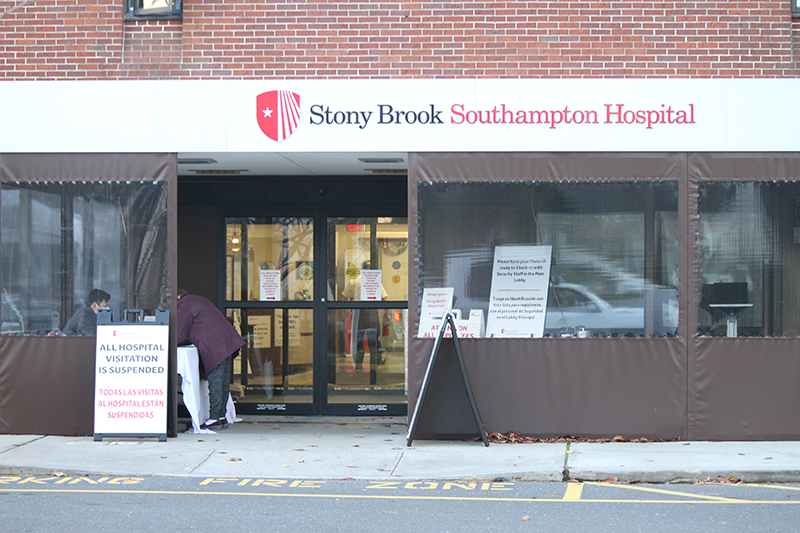
Stony Brook Southampton Hospital.
Stony Brook Southampton Hospital has treated no patients for symptoms of COVID-19 over the past week — the first time it’s coronavirus isolation beds have been empty since August 5, 2021.
That’s despite a small but steady uptick in the numbers of new cases being recorded around Suffolk County, including at the hospital’s own testing facilities.
The head of the hospital’s medical team said that vaccinations and other preventative practices, effective treatments for outpatients, and the natural immunity of those who have contracted the virus in recent months are all combining to keep severe cases in check, even as the most contagious strain of the virus yet has become the dominant variant in newly identified cases.
The hospital has not admitted a patient specifically to be treated for symptoms of COVID-19 since April 5, and has not had a patient admitted for other reasons test positive since April 8, according to online data from the State Department of Health.
But new cases COVID-19 are still popping up and Dr. Fredric Weinbaum, the hospital’s chief medical officer, said that the positivity rates the hospital is seeing at its testing site — about 4 percent — do indicate that there is “community spread” happening once again, as a new sub-variant known as BA.2 has become the dominant strain and proven even more easily spread than the original BA.1 omicron variant that drove the record numbers of new cases over the past winter.
It is also widely assumed that the actual number of new cases is much higher than is being recorded officially, since many people are presumed to be contracting the virus and taking at-home tests, or simply staying home and weathering mild symptoms rather than bothering with PCR tests at official testing sites.
East Hampton Town and Southampton Town have both recorded upticks in their daily numbers of new cases, Southampton now posting about six new cases each day and East Hampton about eight.
Weinbaum said that the South Fork has benefited from a very high vaccination rate among local residents and that advancements in treating COVID-positive people on an outpatient basis have kept hospitalizations at a minimum, both through the enormous surges in cases over the winter and now.
Vaccines and the boosters — a second of which is now recommended for anyone over 50 years old — have greatly reduced the numbers of elderly and immunocompromised people who have fallen severely ill from coronavirus infections.
Treatment with monoclonal antibodies and new oral medication known as Paxlovid, that is available at pharmacies, has also proven to be very effective at keeping the progression of symptoms in check.
“We can test and we can treat, and that has resulted in a 90 percent or greater reduction in hospitalizations,” Dr. Weinbaum said this week.
The hospital is still running vaccination clinics, offering both initial vaccinations and first and second boosters, every Wednesday in Parrish Memorial Hall on Herrick Road. Appointments can be made on the Stony Brook Southampton Hospital website, southampton.stonybrookmedicine.edu or by calling 631-726-8388.
The COVID-19 vaccines, Weinbaum said, are very likely to become something that will be required annually, just like with the flu, as the new coronavirus becomes endemic nationwide. As with the flu vaccine, he said, the purpose of the COVID vaccine will ultimately not be to block all infections, but to reduce their severity and prevent hospitalizations and deaths among those who contract the virus.
Another parallel between the evolution of the COVID-19 pandemic and that of flu: masks work. Weinbaum said that cases of the flu had largely faded out over the winter as the surge in COVID-19 drove people to be more vigilant about wearing masks in public. When mask mandates were lifted in February, flu cases jumped up again.
“It is estimated that between vaccination and infection, there is now some degree of immunity in at least 80 percent of the population nationwide,” he said. “All that is good for a future in which we’re going to be able to live with the virus just like any other respiratory virus. But it’s going to require an ongoing commitment.”


 Michael Wright on Apr 13, 2022