


 3 Photos
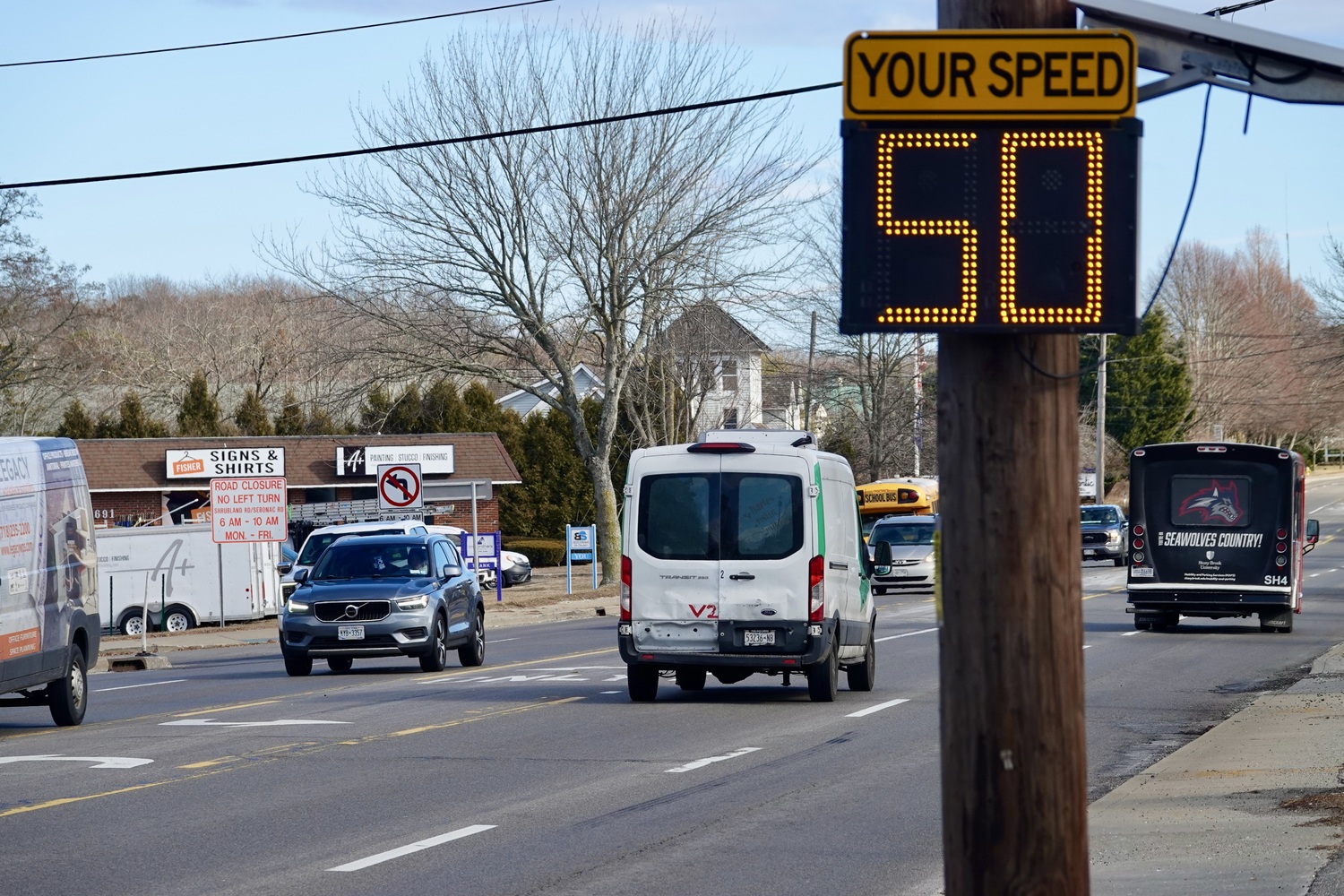
Southampton Town Police are embarking on a campaign to rein in speeding on County Road 39, which residents and business owners say has made the road terrifying to access. MICHAEL WRIGHT
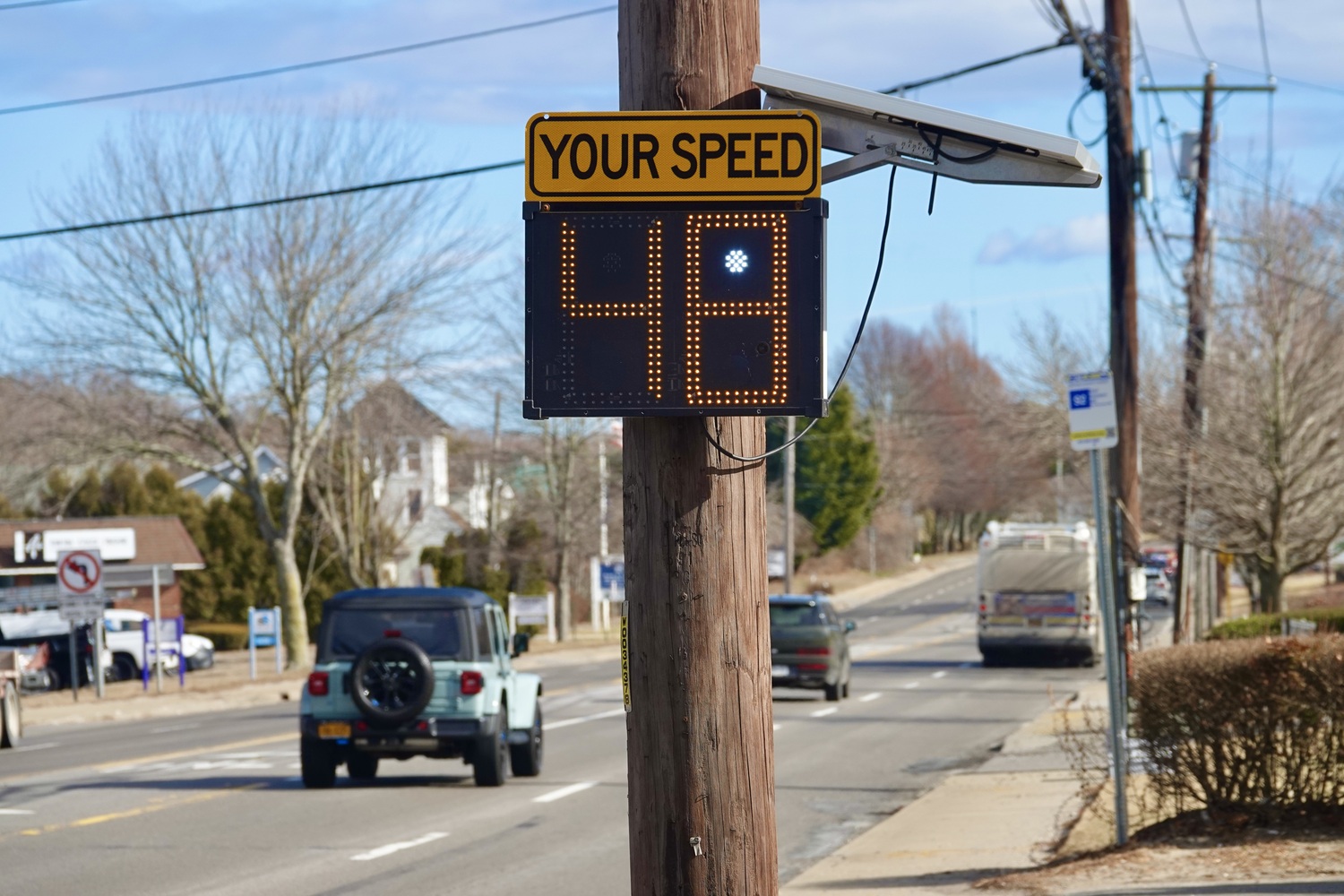
A new speed monitoring sign mounted on the eastbound lane has already shown some improvement in speeds, Councilman Michael Iasilli said he has been told by some constituents. MICHAEL WRIGHT
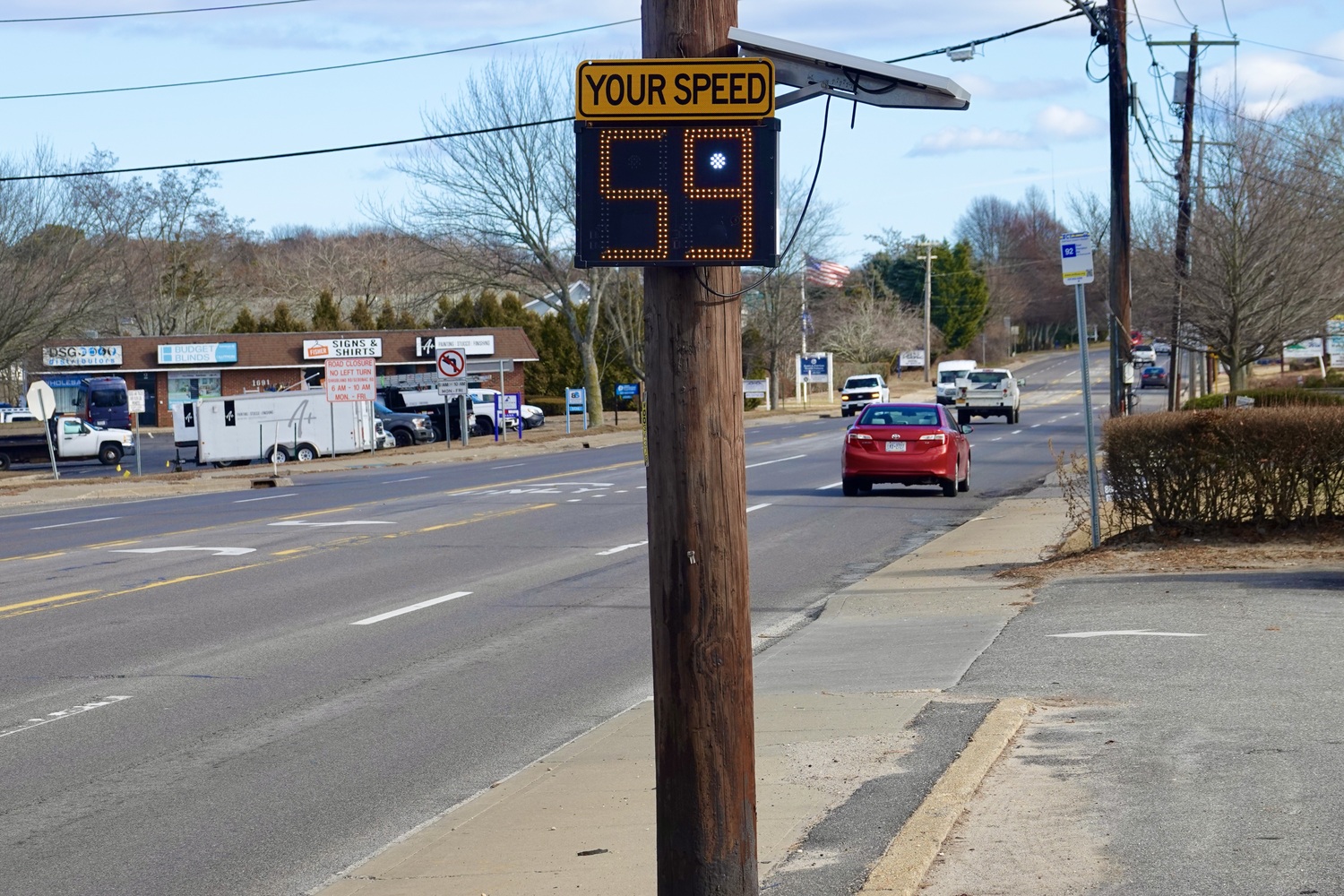
Police Chief James Kiernan said that speed monitoring devices have license plate readers in them and that police will use the technology to track down chronic speeders. MICHAEL WRIGHT
Southampton Town Police are beginning a major push to rein in speeding and improve safety along County Road 39 that will employ new strategies and technologies, like car-tracking drones, teams of police officers stalking speeders and the use of “pace cars” to train motorists to drive slower.
As complaints have mounted from residents of neighborhoods that spur off one of the most infamously over-burdened roads in Suffolk County about the daily fears for their safety while running basic errands, Southampton Town Police Chief James Kiernan said that he has been searching for strategies on how to make the road safer.
Speeding in the hours between the morning and evening gridlock is at the top of the list, since it drives much of the dangers of turning into and off the roadway for residents and the employees and patrons of hundreds of businesses.
“That road, when you get beyond the rush-hour times, it is a wide road, and drivers can see far ahead of them, so it gives them the sense that they can go fast. But people need to take into consideration that people have to be able to get out of businesses and side streets, and when everyone is going fast, it makes that very dangerous,” Kiernan said this week.
“When I drive it, I can see the people trying to pull out, but they can’t because the traffic is coming on so fast. If we can slow the cars down, it will make it a lot easier.”
After announcing the safety initiative last week, the department has already deployed enforcement teams to work the roadway each day after the morning rush-hour and enforce speed limits and has posted a digital speed monitoring sign on a utility pole near Saaz restaurant that indicates the speeds cars approaching it are traveling.
But pulling over a speeder on a four-lane roadway with no shoulder and a nearly constant stream of cars in every lane that can grind to a halt with any interruption in the flow poses some substantial safety challenges of its own.
To address the dangers, police will employ a number of novel strategies to try and collar speeders without creating a hazard to themselves or other drivers. The chief said that officers will use business driveways and side streets to pull cars over, positioning themselves strategically in places that will give them an option downstream for pulling over a vehicle in a safe spot.
Officers can also work in two-car teams, staging along the road in locations where one can monitor speeds and when a vehicle is pegged for excessive speed can radio ahead to a second car positioned to be able to pull it over safely.
The speed crackdown will also deploy 21st century technology — using license plate readers linked to speed cameras to identify chronic speeders, or those who travel at particularly excessive speeds.
“If we see the same people [speeding] over and over, or someone is going recklessly fast, we’ll have a conversation with those people. And if that doesn’t work, we’ll know when the times when they are traveling through our region, and we’ll use that intelligence to target them specifically,” Kiernan said.
Even the department’s state-of-the-art remote-controlled drones could be brought into the game, Kiernan said. The latest drones the department has have the ability to lock onto a specific vehicle and follow it. When identified as a speeder by an officer, the drone could be used to track the vehicle until it can be intercepted in a safe location by a patrol car up the road.
One of the most unconventional experimental strategies the police will roll out for the 2025 initiative will be using a pace car, in much the same way a NASCAR race uses them: to set a certain speed and inhibit a crowd of drivers itching to go faster.
A traffic control vehicle with its lights flashing will drive the roadway occasionally, in the middle of the two lanes of either eastbound or westbound traffic, driving at or slightly above the speed limit, forcing other drivers to drive at the same pace.
It’s a strategy that Kiernan said he came up with and has been field testing himself already on his regular trips from police headquarters in Hampton Bays to Town Hall in Southampton Village.
“I drive an unmarked car, so I’d see the cars whizzing right past me, and I see the problems it causes for the people trying to turn onto the road,” Kiernan said. “One day, I said to myself, ‘I can make them slow down.’ So I turn my [emergency] lights on and drive between the two lanes whenever I go to Town Hall, and everyone stays behind me.
“It occurred to me we could get the [traffic control officers] to do a round trip each day just to try and get people used to going 35 to 40 mph on that road.”
The speed limit on the roadway is 35 mph. On Monday, during a five-minute period of the speed indicator sign in the eastbound lane, far more vehicles clocked in at over 50 mph than at 40 mph or less.
Last spring, Southampton Town Supervisor Maria Moore empaneled a traffic task force to examine the chronic traffic congestion and much of what it heard from residents who came to its six monthly meetings were that the speeding on County Road 39 and on back roads that create a circuitous bypass route was the most stressful impact of the gridlock that gripped the main thoroughfares.
Elaine Bodtmann, a resident of Greenfield Road, which has no other outlet but to County Road 39, applauded the town’s plans to crack down on speeding. She said she and her neighbors have asked for a second speed monitoring device to be put on the westbound lanes.
“We created such a stink with the town over the speed that they are finally doing something,” she said. “My husband travels to Riverhead every morning, and for the last three [days] he has seen police issuing tickets around 8:30. Finally. Let’s hope the chief keeps the pace.”
Town Councilman Michael Iasilli, who sat on the traffic task force, said he has heard from some constituents that even just having the speed sign up in the eastbound lane has made a slight difference in the number of cars traveling well over the 35 mph speed limit.
“The chief has his officers enforcing speeds now, which people see, and I think that is really good,” he said. “We are talking about the need to do [public service announcements] and let people know that if they are speeding, they’re going to get a ticket, which can be a deterrent and get cars to slow down on their own. And we’re talking about whether we could use speed cameras, without violations and whether that would work, which it has in some places.”
Iasilli said that the traffic task force’s public input email address, traffic@southamptontownny.gov will remain active and that the concerns shared by residents will continue to be looked at by a smaller committee of town department heads who will continue meeting quarterly to specifically address the metastasized traffic mess.
While the speed initiative for 2025 will put an emphasis on County Road 39, Kiernan said that it will actually be a “border to border” campaign, with speeding on all of the town’s roadways in officers’ sights.
“The speeding through neighborhood streets by people trying to dodge around the traffic on the highway is almost as bad a public safety issue as on County Road 39,” the chief said. “County Road 39 is going to get extra attention, but we’re going to be focusing on this everywhere we can. All our officers know this is something we’re doing this year, and that they will need to do speed enforcement in between responding to service calls.”
The push is made possible, he said, by the Town Board budgeting for the hiring of four new officers — allowing the department to expand its so-called community response unit, a team of two officers not assigned to regular patrol sectors but deployed to a wide variety of special duties to address specific issues of importance, from drug busts, responding hot spots of public safety concerns to hunting down those with arrest warrants. In 2025, two of the unit’s officers will be dedicated to daily speeding enforcement.
“The call volume and time officers need to provide citizens with the best service possible have both increased over the past several years,” Kiernan said. “This leaves less time available for other enforcement activities. We were able to increase the size of our Community Response Unit by two officers this year and intend to utilize that manpower on this initiative.”
“Our community has always been supportive of our department and our efforts to protect and serve, and I expect that we will gain compliance from our residents first and that will be followed by those who commute here for work and those that visit our area.”


 Michael Wright on Feb 5, 2025