


 1 Photo
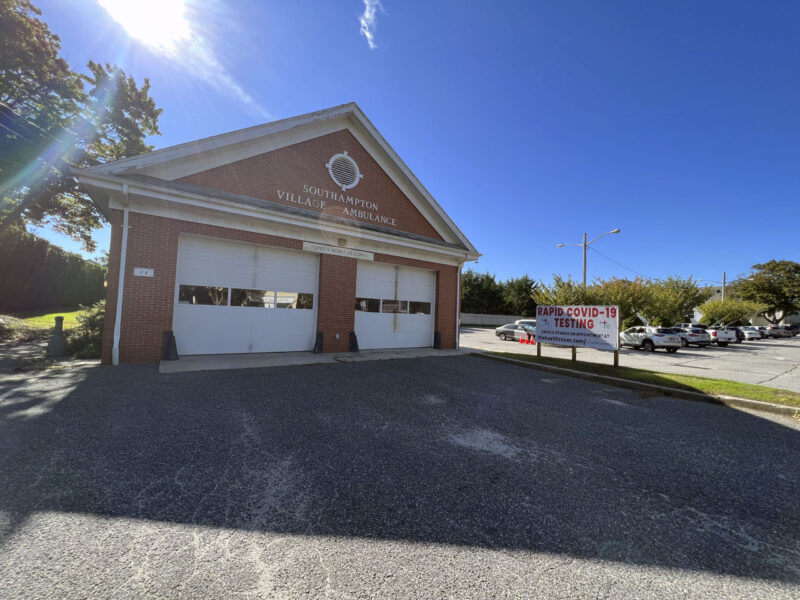
The former Southampton village Ambulance barn. DANA SHAW
In the face of litigation, the Southampton Village Board repealed legislation that it had adopted just last month to enable a food pantry to operate at the former village ambulance barn on Meeting House Lane.
The board voted unanimously on Thursday, October 14, in favor of repealing the law, but according to Mayor Jesse Warren, the board will pass the law again after resolving the issues raised in the lawsuit and holding another public hearing.
Some board members appeared caught off guard when the resolution to repeal the law came up on the agenda. The law was only identified as “Local Law #7” and the resolution stated it would be rescinded effective immediately.
“Can somebody tell me what that law is?” board member Roy Stevenson asked.
Village Attorney Kenneth Gray explained that this is the law the board had adopted to allow a food pantry to operate in a residential district with a special exception permit. “There was some litigation that was commenced on this particular local law being adopted,” he said. “There was a question on whether or not the SEQRA — State Environmental Quality Review Act — was properly followed in the noticing and the adoption of this particular local law. So in an effort to cure the issue, what we’re doing is rescinding the local law that’s been called into question. Hopefully, that will resolve the pending litigation, and then we’ll move forward if necessary with another local law.”
The law was crafted so Heart of the Hamptons, a nonprofit that runs a food pantry and offers other services to those in need, could operate at 44 Meeting House Lane, which was previously home to Southampton Village Volunteer Ambulance. Heart of the Hamptons signed a 30-year lease with the village last year.
Village residents Jim McFarlane, JoAnn Hale and Paul Fagan III brought the lawsuit, which was filed one week after the Village Board adopted the law. The lawsuit asked the New York State Supreme Court to permanently prevent the village from implementing the food pantry legislation.
McFarlane is a former Village Board member and a Wyandanch Lane resident who also owns property on Meeting House Lane. Hale is a Meeting House Lane resident and Fagan, according to public records, is a South Main Street resident.
The lawsuit states that the residents have an interest in preserving the environment, the character and the residential values of their residential district, ensuring there will be no commercial and nonresidential uses of properties in the district and avoiding noise and air pollution.
The lawsuit points out that when the village entered into the agreement with Heart of the Hamptons in December 2020 for the ambulance barn, a food pantry was not a permitted use there.
The Village Board passed a law in May this year to accommodate Heart of the Hamptons, but the legislation had a fatal flaw. Instead of using a “P,” for “permitted,” on a table of use, the legislation was drafted with an “X,” which meant not permitted. Once this mistake was noticed, the Village Board set a public hearing on a revised law. But then the law was criticized for being overly broad, potentially allowing a food pantry anywhere in the residential district as of right. The Village Board withdrew the second attempt at the law in August. Then, in September, over the objections of a number of Meeting House Lane property owners, the board adopted the special exception use law. Before the law was rescinded, it provided an avenue for a food pantry to ask the Village Board for permission to open in a residential district.
The board had deemed the special exception use law a type II action under SEQRA, which means legislation does not require environmental review prior to adoption. The lawsuit argues that the board knew or should have known that the law “would likely have a significant adverse impact on the environment including, but not limited to increased and unsafe traffic, noise, air pollution and negative aesthetic intrusions on an otherwise residential and historic pastoral setting and other negative environmental impacts.” It states that residents and professionals identified several adverse impacts and that the Village Board failed to establish itself as the lead agency under SEQRA — a technical detail that was required before the board could declare that environmental review was unnecessary.
“The Village Board acted wisely in rescinding the law, and therefore it made the lawsuit commenced by the plaintiffs moot,” said Anton Borovina, the attorney representing McFarlane, Hale and Fagan, on Friday.
Borovina said the plaintiffs’ problem is not with having a food pantry in the village but with the process that the village used. “It was in contravention of law,” he said. “They owned up to it, they acknowledged it, as they should have.”
Warren said on Friday that rescinding the law came at the recommendation of the village attorney. “He basically suggested that it would be faster and better to essentially have an additional public hearing to address the concerns of this lawsuit rather than to go waste taxpayer dollars in a court,” he said.
He added: “It’s just disappointing that Jim McFarlane would go this far to try to block the Heart of the Hamptons and take these legal measures.”
The mayor noted that the village previously hired engineering firm VHB to conduct an unrelated traffic study and will now add Meeting House Lane to the scope of that project.
Molly Bishop, the executive director of Heart of the Hamptons, was optimistic in an email Monday. “It is our understanding that the village needed to take this action to fix a technicality,” she wrote. “It might be a slight delay, but it certainly is not a setback as the village and HOH remain steadfast that this is a great location for providing our services to the 1,400 local families we serve. We look forward to working with the village to do what is required to make our new home a reality. And we are focused on our primary mission — ensuring everyone in our community has access to food and emergency support when they need it.”


