


 2 Photos
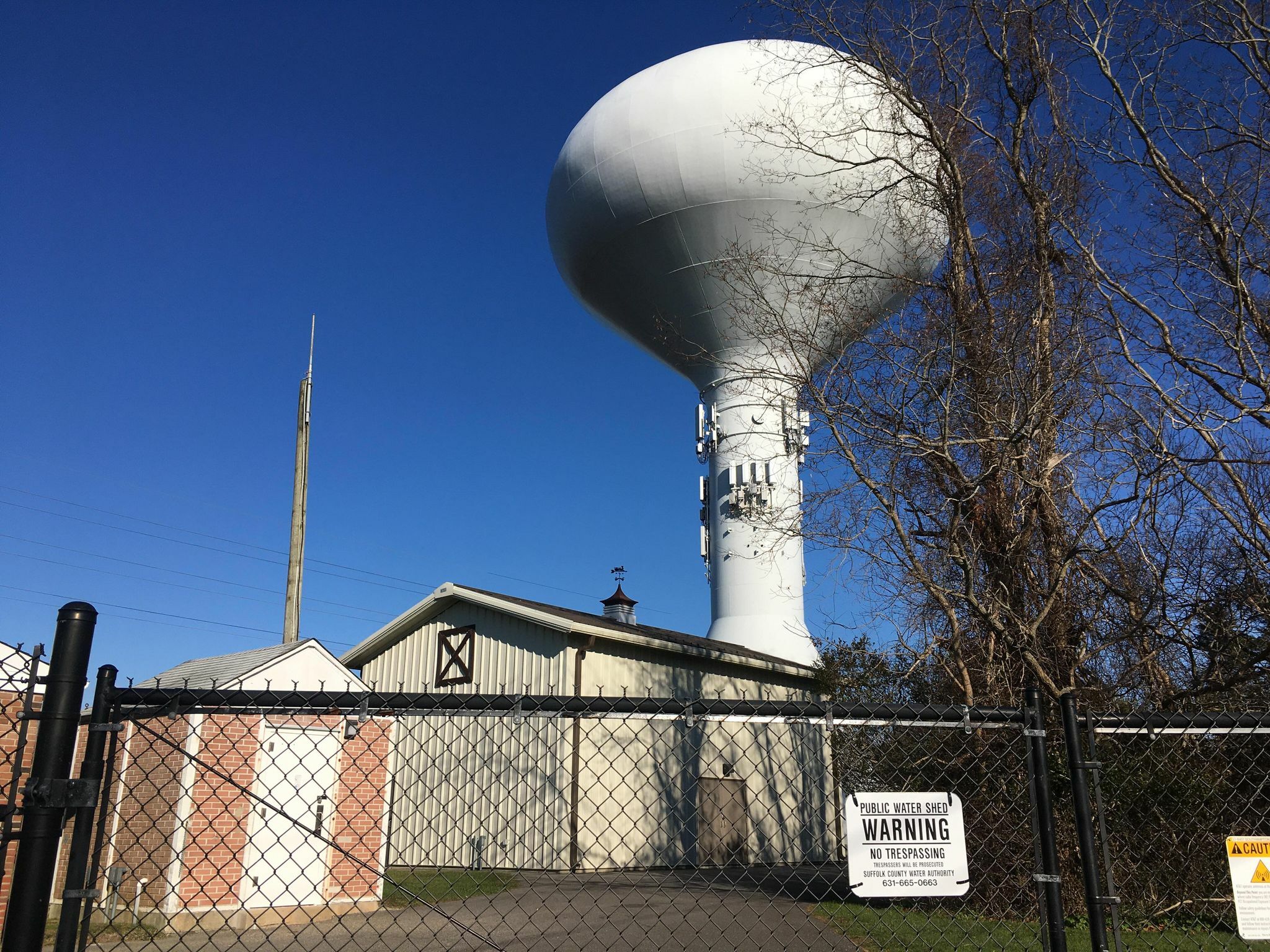
Southampton Village officials expressed concern that effluent from the Liberty Gardens housing development could impact wells at the nearby Suffolk County Water Authority on West Prospect Street. KITTY MERRILL
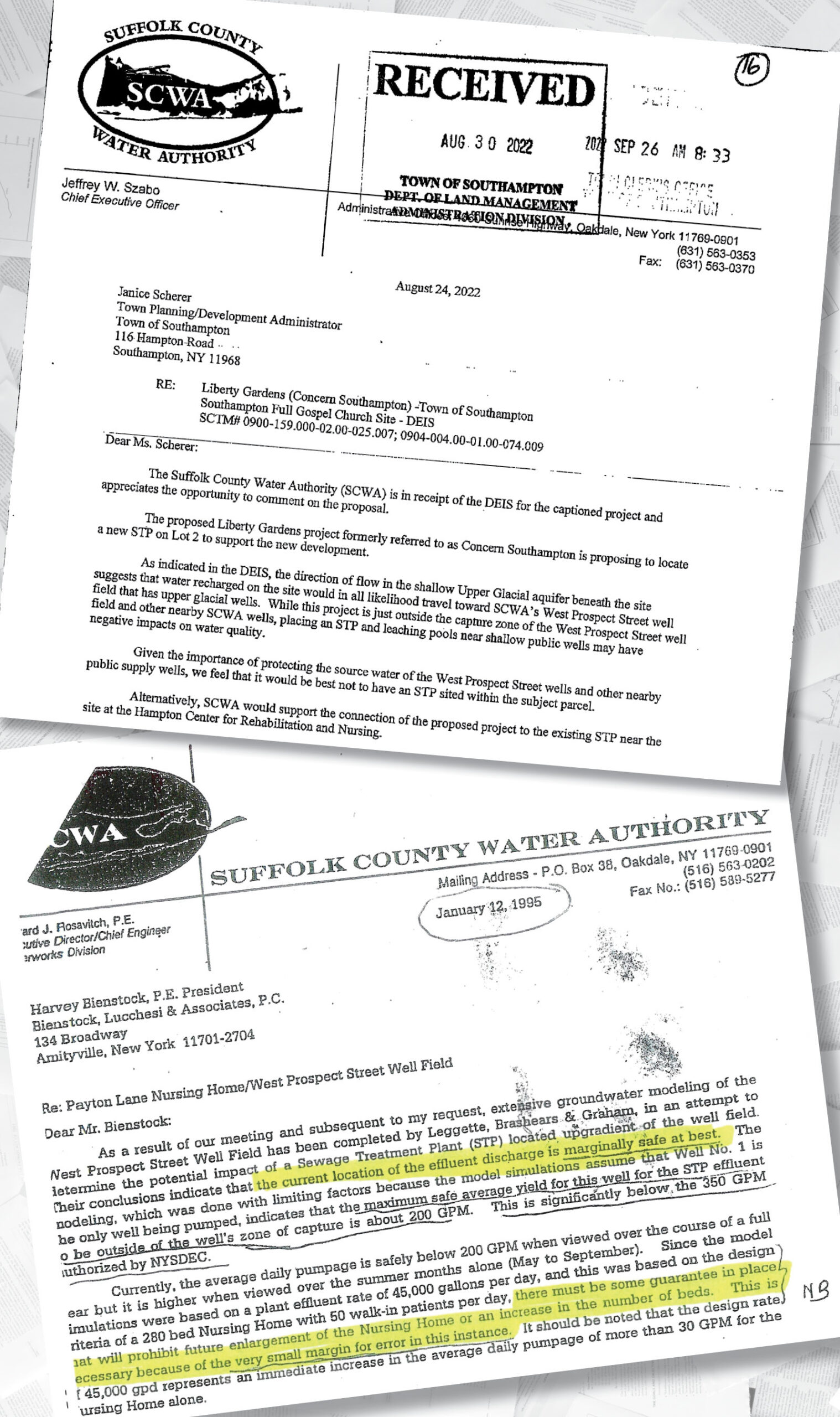
Two seemingly contradictory letters speak to the sewage treatment plan for the Liberty Gardens affordable housing proposal in Southampton.
In a 1995 letter, the Suffolk County Water Authority cautioned the builders of the sewage treatment plant at the then-Payton Lane Nursing Home against expanding or adding any beds, due to its proximity to well fields on West Prospect Street in Southampton Village.
But in a 2022 letter, SCWA President Jeff Szabo offered his support for the 60-unit Liberty Gardens affordable housing complex and its plan to hook into the plant at the nearby nursing home, now known as the Hamptons Center for Rehabilitation and Nursing. Located two doors down from the nursing home, Liberty Gardens, if approved, will be sited on property behind the Southampton Full Gospel Church.
Armed with the first missive, Southampton Village Trustee Bill Manger appeared via Zoom teleconference before the Southampton Town Board last week. The board appears poised to grant the zoning code change that Liberty’s developer, Concern Housing, needs to build the complex on land off County Road 39 in Southampton.
The site straddles the boundary between the village and town in one section. And while Village Board members appeared at a Town Board public hearing in October asking members to keep the hearing open for additional study and comment, the Town Board closed it.
Subsequently, village officials hired their own consultant to review the potential environmental impacts articulated in an environmental study conducted for Concern by the firm Nelson Pope Voorhis. Village officials wrote town officials asking them to hold off on any decisions until their study was complete.
Receiving no answer from Town Board members, Manger went — virtually — to the Town Board meeting on December 13. He noted that the water authority had assessed the nursing home’s plant and wastewater discharge as a concern due to its proximity to their well field. The 1995 letter described the plant’s location as “marginally safe at best” and requested a guarantee that the facility would never expand.
“The village is very concerned,” Manger said, because studies have shown any effluent discharge will flow in a southwesterly direction toward the well field that provides drinking water to village residents. “If that were to become contaminated, that would have a significant impact,” he said, asking for additional time for village officials to conduct their own study before the town moves on to the final phases of its review.
Speaking in a subsequent interview, Manger pointed out that the sewage treatment plant is located very close to the village. It can’t be sited at the actual development because, he said, “almost the entire property is filled up” — with the apartment uses and a proposed community center.
Manger said he got the 1995 letter from community members concerned about the development.
Southampton resident Frances Genovese was one of the people who’d procured the letter from the Southampton Association, which wrote objecting to the plan. Through a Freedom of Information Law request, Genovese obtained the subsequent letter from the water authority.
She also asked for any documents in the intervening years that might solve the mystery of how the plant went from being of concern to being suitable to handle a large-scale development plus the care center. “They said there was absolutely nothing, and that they are only required to keep records for six years,” she said.
Asked about the reason for the change of heart, this week SCWA spokesman Timothy Motz replied, “The answer is better groundwater modeling. Technological developments since the 1990s have been tremendous and enable us in 2022 to have a much more precise sense of the potential impacts to groundwater of such projects.”
He acknowledged that it’s possible that records related to early reviews were discarded in accordance with state record retention policies.
Hamptons Center Executive Director Charles Day did not respond to a call requesting information about the sewage treatment plant. However, a letter from him included with the Liberty Gardens review states that the center is amenable to negotiating an agreement that would allow the development to hook into the center’s plant. It has the capacity to handle it, Day wrote.
Genovese, an often outspoken critic of local government, said “deep research” has been undertaken by a variety of community members concerned about the project. “What has happened,” she said, “is residents have to take up the full-time job of doing due diligence the town and the village didn’t do.”
She forwarded a second letter obtained through Freedom of Information Law related to the project. Earlier this month, Village Attorney Andrew Preston wrote Supervisor Jay Schneiderman pointing out an error. The village was listed — in land use parlance — as an “interested” agency rather than an “involved” agency. The failure to list the village as an involved agency meant it did not receive any of the requisite notices to which involved agencies are entitled, Preston wrote.
“The board requests the right to participate due to involved agencies and respectfully requests to be reclassified by the town from an interested agency to an involved agency, as well as an extension of the comment period,” he wrote.
Preston concluded his letter with, “We hope the town will accede to these requests to avoid unnecessary litigation.”
Schneiderman didn’t respond personally to that letter either, nor to Manger when he spoke with them via Zoom earlier this month.
Asked if litigation is on the horizon, Manger said village officials are in a holding pattern, waiting to see what the town does next.
Following a recent work session on Concern’s draft environmental study, Senior Planner Michealangelo Lieberman said the final environmental study, which addresses feedback given during the public hearing, should be produced in the new year.
While Schneiderman didn’t reply to village officials, he did comment when queried by The Express News Group.
“They’ve had plenty of time to make their comments known. Coming in at the last minute, when there’s been a very lengthy process — they were fully notified each stage of this — it feels like a delay tactic,” he said in a telephone interview. The issues raised will be addressed in the final environmental study, he said. “If the project moves forward, it will obviously have to have an approved sanitary system. That’s nothing new, nothing we don’t already have to address.”
The time to ask for the record to be extended is when the record was still open, Schneiderman emphasized. After the hearing, the written comment period was left open for several weeks. Village officials should have asked for the extension sooner, Schneiderman said.
Switching gears, the supervisor said, “I don’t know what the village has done for affordable housing — I really don’t. If the village would address affordable housing, maybe the town wouldn’t have as much of a need in that area to do something. If Bill Manger has another approach to create housing for the number of workers who are needed to meet the demand in the village, he should come forward with his plan.”
The supervisor also addressed a point of consternation that’s arisen as the review process moved on — a change to the proposed population of the housing project. At the outset, it was described to the public as 60 units of workforce housing for local workers, with 15 set aside for veterans. It’s morphed into a proposal asking approval for 30 units of supportive housing for veterans with mental illness challenges, and 30 for affordable housing.
“I struggled with that a little bit,” Schneiderman said of the revised plan. He said he asked the developer to change the distribution, but the way the project is funded — with most of the subsidies coming from the New York State Office of Mental Health — wouldn’t allow it.
“It would have been nice if he never modified the proposal,” he said. “But it’s very hard for me to turn my back on homeless veterans.”
Additionally, while he didn’t personally respond to the attorney’s letter, Land Management and Development Administrator Janice Scherer did. Even though a small, wooded portion of the property is located in the village, the Village Board doesn’t have the authority to make any decisions about the project, she said. Still, Scherer argued, village officials received every notification an involved agency would, including the declaration of lead agency adopted in April 2021, which, she wrote, “was not disputed at the time.”


