


 1 Photo
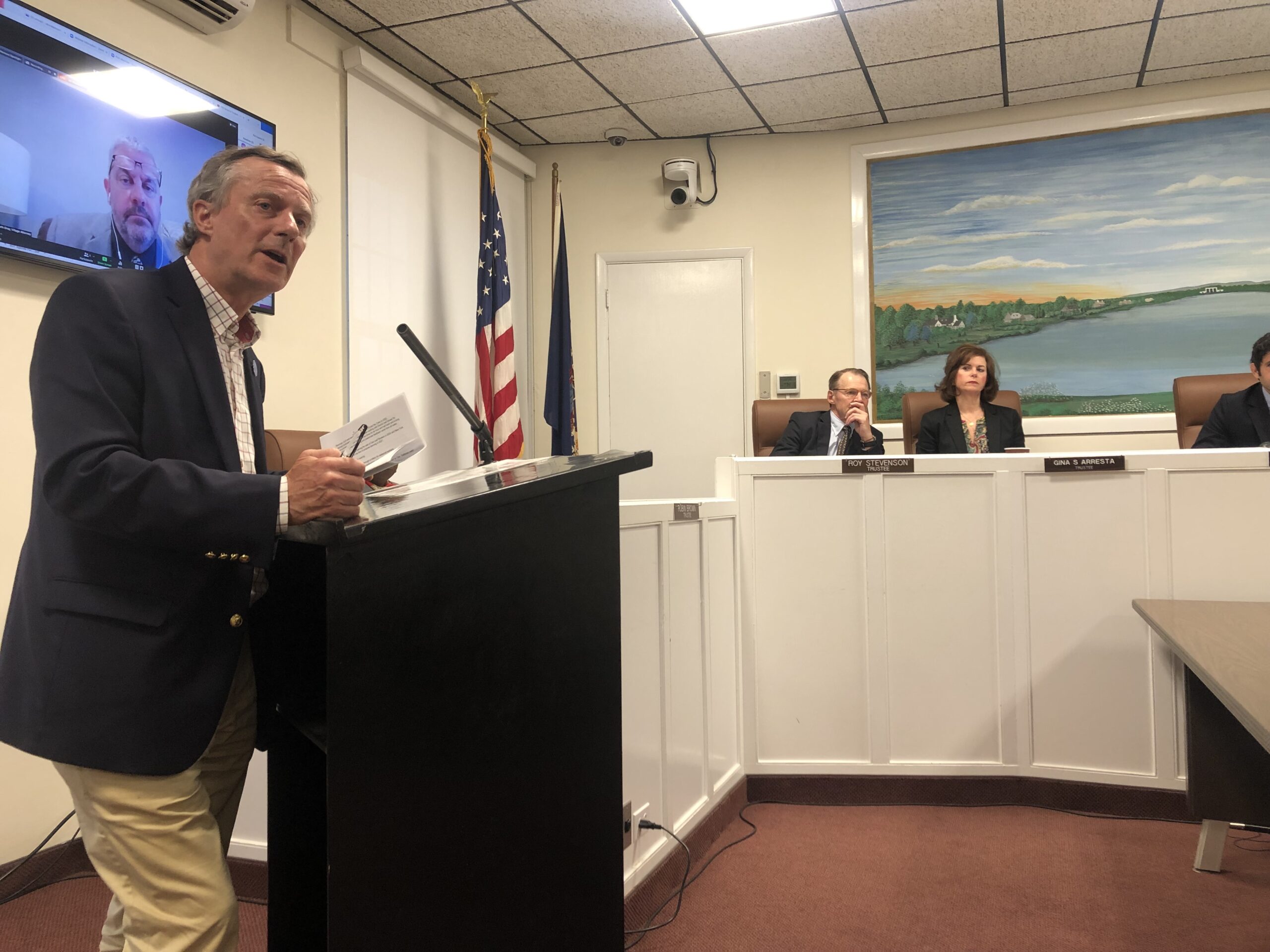
Christian Picot, who headed the leafblower task force, speaks at last week's meeting. CAILIN RILEY
The Southampton Village Board last week unanimously approved a resolution to further regulate the use of gas-powered leaf blowers within the village, and set a target date for phasing out their permitted use completely.
The measure adopted at a meeting on May 12 also adds a new requirement that all landscapers doing business in the village must have a valid home improvement contractors license, issued by the Town of Southampton.
Independent contractors and village employees can now only use gas-powered leaf blowers from March 15 to May 15, and from October 15 to December 31, for spring and fall cleanups, no earlier than 8 a.m. or later than 6 p.m. on any weekday, and no earlier than 9 a.m. or later than 5 p.m. on Saturdays.
The use of gas-powered leaf blowers is prohibited at all times on Sundays and on federal and state holidays.
One of the biggest changes to the law was the provision that gas-powered leaf blowers will be fully banned for use by contractors effective October 1, 2024.
The changes to the village code, which were approved after a public hearing, maintain Southampton Village’s status as a pioneer when it comes to updating its laws to further restrict the use of the blowers, which many residents have passionately expressed their views about in recent months, saying they not only diminish quality of life with the noise they create but also pose health and environmental hazards.
While there were many residents eager to see not only the extension of the restrictions but a full ban that would take effect immediately, several representatives from the landscaping community made it clear that an immediate ban on the gas-powered blowers would be a real punch in the gut for them and their businesses.
Mayor Jesse Warren said that waiting until 2024 to institute a full ban was an acknowledgment of the challenges that landscapers will face in making the transition from gas-powered blowers to electric equipment, adding that the supply chain crisis in particular would have created an almost insurmountable obstacle for landscapers if the ban came any sooner.
The changes to the code were the results of the work of a leaf blower task force, which included people with interests on both sides. It was chaired by Christian Picot, who shared that the process was largely rewarding, with both sides reaching compromise in several areas, but he said the one sticking point that the sides did not agree upon was the date for a full ban.
Landscapers were also adamant that enforcement would be key, and to that end the village will pay for part-time village employees and traffic control officers to take a part-time code enforcement class, which would allow them to help with enforcement.
While Southampton Village is a leader on this issue on the East End, there is legislation being proposed in California to ban the sale of gas-powered leaf blowers in 2024, and similar legislation to ban the blowers in New York in 2027.
Now that the code has been updated, the village will send a leaflet out to village residents with the new information. Individual homeowners will not be subject to the same restrictions as the landscape contractors.
While many proponents of the ban expressed satisfaction with the compromise that was reached, at least one landscaping contractor spoke out passionately at the meeting against the new restrictions.
Garrett Goodwin, who owns a landscaping company and operates in the village, said that while he doesn’t mind not using the blowers in the summer, he feels the plan to phase them out by 2024 is “not realistic,” citing not only the challenge of buying new equipment but other challenges that come with electric blowers. Landscapers say they are not as efficient and create challenges regarding keeping the batteries charged, which sometimes requires running a loud, gas-powered generator.
For his part, Warren said he was generally satisfied with the compromise that was reached. “I thought Christian and the task force did a very good job,” he said earlier this week.
He acknowledged the challenges that the landscapers will face in making the transition, but added, “We also acknowledged the fact that a lot of residents do really care about quality of life, and we do want to be a leader as far as issues relating to the environment and quality of life.”


 Cailin Riley on May 18, 2022