



 2 Photos
The new Stony Brook Southampton Hospital will be built on the site of the current ballfields at the campus's northeastern end, adjacent the former LIRR station. The university has set aside 15 acres for the new hospital facilities. SOUTHAMPTON HOSPITAL ASSOCIATION
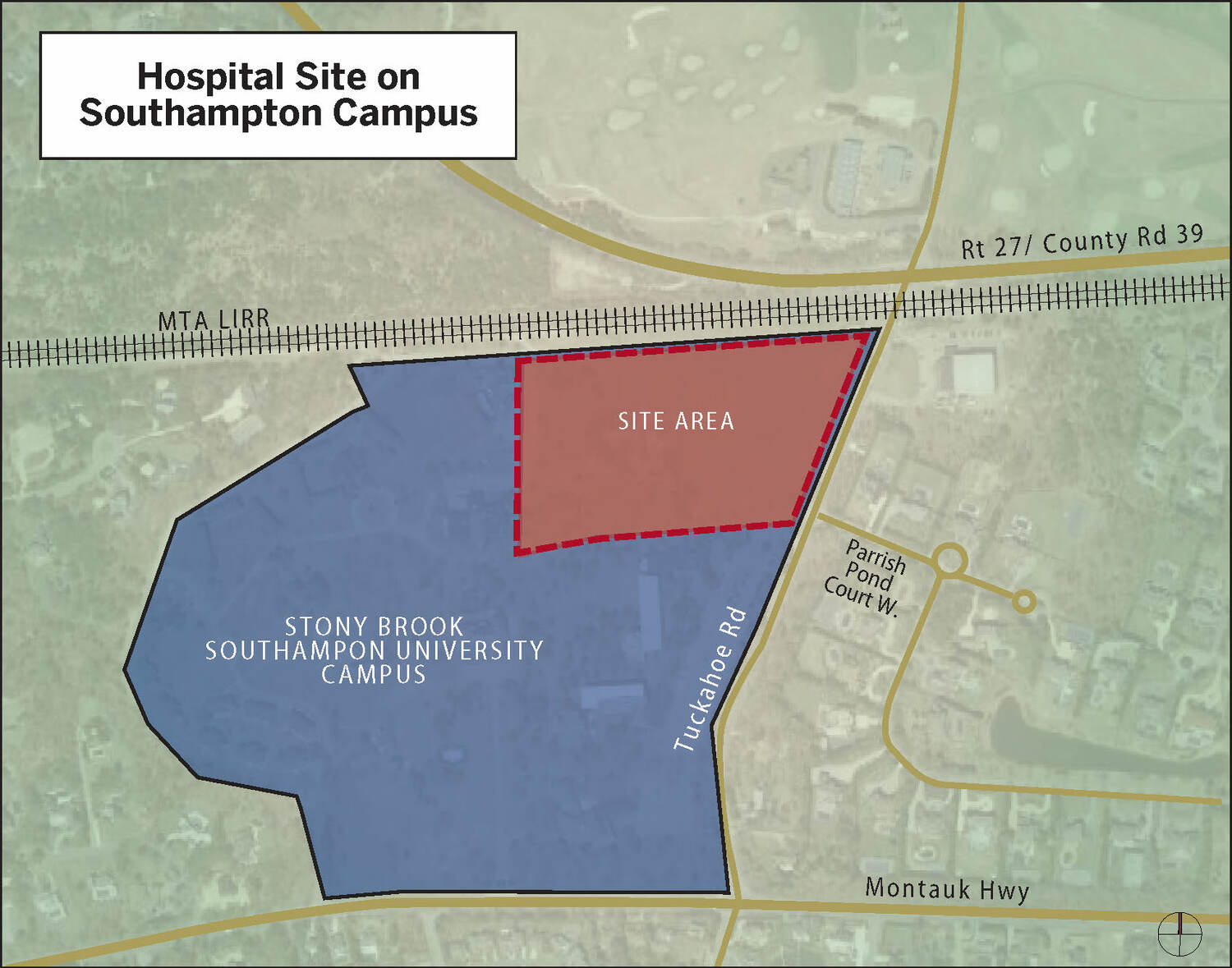
The new Stony Brook Southampton Hospital will be built on 15 acres at the northeastern end of the campus, where the baseball and soccer fields are now. The site is adjacent to where the LIRR station used to stand, and may again someday.
When Stony Brook University and Stony Brook Medicine brought Southampton Hospital into their network in 2017, the vision of a new, state-of-the-art hospital on the Stony Brook Southampton campus in Shinnecock Hills was a marquee component of the partnership.
Housing initiatives and the deterioration of campus buildings have nudged the hospital proposal from the spotlight when it comes to the campus, but the project is still on the front burner for the Southampton Hospital Association, its leadership says, and advancing toward a hoped-for 2030 opening.
There have been some bumps in the road. The pandemic bogged down many aspects of the project, and then the departure of Stony Brook Southampton Hospital Chief Administrative Officer Robert Chaloner — who had been the new facility’s biggest champion — left the planning effort without a majordomo.
But the construction of a new hospital remains a critical component of the future of the 85-acre campus.
“We need a long-term plan for that campus, it is an underutilized commodity,” State Assemblyman Fred W. Thiele Jr., who shepherded legislation in 2018 that allowed a hospital to be built on the campus, said last week during an Express Sessions event focusing on the campus. “Medical science programs, the graduate programs that are already on that campus, would expand.”
Wendy Pearson, vice president for strategic initiatives at Stony Brook University, said that the hospital is an eagerly anticipated addition to the Southampton campus, even as the university moves forward with other approaches to revitalizing the campus in the meantime.
“It would be great for the university, the health professions programs would certainly thrive — so that is definitely plan A,” she said. “I will say, though, that the plan around workforce housing creates so many opportunities around programming that we can still thrive … with or without a hospital.”
Southampton Hospital Association Chairman Kenneth B. Wright said that in recent conversations with Stony Brook University President Maurie McInnis, she assured him she has two top priorities for the university: securing Stony Brook’s role as the anchor institution for the recently announced New York Climate Exchange on Governor’s Island in New York Harbor, and the construction of a new Stony Brook Southampton Hospital.
Despite the setbacks of the pandemic and leadership turnover, Wright said the “realistic best case scenario” is that the new hospital could still be open to accept patients six years from today.
There is some very heavy financial lifting to do in the near future if that target is to be met.
“I thought this would be about a five- or six-year process, but it turns out building a hospital is about a 15-year process,” Wright said. “Fortunately, we’re about nine years into it. We’ve made a lot of progress today, but we’ve got a long ways to go with the fundraising.
“We got sidelined by COVID and, frankly, Bob Chaloner’s decision to move to Wisconsin was a little bit of a setback,” he continued. “We haven’t had a full-time professional at the association who was a capital campaign-specific person.”
The Southampton Hospital Association — which was formed in 1909 specifically to muster funding to build the South Fork’s first hospital — is solely responsible for marshaling the funding and overseeing the planning and construction of the facility, albeit with extensive collaboration from Stony Brook Medicine on the details of its design and services.
The fundraising itself is done primarily through the Southampton Hospital Foundation, a nonprofit corporation set up by the association specifically to accept donations for the improvement and expansion of clinical services associated with Stony Brook Southampton Hospital. Wright said that the foundation will announce a new head of its capital campaign later this winter.
When completed, the association would own the building, which it would lease to Stony Brook.
When Stony Brook Medicine took over operations of Southampton Hospital in 2017, part of the agreement inked was that the university would set aside 15 acres of its Southampton campus for the new hospital facilities. Architects selected the site — located at the northeastern corner of the main campus property, adjacent the former Long Island Rail Road station and Tuckahoe Road, where there are currently baseball and soccer fields.
The preliminary planning of the new facility is for a 275,000-square-foot building. That is approximately the same size as the current building in Southampton Village, Wright said, since modern designs and new thinking about the role the facility will play balance out the need for space.
“Our population is aging — the demographics are trending toward a larger proportion of the population on the East End being over 65 — so that argues for more patient rooms. But at the same time, stay times are shrinking and more people are being treated on an out-patient basis, so that argues for fewer rooms,” Wright said. “We do think our market share will grow with the new facility, as a state-of-the-art hospital, and farther to the west. But it will be more efficiently laid out, so the bottom line is still very similar.”
Construction itself will take two years, Wright said, meaning the association has about four years to fund the project and order the construction plans if it is to meet its 2030 goal. Architects have already been hired, a preliminary plan for the layout has already been drafted, archeological and environmental studies have been completed, and traffic surveys are underway.
Construction costs leapt in the wake of the pandemic, but have dialed back a bit in the last year, the association chairman, who owns Wright & Company Construction, said. The original estimate of $365 million in total costs for the facility are now probably north of $400 million, he estimated.
The association plans to pay for the work with three main sources of funding: philanthropic donations, the sale of its current land in Southampton, and borrowing. The philanthropic fundraising target remains $250 million. To date, the association has about $60 million in pledged funding from donors for the facility, Wright said.
The association has a well-established history of tapping robust philanthropic support when it comes to boosting health care services on the South Fork. It was able to fund the $40 million construction of the new 22,000-square-foot East Hampton emergency department — which is underway and set for a 2026 opening — and the $30 million Phillips Family Cancer Center in Southampton, solely through fundraising without taking on any debt.
“We have a good track record of coming up with plans, executing them, raising the money and getting it done,” Wright said. “And I think we’ll do the same with the new hospital.”
All of the philanthropic funds do not have to be in hand for the association to make the call to advance the project. Wright says raising over half of the total would probably suffice, but that reading the tea leaves of the fundraising effort will be the true indicator.
“We don’t need to be a at 100 percent of our philanthropy target, but we need to be well on the way and it really depends on how it’s going, what sort of momentum we have, and other factors,” he said. “Pulling the trigger on the construction documents is a major step. That’s a big bill.”
Other funding sources are more fixed.
The association expects the land where the existing hospital stands — 19 acres in the heart of south-of-the-highway Southampton Village — will generate approximately another $100 million, albeit not until well after the new hospital has been built and open for business.
The balance, whatever it is, will have to be raised through longterm bank loans.
Wright said the association sees $75 million as a reasonable amount of borrowing that the hospital would be able to pay off over time — several decades — with its operating revenues. In the 1990s, the hospital borrowed more than $35 million to dig itself out of a financial mismanagement scandal. That loan is nearly paid off, Wright said, and proves that the hospital is able to carry a debt load.
Stony Brook University and Stony Brook Medicine will have to approve all of the plans, since the costs of any borrowing will be passed on to them in the lease price for the building. The Stony Brook Medicine network will also play a key role in the final designs of the building, to meet their needs and aspirations for the facility as the new jewel in its crown.
Wright said the university and Stony Brook Medicine have been supportive throughout and that everyone involved is eager to see the new hospital become a reality as soon as possible.
“They know that this hospital will be a feather in the university’s cap,” he said. “And it will be a boon for health care on the entire East End, which is something that they are very serious about.”
If the project’s aspirational future in the public eye has gotten a bit lost in the fog of news over the last few years, it is up to supporters to pull it back to the fore, Thiele said.
“Whether this is the cornerstone for the campus, it is certainly a major part of the future of the campus,” he added. “I think we all need to engage with the public at large and the community and let them know that things got slowed down, but we’re ready to go now.”


 Michael Wright on Jan 17, 2024