


 1 Photo
A study conducted in the wake of Superstorm Sandy recommends that New York consider erecting giant sea gates at each of Long Island's ocean inlets to protect against storm surge flooding during severe storms like hurricanes.
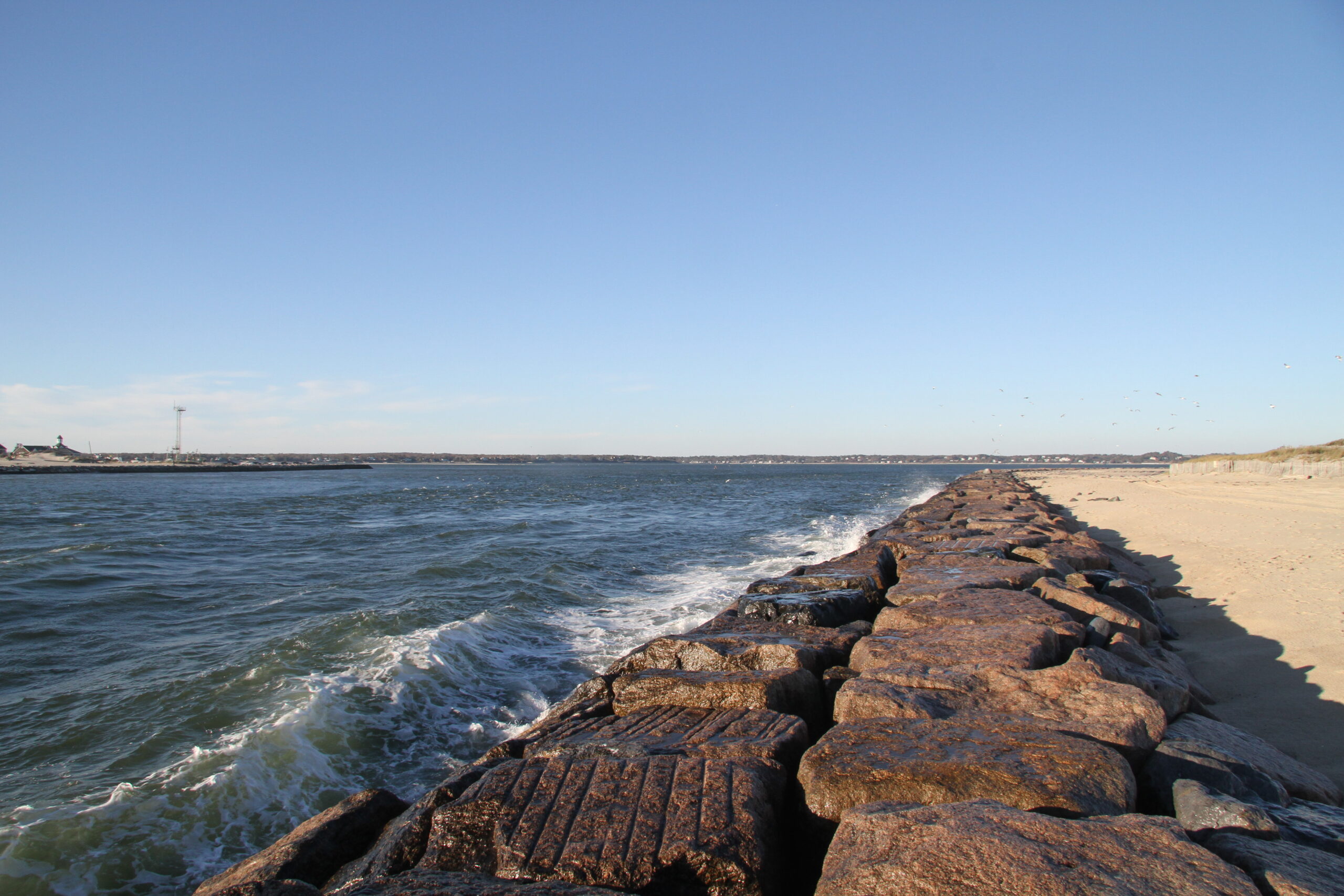
A report by a Stony Brook University researcher says that Long Island municipalities should explore the possibility of installing mechanical “sea gates” at the inlets that lead from the Atlantic Ocean into the South Shore estuaries to hold back flooding of low-lying coastal areas during hurricanes.
The report from a study conducted by Malcolm Bowman, Ph.D., a oceanography professor at Stony Brook’s School of Marine and Atmospheric Sciences, said that having sea gates at the six inlets along the South Shore during Superstorm Sandy would have reduced severe flood damage.
The gates, which would likely need to be stalwart structures of steel and concrete, could be installed in the fairways of each inlet from the Rockaways to Shinnecock. They would stand open most of the time, Bowman says, but when a hurricane approached, they could be closed, stemming the rush of storm surge into the bays, which caused extensive damage even far inland of the South Shore’s barrier islands during Sandy.
“Think of them like a saloon door,” Bowman said while presenting the results of his report to the Long Island Regional Planning Council last week via Zoom. “They’re mainly open 99.9 percent of the time. But if a hurricane is coming up the East Coast, they can be closed.”
The study was funded by the State Department of Environmental Conservation with money from the Superstorm Sandy federal aid package.
He also proposed that large water bodies like Great South Bay could be outfitted with “baffles” on the bay bottoms that would reduce the heights of waves sweeping inland by disrupting water flow.
Bowman has also been instrumental in the work done since Sandy by the New Jersey-New York Storm Surge Working Group, which he chairs. The group has looked at defense for the New York City metro area against the kind of flooding seen during Sandy, which he characterized last week as being still far from the “worst-case scenario” of a much a stronger storm.
In part based on some of the work done by the working group, the U.S. Army Corps of Engineers just this month presented a proposal for a more than $52 billion project to build a system of sea walls and gates across the mouth of New York Harbor — modeled after similar systems around the world — that would be able to keep storm surge at bay during a hurricane.
The cities of Providence, Rhode Island, and New Bedford, Massachusetts, have sea gate systems built into towering concrete and earthen dykes across the entrances to their harbors.
The project would be extraordinarily expensive, and Bowman acknowledged that the multibillion-dollar cost of the sea gates — which he called “maximum protection, at maximum cost — would make it a heavy, if not impossible, lift for Nassau and Suffolk counties. The cost benefits to the less densely populated regions lying inshore of Shinnecock and Moriches inlets would be particularly difficult to match up, he surmised.
But in other areas, Long Island’s vulnerability to hurricanes looms increasingly large as sea level rise and the anticipated effects of global warming create more and strong tropical cyclones.
“While we have made a lot of progress, there is still a lot of work to do,” he said. “The island is still very exposed to major storm events and flood damage. Do we have to wait for Sandy No. 2 to come roaring by before we wake up?”


 Michael Wright on Nov 22, 2022