



 3 Photos
The Hampton Bays water tower. VALERIE GORDON
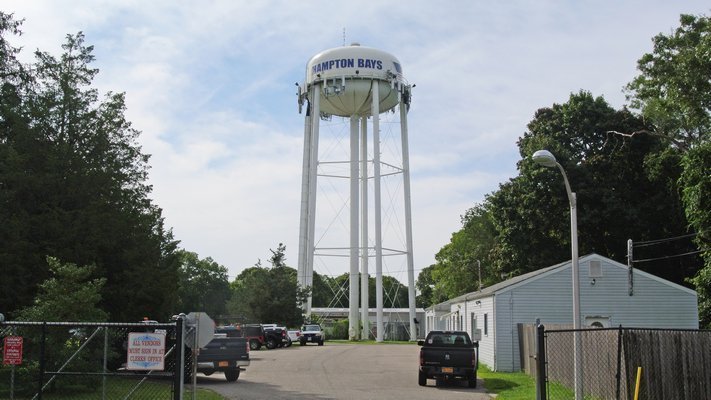
The Hampton Bays water tower. VALERIE GORDON
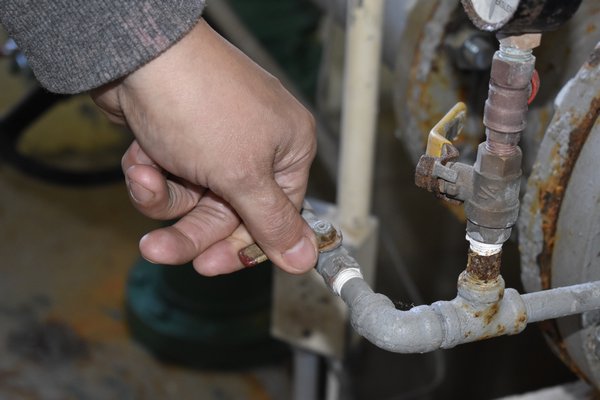
Warren Booth explains how to collect raw water samples. VALERIE GORDON
Suffolk County Water Authority officials released results this week pointing to elevated levels of manganese and iron in two Hampton Bays Water District public drinking water wells.
At two public meetings to discuss a proposal to have the water authority take over management of the locally-owned district, the water authority’s CEO, Jeff Szabo, said that testing done in August showed high levels of manganese in the district’s water supply.
Hampton Bays officials disputed those claims last week. And, in fact, when compared to testing results completed in July through Melville-based Pace Analytical—the company responsible for conducting quarterly manganese testing for the water district’s 11 wells—the August results by the SCWA proved to be relatively similar and well below the Environmental Protection Agency’s limit of 0.3 mg/L.
However, on Wednesday, February 20, SCWA Laboratory Manager Tom Schneider noted that the district’s water supply also is tainted by high levels of iron. He pointed to the New York State Sanitary Code, which states that if iron and manganese are present, the total concentration of both should not exceed 0.5 mg/L.
“You cannot look at drinking water manganese levels in a vacuum,” Mr. Schneider wrote in an email. “You also have to look at the levels of iron in water coming from the same location.”
When combined, the district’s iron and manganese levels show a total concentration of 1 mg/L for well 4-1 and 1.1 mg/L for well 4-2, according to the water authority’s results. Pace Analytical’s report had the totals slightly lower in July, with well 4-1 showing 0.97 mg/L and well 4-2 at 0.96 mg/L, but still nearly twice the state code’s limit.
After a private water test done in October through the county’s Division of Environmental Quality Public and Environmental Health Laboratory, the water district was in compliance with both EPA and state guidelines.
Based on a report released last year from the State Department of Health, iron concentrations above 1.0 mg/L can cause gastrointestinal problems. Also, studies have shown that long-term consumption of water with manganese levels above 0.6 mg/L can lead to possible nervous system effects, weakness, stiff muscles, and trembling of hands in adults.
To remove the inorganic chemicals from the hamlet’s water supply, SCWA officials have offered—as part of a bid to take over operation of the hamlet’s water district—to install a $2.6 million iron and manganese filtration system. Under the proposal, the cost of system, as well as an additional $11.4 million in infrastructure upgrades, would be shared with the authority’s 1.2 million customer base.
Typically, water suppliers could also dilute manganese and iron levels through a process known as blending. Warren Booth, a maintenance mechanic for the HBWD, explained that there are multiple wells within each of the district’s well fields, which essentially allows the water to blend together, further diluting any elements such as manganese or iron.
But Mr. Schneider noted that the Ponquogue Avenue district’s well field in question has two wells, both of which are currently exceeding New York State Sanitary Code: “Blending the two wells together would not be effective, because they are both elevated.”
“It wouldn’t get you down below 0.3 [mg/L],” added Jason Hime, the supervisor for the Bureau of Drinking Water for the Suffolk County Department of Health.
In June, a private water analysis was done at 30 Nautilus Drive in Hampton Bays, revealing manganese concentration levels of 4.9 mg/L. After flushing the system, those numbers dropped to 0.1 mg/L for iron and 0.003 mg/L for manganese, Mr. Hime said.
He added that water district officials have also been sequestering the district’s water supply, as recommended by the Health Department, to treat the discoloration caused by the compounds. Injecting a polyphosphate orthophosphate blend into the water supply helps prevent iron from oxidizing. However, it does not remove the particles, he said.


 Valerie Gordon on Feb 22, 2019