



 11 Photos




One of the three interior mosaics at the Dormition of the Virgin Mary Greek Orthodox Church of the Hamptons. DANA SHAW


Votes being counted for the Sag Harbor School budget and election. DANA SHAW
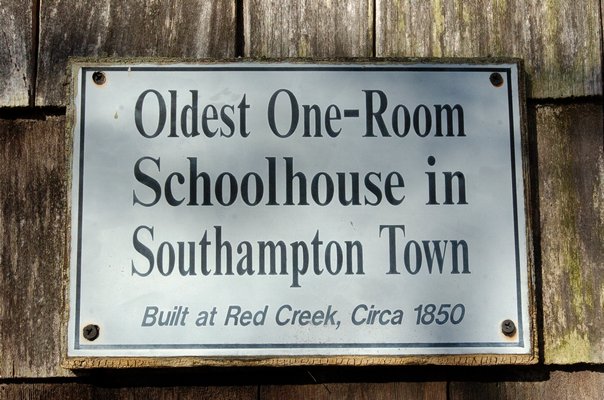
The oldest, one-room schoolhouse in Southampton Town was built in Red Creek around 1850 and now resides on the grounds of the Southampton Historical Museum. DANA SHAW
The proposed PDD development would add less nitrogen to the groundwater than the as of right alternative, according to Dr. Gobler’s 12-page report that analyzes the FEIS.
Dr. Gobler presented his findings on Monday morning in front of about 40 people inside a classroom on the second floor of the Stony Brook Southampton Marine Science Center on Little Neck Road in Shinnecock Hills, where he is employed as a professor. His slide show indicated that the five new additions to the FEIS that were not in the draft—an on-site wastewater treatment system, the addition of a sewage treatment plant that would service East Quogue Elementary School, the proposed purchase of 33 acres elsewhere in the hamlet for preservation, and the purchase of pine barren credits—do, in fact, reduce the nitrogen impact of the PDD.
Dr. Gobler’s12-page report also looked at a community septic system rebate program, which was included in the draft but was left out of the professor’s first analysis.
“Calculations demonstrated that the Hills PDD as described within the FEIS yielded a lower nitrogen loading rate compared to a higher and lower and lower impact, as of right development on the property,” Dr. Gobler said in his report.
During a question and answer portion of the presentation, Mark Hissey, vice president of Discovery Land Company, the developer behind the project, pointed out that if the PDD is built, it would likely reduce even more nitrogen than Dr. Gobler projects. The report doesn’t include some aspects of the project, including the developer putting shellfish in the bay and a fertigation technique—the injection of fertilizers and other water-soluble products into an irrigation system—to decrease nitrogen on the golf course. Dr. Gobler said the amount of nitrogen that shellfish can filter is difficult to calculate on paper and the latter is still an experimental idea, which is why he excluded both from his findings.
Dr. Gobler agreed that both the shellfish and the fertigation would likely reduce some of the nitrogen.
The audience was filled with local civic leaders, critics of the project, and supporters who all asked questions about the potential environment and applauded Dr. Gobler for his research.
Dr. Chris Gobler’s long-awaited assessment of the Final Environmental Impact Statement for a proposed luxury golf resort—an opinion that Southampton Town Supervisor Jay Schneiderman has said would heavily influence his vote on the controversial application—will be released on Monday morning.
Additionally, Mr. Schneiderman shared earlier this week and following Tuesday’s Town Board meeting in Hampton Bays that was attended by between 150 and 200 supporters of the project, dubbed The Hills at Southampton, that his board would likely vote on The Hills at Southampton application by the end of September, well before the November elections.
Dr. Gobler, a professor at Stony Brook Southampton and one of the region’s most well-respected marine scientists, said on Thursday that he will share his report on the environmental document, filed earlier this summer by the developer, Discovery Land Company of Arizona, at a 9:30 a.m. press conference that will be held at the Stony Brook Southampton Marine Science Center on Little Neck Road in Shinnecock Hills.
After sharing his report, Dr. Gobler, who lives in East Quogue, the same community that the luxury golf resort would be constructed in, will take questions from the audience. Attendees are asked to park at the south end of the large parking lot located at 239 Montauk Highway.
Dr. Gobler, who agreed to review both the final and draft versions of the report pro bono for the town, declined to divulge on Thursday whether proposed development, which calls for the construction of 117 residential units and an 18-hole private golf course centered on 168 acres, would have less of an impact on the environment as opposed to the as-of-right alternative, a standard subdivision with 118 single-family homes.
“You’ll have to stay tuned,” Dr. Gobler said. “I’ll show you on Monday.”
He noted that his presentation will explain on how he reached his conclusions when comparing the projected nitrogen impact of both proposals, as well as a third option that he described as a second as-of-right scenario that he says he created on his own. Dr. Gobler declined to elaborate on his version, only offering that he made some modifications to make the alternative more “realistic.”
The scientist also explained that his report will focus on a handful of changes in the FEIS that were not part of the draft. Some of those changes include the addition of a sewage treatment plant, the proposed purchase of 33 acres elsewhere in the hamlet for preservation, a community septic system rebate program and the purchase of pine barren credits.
He added that he intends to file his report with Town Hall immediately following Monday’s press conference.
“My rationale isn’t to be sneaky at all,” Dr. Gobler said on Thursday. “I just want to be able to answer questions to everyone at once.
“Rather than other people interpreting it for me,” he continued, “I want to be the one who interprets it for everyone. And specifically answer questions from people both for and against the project.”
Discovery Land is seeking Town Board approval of special zoning, called a planned development district, that requires the support of four of the five Town Board members, also known as a super-majority. The Town Board outlawed the special zoning earlier this year, citing the numerous problems it has generated, including the fact that it often gave developers too much leeway in dictating the benefits of their proposals.
Dr. Gobler’s assessment has the potential to make or break the project as its potential impact on the environment—and, specifically, already threatened Weesuck Creek and Shinnecock Bay—has been the topic of heated debate over the past few years. In fact, the project’s potential nitrogen impact is being closely monitored by Mr. Schneiderman, who previously stated that he has his own set of criteria that the project must surpass to earn his support.
Mr. Schneiderman could not be immediately reached for comment on Thursday.


 Amanda Bernocco on Aug 24, 2017